Flow Meter for Liquid
Flow Meter for Liquid
In the landscape of industrial process control, the accurate measurement of fluid movement is as critical as the monitoring of storage volumes. A flow meter for liquid serves as the sensory input for automation systems, ensuring that chemical dosing is precise, water treatment cycles are efficient, and oil and gas transfers are accounted for with fiscal-grade accuracy. While level measurement provides a snapshot of inventory, flow measurement provides the dynamic data necessary for real-time process optimization.
Selecting the appropriate flow meter for liquid requires a deep understanding of fluid dynamics, pipe geometry, and the physical properties of the medium. This guide examines the primary measurement technologies, selection criteria, and installation best practices essential for engineering professionals.
Measurement Principles and Technologies
Industrial flow measurement is not a one-size-fits-all discipline. Different physical principles are leveraged depending on whether the liquid is conductive, clean, slurry-filled, or highly viscous.
1. Electromagnetic Flow Meters (Magmeters)
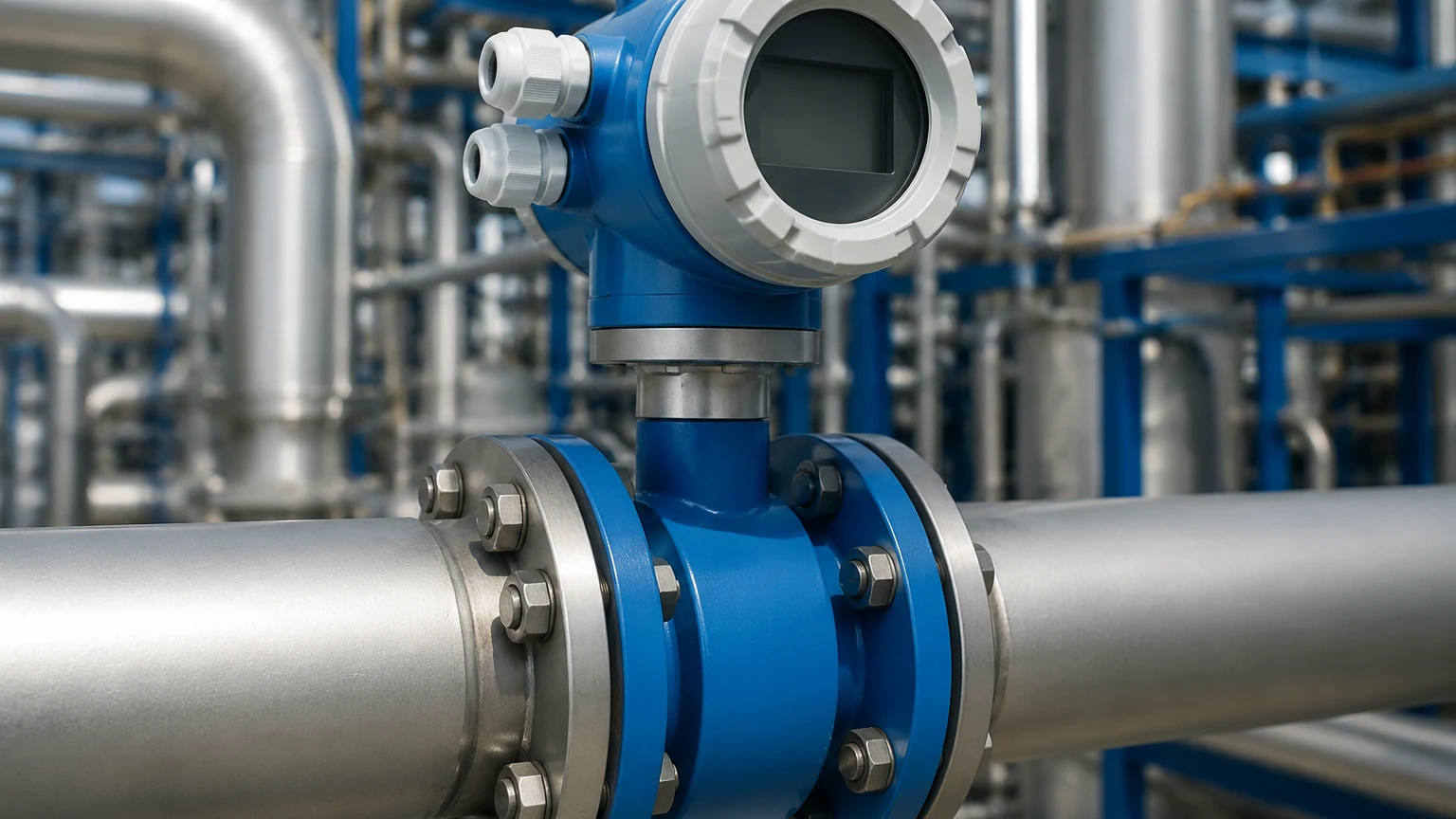
Electromagnetic meters operate based on Faraday’s Law of Electromagnetic Induction. This principle states that a conductor (the liquid) moving through a magnetic field produces an electrical voltage proportional to its velocity.
* How it works: The meter body contains electromagnetic coils that generate a field. As a conductive liquid flows through the pipe, electrodes detect the induced voltage.
* Best Use Cases: Conductive liquids such as water, wastewater, acids, and slurries.
* Advantages: No moving parts, zero pressure drop, and high resistance to wear from abrasive solids.
2. Ultrasonic Flow Meters
Ultrasonic technology uses sound waves to determine flow velocity. There are two primary types: Transit-Time and Doppler.
* Transit-Time: Two transducers send and receive ultrasonic pulses. The time difference between the pulse traveling with the flow and the pulse traveling against the flow is used to calculate velocity. This is ideal for clean liquids.
* Doppler: These meters reflect sound waves off bubbles or particles in the liquid. The frequency shift (Doppler effect) indicates the speed of the flow. This is preferred for aerated liquids or slurries.
* Advantages: Clamp-on versions allow for non-intrusive measurement without cutting into the pipe.
3. Turbine Flow Meters
Turbine meters utilize the mechanical energy of the liquid to rotate a rotor within the flow stream. The rotational speed is directly proportional to the velocity of the liquid.
* How it works: As liquid passes through the turbine blades, the rotor spins. A pickup coil or sensor detects the passage of the blades, converting the mechanical rotation into an electronic signal (pulses).
* Best Use Cases: Low-viscosity, clean liquids like hydrocarbons, deionized water, and solvents.
* Limitations: Sensitive to debris and high-viscosity fluids which can cause mechanical drag.
4. Coriolis Mass Flow Meters
Unlike volumetric meters, Coriolis meters measure the actual mass of the liquid. They operate on the principle of inertia.
* How it works: Liquid flows through vibrating tubes. The mass of the liquid causes the tubes to twist slightly due to the Coriolis effect. Sensors measure this displacement to determine mass flow and density simultaneously.
* Best Use Cases: High-value liquids, chemical blending, and applications where temperature-driven density changes would affect volumetric accuracy.
5. Vortex Flow Meters
Vortex shedding occurs when a fluid passes a "bluff body" (an obstruction), creating alternating vortices (swirls) downstream.
* How it works: The frequency of these vortices is proportional to the flow velocity. A sensor detects the pressure fluctuations caused by the vortices.
* Best Use Cases: High-temperature liquids, steam, and low-viscosity chemicals.
Technical Selection Criteria
Choosing a flow meter for liquid involves more than matching a pipe size. Engineers must evaluate the following parameters to ensure long-term reliability and accuracy.
Fluid Characteristics
* Conductivity: If the liquid is non-conductive (like demineralized water or oil), electromagnetic meters cannot be used.
* Viscosity: High-viscosity liquids (like heavy oils or syrups) may require positive displacement or Coriolis meters, as turbine meters will lose accuracy due to laminar flow profiles.
* Corrosiveness: The wetted parts of the meter (liners and electrodes) must be chemically compatible with the medium. Common materials include PTFE, PFA, and Hastelloy.
Process Conditions
* Flow Range (Turndown Ratio): This is the ratio between the maximum and minimum flow the meter can measure accurately. For example, a 10:1 turndown ratio means a meter rated for 100 m³/h can measure down to 10 m³/h.
* Pressure and Temperature: Ensure the meter housing and seals are rated for the maximum expected process pressure (measured in bar or PSI) and temperature (Celsius or Fahrenheit).
Performance Requirements
| Technology | Typical Accuracy | Turndown Ratio | Fluid Type Requirements |
| :— | :— | :— | :— |
| Electromagnetic | ±0.5% | 20:1 to 100:1 | Conductive (>5 μS/cm) |
| Ultrasonic | ±1.0% to ±2.0% | 50:1 | Clean or Dirty (type dependent) |
| Turbine | ±0.25% to ±0.5% | 10:1 | Clean, Low Viscosity |
| Coriolis | ±0.1% | 100:1 | Any (Mass-based) |
| Vortex | ±1.0% | 15:1 | Clean, Low Viscosity |
Installation Considerations
Even the most accurate flow meter for liquid will fail to perform if installed incorrectly. The following engineering best practices should be followed:
Straight Pipe Runs
Most flow technologies require a "fully developed flow profile." Turbulence caused by elbows, valves, or pumps can skew readings.
* Upstream: Typically requires 10 to 20 diameters (D) of straight pipe.
* Downstream: Typically requires 5 diameters (D) of straight pipe.
* *Note: If space is limited, flow conditioners or specific technologies like certain electromagnetic meters may reduce these requirements.*
Pipe Orientation and Fill
A flow meter must always be full of liquid to provide an accurate reading.
* Vertical Upward: This is the ideal orientation for most meters as it ensures the pipe remains full and prevents air pockets.
* Horizontal: Acceptable, but the meter should not be placed at the highest point of a piping system where air can collect.
* Vertical Downward: Generally avoided for liquids, as the pipe may not remain completely full, leading to significant measurement errors.
Grounding and Interference
For electromagnetic meters, proper grounding is essential to eliminate stray electrical noise that could interfere with the low-voltage signal generated by the flow. In plastic piping systems, grounding rings are often required to establish a reference potential with the liquid.
Common Risks and Limitations
Understanding the failure modes of a flow meter for liquid is vital for maintenance planning.
1. Cavitation: If the pressure drops below the liquid's vapor pressure, bubbles form and collapse. This can erode turbine blades and cause erratic readings in ultrasonic and vortex meters.
2. Entrained Air: Small amounts of air can cause ultrasonic meters to lose signal and can lead to significant over-reading in volumetric meters.
3. Scaling and Coating: In wastewater or chemical applications, buildup on electrodes (in magmeters) or the inner pipe wall can change the effective diameter, leading to drift in accuracy.
4. Mechanical Wear: Meters with moving parts, such as turbine or positive displacement meters, require periodic calibration and part replacement, especially when handling abrasive fluids.
Integration with Level Measurement
In many industrial applications, flow and level measurement are used in tandem. For example, in a chemical storage tank, a radar level meter provides the inventory status, while a flow meter for liquid on the inlet line monitors the rate of replenishment.
Welk provides a comprehensive range of level instruments that complement flow systems. For instance, when managing a tank with a high-speed inflow, using a non-contact radar level meter ensures that the turbulence caused by the flow does not interfere with the volume reading. To explore how these technologies integrate into a complete automation solution, Review product options and application support.
Frequently Asked Questions (FAQ)
Q: Can I use a water flow meter for chemicals?
A: Only if the wetted materials (the parts touching the liquid) are compatible. A standard brass or stainless steel water meter may corrode rapidly if used with acids. Always check the chemical compatibility chart for the liner and electrode materials.
Q: What is the difference between mass flow and volumetric flow?
A: Volumetric flow measures the space the liquid occupies (e.g., m³/h or L/min). Mass flow measures the actual weight of the liquid (e.g., kg/h). Mass flow is more accurate for liquids that expand or contract significantly with temperature changes.
Q: Why is my ultrasonic flow meter giving a "No Signal" error?
A: This is often due to a lack of acoustic coupling between the sensor and the pipe, air bubbles in the liquid, or a pipe that is not completely full. Ensure the pipe is clean and use sufficient coupling gel for clamp-on models.
Q: How often should a flow meter for liquid be calibrated?
A: Calibration frequency depends on the criticality of the process and the technology used. Mechanical meters may need annual checks, while electromagnetic meters in clean water service may go several years between calibrations. Regulatory requirements (such as for environmental discharge) often dictate the schedule.
Conclusion
Selecting the right flow meter for liquid is a balance of technical requirements, fluid properties, and budget constraints. By understanding the underlying physics—whether it be electromagnetic induction, ultrasonic transit time, or mechanical rotation—engineers can implement measurement solutions that enhance process stability and reduce waste. Proper installation, particularly regarding straight pipe runs and orientation, remains the most critical factor in achieving the manufacturer's specified accuracy.