Food Manufacturing Efficiency Solutions
Food Manufacturing Efficiency Solutions
In the competitive landscape of the food and beverage industry, operational efficiency is no longer a luxury but a fundamental requirement for sustainability. Food manufacturing efficiency solutions rely heavily on the integration of precise automation and real-time data acquisition. At the heart of these systems is level measurement—a critical process variable that dictates batch accuracy, inventory management, and the reduction of material waste.
By implementing advanced level sensing technologies, manufacturers can mitigate the risks of tank overfills, dry-running pumps, and inconsistent product quality. This guide explores the engineering principles behind level measurement and how selecting the appropriate instrumentation serves as a cornerstone for modern food manufacturing efficiency solutions.
Core Measurement Principles in Food Processing
To achieve high efficiency, engineers must match the physical properties of the medium with the correct measurement principle. In food production, these mediums range from thin liquids like milk and oils to viscous pastes, powders, and granular solids.
Radar Level Measurement (Non-Contact)
Radar level meters operate on the Time-of-Flight (ToF) principle. The sensor emits high-frequency microwave pulses (often in the 26GHz or 80GHz range) toward the product surface. The pulses reflect off the surface and return to the antenna. The distance is calculated based on the time interval between emission and reception.
In the context of food manufacturing efficiency solutions, radar is highly valued because it is non-contact. It is unaffected by changes in pressure, temperature, or the presence of vapors and dust. High-frequency 80GHz radar is particularly effective for narrow tanks or vessels with internal agitators, as it produces a narrow beam angle that avoids internal obstructions.
Ultrasonic Level Sensing
Ultrasonic sensors also use the ToF principle but utilize sound waves instead of microwaves. These sensors are cost-effective for atmospheric tanks and are widely used for water treatment or bulk storage of non-foaming liquids. However, their accuracy can be compromised by temperature fluctuations (which change the speed of sound) and heavy foam or steam, which can absorb the acoustic signal.
Hydrostatic Level Transmitters
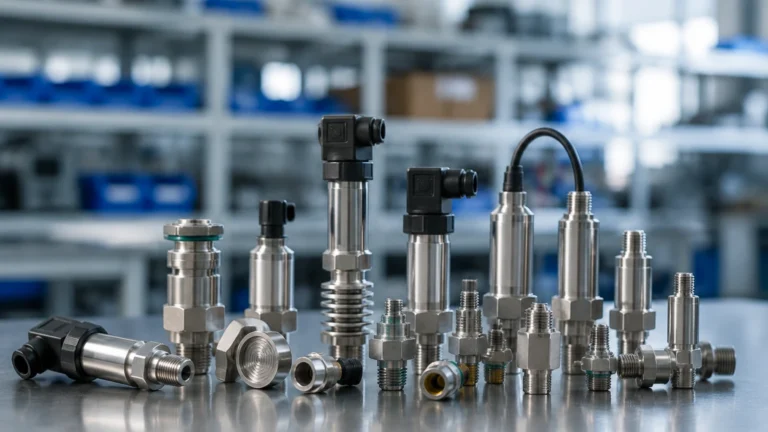
Hydrostatic measurement determines the level by sensing the pressure exerted by the liquid column at the bottom of the tank. The formula $P = \rho \cdot g \cdot h$ (where $P$ is pressure, $\rho$ is density, $g$ is gravity, and $h$ is height) allows the transmitter to calculate the level. For food applications, these transmitters must use flush diaphragms to prevent food particles from clogging the sensing element, ensuring hygiene and ease of cleaning.
Magnetic Level Gauges
Used primarily for bypass measurement on large storage tanks, magnetic level gauges use a float containing a permanent magnet. As the liquid level rises, the float moves, flipping magnetic flaps on an external scale to provide a visual indication. When paired with a reed chain transmitter, they provide a continuous electrical signal for remote monitoring.
Selection Criteria for Food-Grade Level Instrumentation
Selecting the right instrument is the first step in optimizing food manufacturing efficiency solutions. Engineers must consider the chemical compatibility of the sensor with both the food product and the cleaning agents used in Clean-in-Place (CIP) or Sterilization-in-Place (SIP) cycles.
Material and Hygiene Standards
All wetted parts must be constructed from food-safe materials, typically 316L stainless steel, PTFE, or PEEK. Surfaces should have a high polish (Ra < 0.8 μm) to prevent bacterial growth. Process connections, such as Tri-clamp or SMS unions, are standard to ensure leak-proof and sanitary seals.
Selection Table: Technology Comparison
| Technology | Accuracy | Suitability for Foam | Hygiene Rating | Ideal Application |
| :— | :— | :— | :— | :— |
| 80GHz Radar | ±1 mm | Excellent | High | Fermentation tanks, chocolate, oils |
| Ultrasonic | ±0.25% of range | Poor | Medium | Water storage, wastewater |
| Hydrostatic | ±0.1% to 0.5% | Good | High | Milk silos, juice storage |
| Level Switches | N/A (Point) | Moderate | High | Overfill protection, pump dry-run |
Enhancing Efficiency Through Automation
Food manufacturing efficiency solutions are realized when level data is integrated into a centralized PLC (Programmable Logic Controller) or SCADA system. This integration allows for:
1. Automated Inventory Management: Real-time tracking of raw ingredients prevents production halts due to stockouts.
2. Batch Consistency: Precise level control ensures that the exact volume of ingredients is dispensed, maintaining flavor profiles and nutritional standards.
3. Waste Reduction: Accurate measurement at the bottom of the tank allows manufacturers to utilize the maximum amount of product before switching batches, reducing the volume of "heel" or residual product sent to waste.
For comprehensive technical support and to Review product options and application support, engineers should consult with specialists who understand the nuances of food-grade instrumentation.
Installation Considerations for Maximum Reliability
Even the most advanced sensor will fail to provide efficiency if installed incorrectly. In food manufacturing, the physical environment is often challenging due to washdown procedures and complex tank geometries.
Avoiding Obstructions
In tanks equipped with agitators or spray balls for cleaning, sensors must be positioned to avoid these internal structures. Radar sensors with narrow beam angles are preferred here. If a sensor is placed too close to a filling inlet, the turbulence or the falling stream of product can cause false readings.
Managing Condensation and Steam
Food processes often involve high temperatures (e.g., pasteurization). This leads to heavy condensation on the sensor face. While radar is generally resistant, selecting a sensor with a convex lens or a PTFE-encapsulated antenna helps moisture beads roll off, maintaining signal integrity.
Dead Zones
Every non-contact sensor has a "dead zone" or "blocking distance" (typically 50 mm to 200 mm / 2" to 8") directly below the sensor where measurement is not possible. To maximize tank capacity, sensors should be mounted on nozzles that account for this distance, ensuring the tank can be filled to its true maximum volume.
Limitations and Environmental Factors
While modern instruments are robust, certain factors can limit the effectiveness of food manufacturing efficiency solutions:
* Dielectric Constant ($ε_r$): Radar relies on the dielectric constant of the material. Non-conductive materials like dry grains or certain oils have low $ε_r$ values, which result in weaker reflections. High-sensitivity radar units are required for these applications.
* Foam Density: Light, airy foam can be transparent to radar but may reflect ultrasonic waves. Conversely, thick, dense foam can attenuate radar signals. In cases of extreme foaming, hydrostatic pressure sensors or guided wave radar (GWR) may be more reliable.
* Ambient Noise: Ultrasonic sensors can be affected by high-frequency acoustic noise from pneumatic valves or heavy machinery, leading to signal interference.
Maintenance and Calibration Protocols
To maintain the gains provided by food manufacturing efficiency solutions, a proactive maintenance schedule is essential.
1. Verification: Regular verification against a manual dip-tape or a secondary reference point ensures the sensor hasn't drifted.
2. Cleaning Inspections: During CIP cycles, the wetted parts of level sensors are cleaned. Periodic visual inspections should be conducted to ensure no scaling or "milk stone" buildup has occurred on the diaphragms of hydrostatic sensors.
3. Signal Mapping: For radar installations, periodic "false echo suppression" or signal mapping should be performed to account for any new internal tank modifications that might cause interference.
Frequently Asked Questions (FAQ)
Q: Can one sensor type be used for all food applications?
A: No. While radar is highly versatile, it may be overkill for a simple water tank where an ultrasonic sensor is more cost-effective. Similarly, for highly viscous syrups that might coat a radar lens, a hydrostatic transmitter with a flush diaphragm might be more reliable.
Q: How does level measurement impact CIP efficiency?
A: Level sensors monitor the volume of cleaning chemicals and rinse water. By accurately measuring these levels, plants can optimize the amount of water and chemicals used, significantly reducing utility costs and environmental impact.
Q: What is the benefit of 80GHz radar over 26GHz in food plants?
A: The 80GHz frequency allows for a much smaller antenna and a narrower beam. This makes it easier to install on small tanks or through narrow nozzles, and it is better at "ignoring" internal tank features like heating coils or agitator blades.
Conclusion
Implementing effective food manufacturing efficiency solutions requires a deep understanding of both the process requirements and the physics of measurement. By selecting high-quality radar, ultrasonic, or hydrostatic instruments and adhering to strict installation standards, manufacturers can achieve higher throughput, lower waste, and superior product consistency. For those looking to upgrade their facilities, consulting the Main Page of a dedicated instrument manufacturer provides the necessary technical data to make informed procurement decisions.