Gas Tank Level Sensor
Gas Tank Level Sensor
In industrial process automation, the accurate monitoring of gas storage is a critical requirement for safety, inventory management, and operational efficiency. Whether the medium is liquefied petroleum gas (LPG), liquid nitrogen, compressed air, or specialized chemical vapors, selecting the correct gas tank level sensor requires a deep understanding of fluid dynamics, thermodynamics, and sensor physics. Unlike liquid level measurement in open atmospheric tanks, gas tanks often involve high pressures, cryogenic temperatures, and volatile substances that can interfere with standard instrumentation.
This guide examines the primary measurement principles used in industrial gas level monitoring, provides technical selection criteria, and outlines the practical considerations necessary for successful deployment in B2B environments.
Understanding Gas Tank Level Measurement Principles
Before selecting a specific instrument, it is essential to understand the physical principles that govern how these sensors detect the interface between the liquid and gas phases, or how they calculate the volume of a compressed gas. In most industrial "gas tank" applications, the substance is stored in a liquefied state under pressure or at low temperatures. Therefore, the sensor is typically measuring the liquid level of the gas in its condensed form.
Time-of-Flight (ToF)
Time-of-Flight is the most common principle for non-contact measurement. The sensor emits a signal (either electromagnetic or acoustic) that travels to the surface of the medium and reflects back to the receiver. By measuring the time taken for the round trip and knowing the constant speed of the signal, the device calculates the distance to the product surface.
Hydrostatic Pressure
This principle relies on the relationship between the height of a liquid column and the pressure it exerts at the base of the tank. For pressurized gas tanks, a differential pressure (DP) approach is required. The sensor measures the pressure at the bottom of the tank and subtracts the gas-phase pressure (top pressure) to isolate the pressure exerted solely by the liquid column.
Buoyancy and Magnetic Coupling
Based on Archimedes' principle, a float with a specific density is designed to sit on the liquid surface. In magnetic level gauges, this float contains a permanent magnet that interacts with an external column of flaps or a sensing rod. As the gas liquefies or is consumed, the float moves, providing a mechanical and often electrical indication of the level.
Key Technologies for Gas Tank Level Sensors
Industrial manufacturers like Welk provide several distinct technologies to handle the varied requirements of gas storage. Each technology has specific strengths depending on the tank geometry and the physical properties of the gas.
1. Radar Level Meters (FMCW and Pulse)
Radar is widely considered the gold standard for a gas tank level sensor in high-pressure environments. Frequency Modulated Continuous Wave (FMCW) radar, particularly those operating at 80GHz, offers a narrow beam angle and high precision.
* How it works: Microwaves are emitted from the antenna. Since microwaves do not require a medium to travel, they are unaffected by the vacuum or the gas composition in the tank's headspace.
* Advantages: Non-contact, high accuracy (up to ±1 mm), and capable of penetrating heavy vapors or dust.
2. Ultrasonic Level Sensors
Ultrasonic sensors are cost-effective solutions for gas tanks operating at near-atmospheric pressures.
* How it works: The sensor sends out high-frequency sound waves. The speed of these waves is dependent on the air/gas temperature and density.
* Advantages: No moving parts and easy installation. However, they are generally limited to tanks where the gas composition is stable and the pressure is below 3 bar (0.3 MPa).
3. Hydrostatic Differential Pressure Transmitters
For large-scale cryogenic storage (such as liquid oxygen or CO2), hydrostatic sensors are frequently used.
* How it works: Two pressure sensors (or one DP transmitter with two ports) measure the pressure at the bottom and top of the tank. The difference is divided by the product density to determine the level.
* Advantages: Proven reliability in high-pressure vessels and relatively simple maintenance.
4. Magnetic Level Gauges (MLG)
MLGs are preferred when a visual local indication is required alongside an electronic signal. They are common in LPG and ammonia storage.
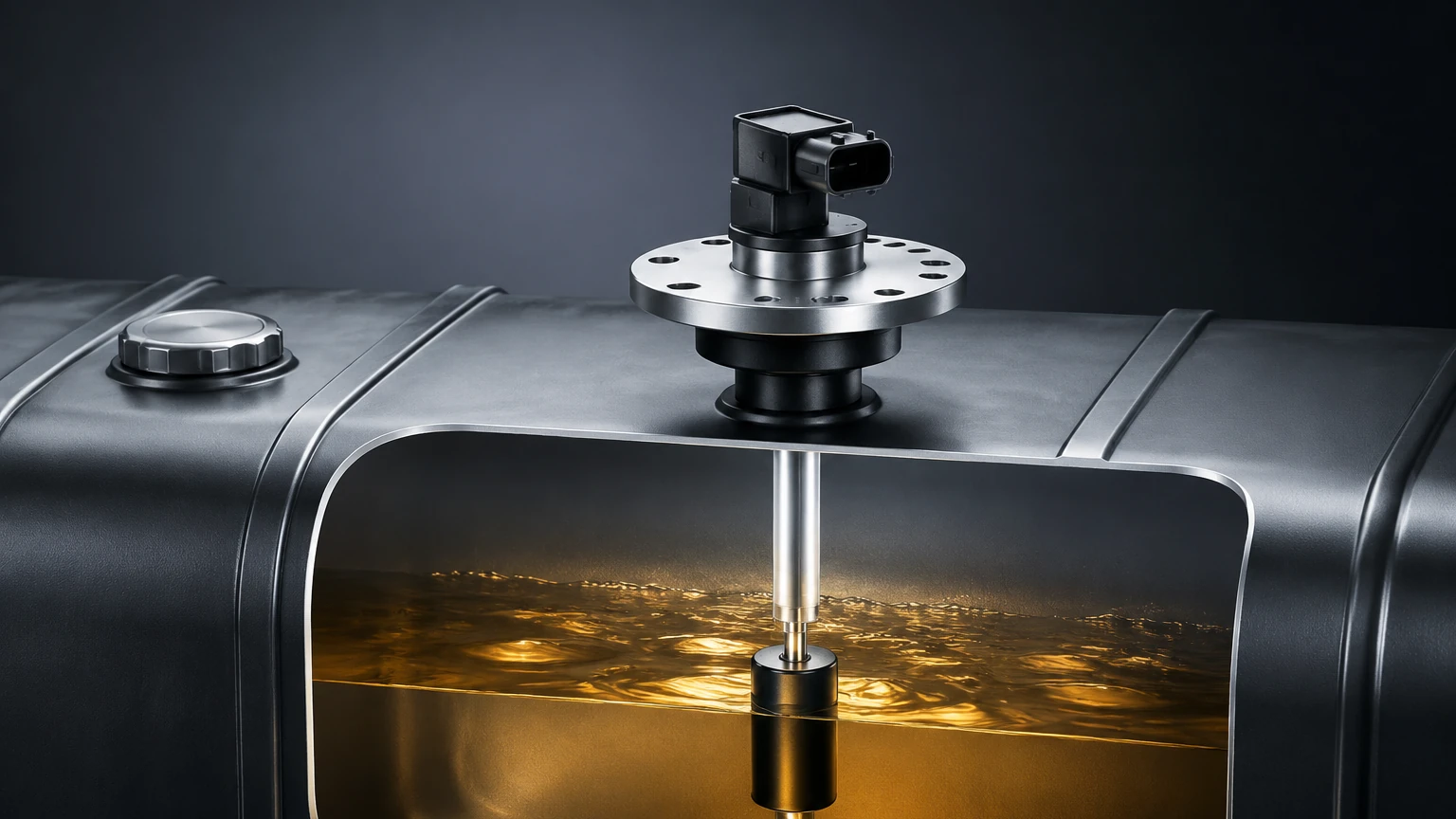
* How it works: A bypass chamber is mounted to the side of the tank. A magnetic float inside the chamber moves with the liquid level, flipping external bicolored flags and triggering a reed chain or magnetostrictive transmitter.
* Advantages: Redundant measurement (visual + electronic) and high safety for hazardous or toxic gases.
Technical Selection Criteria for Industrial Gas Storage
Selecting a gas tank level sensor is not a one-size-fits-all process. Engineers must confirm the following parameters before procurement:
1. Dielectric Constant (εr): For radar sensors, the dielectric constant of the liquefied gas is critical. Low-dielectric fluids (like liquid nitrogen or propane) reflect less energy, requiring high-sensitivity radar antennas.
2. Operating Pressure: Gas tanks can range from atmospheric to over 100 bar. Ensure the sensor housing and process connection (flange or thread) are rated for the maximum allowable working pressure (MAWP).
3. Temperature Extremes: Cryogenic gases require specialized seals and thermal extensions to protect the sensor electronics. Conversely, heated gas storage requires high-temperature-resistant materials.
4. Tank Geometry: Internal obstructions like agitators, heating coils, or baffles can cause false echoes for radar and ultrasonic sensors. In such cases, guided wave radar (GWR) or stilling wells may be necessary.
Technology Selection Table
| Feature | Radar (80GHz) | Ultrasonic | Hydrostatic (DP) | Magnetic Level Gauge |
| :— | :— | :— | :— | :— |
| Measurement Type | Non-contact | Non-contact | Contact | Contact (Bypass) |
| Accuracy | ±1 mm to ±5 mm | ±0.25% of range | ±0.1% to ±0.5% | ±5 mm to ±10 mm |
| Max Pressure | Up to 160 bar | Up to 3 bar | Up to 400 bar | Up to 250 bar |
| Max Temperature | +450°C | +80°C | +120°C (Direct) | +400°C |
| Gas Vapors | Unaffected | Highly Sensitive | Unaffected | Unaffected |
| Cost | High | Low | Moderate | Moderate/High |
Installation and Safety Considerations
Proper installation is paramount for the longevity and accuracy of a gas tank level sensor. Because many gases are flammable or explosive, compliance with international safety standards is mandatory.
* Hazardous Area Certification: In B2B industrial environments, sensors must carry ATEX, IECEx, or UL/CSA certifications for explosive atmospheres (Zone 0, 1, or 2).
* Nozzle Position: For radar and ultrasonic sensors, the device should be mounted away from the tank wall to avoid signal interference. Typically, the sensor should be placed at 1/4 to 1/6 of the tank diameter from the wall.
* Vapor Space Compensation: In high-pressure gas tanks, the density of the gas in the headspace can increase significantly, potentially slowing down the speed of ultrasonic waves. If using ultrasonic technology, temperature and gas-type compensation must be programmed into the transmitter.
* Orientation: Hydrostatic transmitters should be mounted in a way that prevents gas bubbles from being trapped in the impulse lines, which can lead to "gas locking" and erroneous readings.
For more detailed technical specifications on sensor mounting and configuration, engineers can visit the Main Page to review product options and application support.
Limitations and Challenges in Gas Level Monitoring
While modern instrumentation is highly advanced, certain conditions remain challenging for gas tank level sensors:
* Boiling Surfaces: Liquefied gases near their boiling point can create a turbulent surface with heavy bubbling. This can scatter radar signals. Using a stilling well or a guided wave radar probe can mitigate this effect.
* Foaming: Some chemical gases may produce foam during filling or agitation. Ultrasonic signals are often absorbed by foam, leading to a "loss of echo." Radar is generally more resistant but may still experience signal attenuation.
* Condensation: In humid environments or cryogenic applications, condensation can form on the sensor face. Welk radar sensors often utilize PTFE-encapsulated antennas or "drip-off" designs to prevent water droplets from blocking the signal.
* Gas Composition Changes: If the gas mixture in the tank changes (e.g., a mix of Nitrogen and CO2), the speed of sound changes. This makes ultrasonic sensors unreliable unless they are equipped with a fixed-distance reference target for auto-calibration.
Frequently Asked Questions (FAQ)
Q: Can I use a hydrostatic sensor for a pressurized LPG tank?
A: Yes, but you must use a differential pressure (DP) transmitter. A single-ended hydrostatic sensor would measure both the liquid height and the gas pressure, resulting in a massive overestimation of the level.
Q: Is radar safe for flammable gas storage?
A: Yes, provided the sensor is intrinsically safe (Ex ia) or explosion-proof (Ex d). Radar sensors use very low-power microwave pulses that do not have enough energy to ignite flammable vapors.
Q: How do I measure the level in a horizontal cylindrical gas tank?
A: The sensor measures the linear distance to the surface. To get the volume, the transmitter's software must be configured with a strapping table or a linearization formula that accounts for the tank's curved geometry.
Q: What is the maintenance requirement for these sensors?
A: Non-contact sensors like radar require very little maintenance as they have no moving parts. Magnetic level gauges should be flushed periodically to prevent sediment buildup in the bypass chamber, and hydrostatic seals should be checked for leaks.
Conclusion
Selecting the right gas tank level sensor involves balancing technical requirements with budget constraints and safety regulations. Radar remains the most versatile and accurate choice for complex industrial gas applications, while hydrostatic and magnetic solutions offer robust performance for specific storage configurations. By carefully evaluating the dielectric constant, pressure, and temperature of the process, engineering teams can ensure reliable inventory tracking and process safety. For further assistance in selecting the appropriate instrument for your specific industrial application, consult the technical resources available on the Main Page.