Handheld Ph Meter
Handheld Ph Meter
In industrial process control, the measurement of liquid properties is as critical as the measurement of volume and level. While level measurement instruments—such as radar level meters and ultrasonic sensors—provide the necessary data for inventory and safety, analytical instruments like the handheld pH meter offer essential insights into the chemical composition and quality of the medium. For engineers and technicians in water treatment, chemical processing, and industrial automation, understanding the principles, selection, and maintenance of these portable devices is vital for maintaining operational standards.
The Principle of pH Measurement
Before selecting a handheld pH meter, it is essential to understand the underlying electrochemical principle. The pH value is a logarithmic measure of the hydrogen ion activity in a solution, defined as the negative base-10 logarithm of the hydrogen ion concentration.
The Electrochemical Cell
A pH measurement system typically consists of three parts: a glass electrode (sensing electrode), a reference electrode, and a high-impedance meter. Most modern handheld pH meters utilize a "combination electrode," where both the sensing and reference elements are housed in a single probe body.
1. The Glass Electrode: This electrode features a thin, hydrogen-ion-sensitive glass bulb. When immersed in a solution, a hydrated gel layer forms on the outside of the bulb. A similar layer exists on the inside, which is filled with a known pH 7 buffer solution. The difference in hydrogen ion concentration between the internal and external solutions creates a millivolt (mV) potential across the glass membrane.
2. The Reference Electrode: To measure the potential of the glass electrode, a stable reference point is required. The reference electrode provides a constant potential that is independent of the pH of the solution. It typically uses a silver/silver chloride (Ag/AgCl) system immersed in a potassium chloride (KCl) electrolyte, which makes contact with the sample through a porous junction.
3. The Nernst Equation: The relationship between the measured potential and the pH value is governed by the Nernst equation. At 25°C (298.15 K), a change of one pH unit corresponds to a theoretical change of 59.16 mV.
Temperature Compensation
Because the Nernstian slope is temperature-dependent, accurate measurement requires temperature compensation. Most industrial-grade handheld pH meters include an Integrated Temperature Sensor (ITS) to perform Automatic Temperature Compensation (ATC), adjusting the pH reading based on the actual temperature of the sample.
Key Components and Features
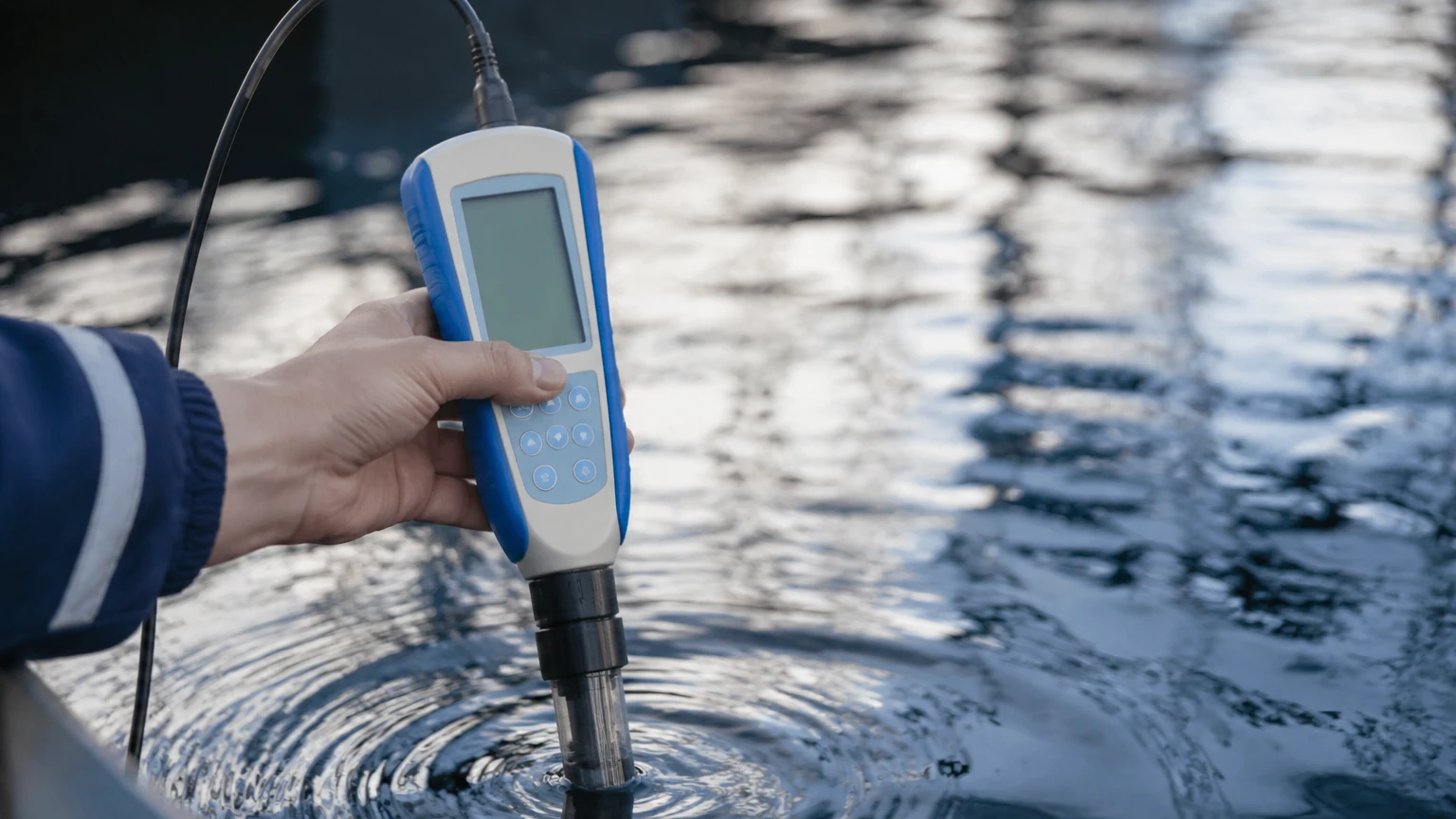
A professional handheld pH meter is designed for durability and precision in field environments. Unlike laboratory benchtop models, these units must withstand exposure to moisture, dust, and varying temperatures.
* The Meter Body: Usually rated IP67 for waterproof and dustproof performance. It contains the microprocessor that converts the mV signal into a digital pH display.
* The Electrode Junction: The junction is the point where the internal electrolyte of the reference electrode meets the sample. In industrial applications involving suspended solids or oils, a "clog-resistant" junction (such as a PTFE or open junction) is preferred over standard ceramic frits.
* Data Logging and Connectivity: Modern B2B-grade meters often include internal memory to store hundreds of data points, which can be exported via USB or Bluetooth for compliance reporting.
Selection Criteria for Industrial Applications
When evaluating a handheld pH meter for use alongside larger process systems, such as those found on the Main Page of industrial instrumentation providers, several technical factors must be considered.
Accuracy and Resolution
For basic water monitoring, a resolution of 0.1 pH may suffice. However, in chemical dosing or pharmaceutical applications, a resolution of 0.01 pH and an accuracy of ±0.01 pH are standard requirements.
Calibration Points
The linearity of an electrode can drift over time. A meter that supports multi-point calibration (typically 3 to 5 points) ensures accuracy across a wider range of the pH scale (e.g., pH 1.68 to 12.45) compared to a simple 2-point calibration (pH 4.01 and 7.00).
Electrode Replaceability
Electrodes are consumable items with a finite lifespan (typically 6 to 18 months). Professional handheld units feature detachable electrodes with BNC connectors or proprietary waterproof connectors, allowing the user to replace the probe without discarding the meter.
Practical Selection Table
| Feature | Entry-Level Field Meter | Professional Industrial Meter | Multi-Parameter Handheld |
| :— | :— | :— | :— |
| pH Range | 0.0 to 14.0 | -2.00 to 16.00 | -2.00 to 20.00 |
| Resolution | 0.1 pH | 0.01 pH | 0.001 pH |
| Accuracy | ±0.1 pH | ±0.01 pH | ±0.002 pH |
| Calibration | 1 or 2 points | Up to 5 points | Up to 6 points |
| ATC | Yes | Yes | Yes |
| Memory | None | 50 – 500 Data Points | >1000 Data Points |
| Additional Parameters | Temperature | Temp, mV (ORP) | Temp, ORP, Cond, DO, Turbidity |
| Protection | IP65 | IP67 | IP67 |
Installation and Operating Considerations
While a handheld pH meter does not require permanent installation like a radar level transmitter, its "installation" into the workflow requires strict adherence to operating protocols to ensure data integrity.
Calibration Procedure
1. Preparation: Rinse the electrode with deionized water. Never wipe the glass bulb, as this can create a static charge that causes erratic readings; instead, blot it gently with a lint-free tissue.
2. Buffer Selection: Use fresh NIST-traceable buffer solutions. Always start with pH 7.00 (the zero point) and then move to pH 4.01 or 10.01 depending on whether the sample is acidic or alkaline.
3. Stabilization: Allow the reading to stabilize before accepting the calibration point. Most modern meters have a stability indicator (e.g., a "ready" icon).
Measurement Best Practices
* Immersion Depth: Ensure the junction is fully submerged in the sample. This is typically 2 to 3 cm from the tip of the probe.
* Stirring: Gently stir the sample with the probe to ensure homogeneity and to speed up the response time of the electrode.
* Sample Temperature: For the highest precision, calibrate the meter using buffers that are at the same temperature as the process sample.
Limitations and Maintenance
A handheld pH meter is a sensitive analytical tool and has specific limitations that must be managed by the technical staff.
Electrode Fouling
In wastewater or chemical slurries, the glass membrane or the reference junction can become coated with oils, proteins, or precipitates. This leads to "sluggish" response times and inaccurate readings. Regular cleaning with specialized cleaning solutions (e.g., pepsin/HCl for proteins or general detergents for oils) is required.
Dehydration
The glass bulb must remain hydrated to function. If the electrode dries out, the hydrated gel layer collapses, and the meter will fail to provide stable readings. Electrodes should always be stored in a dedicated storage solution (typically 3M or 4M KCl), never in deionized or distilled water, which can leach ions out of the reference electrolyte.
Lifespan and Drift
All pH electrodes degrade over time due to the depletion of the reference electrolyte and the aging of the glass membrane. Users should monitor the "Slope" and "Offset" values during calibration. A slope below 85% or an offset greater than ±30 mV usually indicates that the electrode needs replacement.
Integration with Level Measurement Systems
In B2B industrial environments, pH monitoring and level measurement are often complementary. For example, in a chemical storage tank, a Welk radar level meter provides continuous monitoring of the liquid volume to prevent overfills. Simultaneously, a technician may use a handheld pH meter to verify the concentration or stability of the chemical during routine inspections or before discharging treated effluent.
Integrating these data points allows for a comprehensive view of the process. If a level meter indicates a sudden increase in volume while the pH meter shows a significant shift in acidity, it may indicate a leak or an unintended chemical reaction, triggering immediate corrective action.
Frequently Asked Questions (FAQ)
Q: Can I use a handheld pH meter to measure the pH of high-purity water?
A: Measuring pH in low-conductivity water (like DI or RO water) is difficult because the low ion concentration leads to high resistance and unstable potentials. Specialized "Low Ionic Strength" (LIS) electrodes are required for these applications.
Q: How often should I calibrate my handheld pH meter?
A: For industrial compliance, daily calibration is recommended. At a minimum, the meter should be calibrated at the start of every shift or whenever the accuracy of the reading is in question.
Q: Why does my pH reading drift in a moving stream?
A: This is often caused by "streaming potential," where the movement of the liquid across the reference junction creates a small voltage. For field measurements, it is often better to take a grab sample and measure it in a beaker to ensure a stable environment.
Q: What is the difference between pH and ORP?
A: pH measures the hydrogen ion activity (acidity/alkalinity), while ORP (Oxidation-Reduction Potential) measures the overall electron-moving potential of a solution, indicating its ability to oxidize or reduce other substances. Many professional handheld pH meters can measure both by switching the electrode.
By selecting a high-quality handheld pH meter and following rigorous maintenance and calibration schedules, industrial operators can ensure that their analytical data is as reliable as their level and flow measurements, leading to safer and more efficient process management.