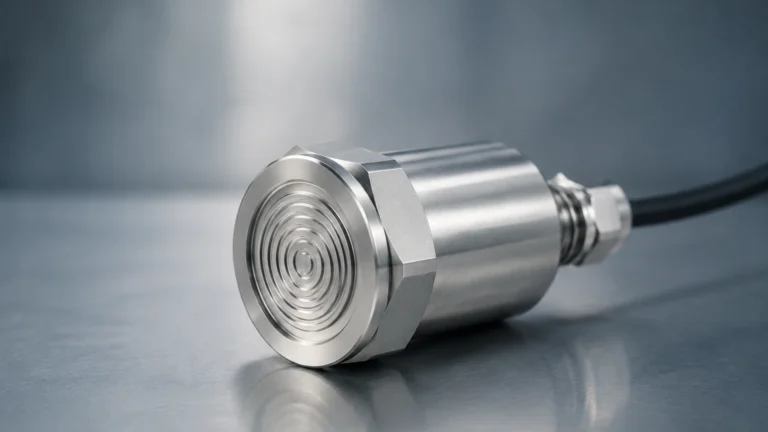
Ifm Ps3208
Ifm Ps3208
In the landscape of industrial automation and process control, precise pressure monitoring is a fundamental requirement for ensuring system safety, efficiency, and longevity. The ifm ps3208 represents a specific category of electronic pressure sensors designed to provide reliable switching and continuous feedback in demanding environments. While often categorized as a pressure switch, its role in modern industrial frameworks extends to data integration via IO-Link and localized process visualization. This article provides a technical analysis of the ifm ps3208, its underlying measurement principles, and how it fits into the broader context of level and pressure measurement technologies.
Understanding the Measurement Principles of Pressure Sensors
Before evaluating a specific instrument like the ifm ps3208, it is essential to understand the physics of pressure measurement. Most modern electronic pressure sensors utilize one of two primary sensing technologies: piezoresistive or ceramic thick-film strain gauges.
Piezoresistive Sensing
In piezoresistive sensors, a silicon-based diaphragm is used. When pressure is applied, the diaphragm deforms, changing the electrical resistance of the integrated resistors. This change is proportional to the applied pressure. These sensors are known for their high sensitivity and are often used in applications requiring high precision.
Ceramic Capacitive/Thick-Film Sensing
The ifm ps3208 family typically utilizes a ceramic measuring cell. Ceramic is an exceptionally robust material, resistant to corrosion and mechanical wear. In this design, a ceramic diaphragm moves slightly under pressure. This movement is detected either by a change in capacitance or through thick-film strain gauges bonded to the ceramic.
Hydrostatic Level Measurement Principle
In many industrial applications, pressure sensors are used to determine the level of a liquid in a tank. This is known as hydrostatic level measurement. The principle is based on the relationship between the height of the liquid column and the pressure exerted at the bottom of the vessel:
$$P = \rho \cdot g \cdot h$$
Where:
* P is the hydrostatic pressure (Pa).
* ρ (rho) is the density of the liquid (kg/m³).
* g is the acceleration due to gravity (approximately 9.81 m/s²).
* h is the height of the liquid column (m).
By measuring the pressure at a fixed point (usually the bottom of the tank), and knowing the density of the fluid, the sensor can accurately calculate the liquid level. While the ifm ps3208 is frequently used in high-pressure hydraulic systems, the same logic applies to lower-pressure level monitoring applications.
Technical Overview of the ifm ps3208
The ifm ps3208 is an electronic pressure sensor characterized by its integrated display and programmable switching outputs. It is designed for medium to high-pressure ranges, typically up to 250 bar (25 MPa / 3625 psi), making it suitable for hydraulic and pneumatic systems where robust monitoring is required.
Key Specifications
* Measuring Range: 0 to 250 bar.
* Process Connection: G 1/4 female thread.
* Output Signals: Two switching outputs (normally open or normally closed) with IO-Link communication.
* Display: 4-digit alphanumeric display for real-time pressure monitoring and parameter setting.
* Protection Rating: IP 67, ensuring resistance to dust and temporary immersion in water.
* Housing Materials: Stainless steel (1.4404 / 316L) and high-grade plastics (PBT, PC).
IO-Link Integration
A defining feature of the ps3208 is its IO-Link capability. IO-Link is a point-to-point communication interface that allows for the digital transmission of process data, parameters, and diagnostic information. This reduces electrical interference compared to traditional analog signals and enables remote configuration and "plug-and-play" sensor replacement.
Applications in Hydrostatic Level Measurement
While the ifm ps3208 is often associated with hydraulic power units, it can be integrated into specialized level measurement tasks. In high-pressure storage systems or pressurized vessels, standard ultrasonic or radar sensors may face limitations due to vapor space density or mechanical constraints.
In these scenarios, a pressure-based approach using a sensor like the ps3208 offers several advantages:
1. Compact Form Factor: The G 1/4 connection allows for installation in tight spaces where larger level transmitters cannot fit.
2. Dual Functionality: It can monitor the system's operating pressure while simultaneously acting as a high-level or low-level safety switch.
3. Local Feedback: The onboard display allows maintenance personnel to verify levels or pressures at the point of measurement without needing to check a central control room.
For broader applications involving diverse media or larger tanks, engineers often look toward specialized radar or ultrasonic solutions. You can review product options and application support on our Main Page to compare these technologies.
Selection Criteria: Pressure Sensors vs. Other Level Technologies
Choosing the right sensor requires an evaluation of the media, environment, and accuracy requirements. The following table compares the ifm ps3208 (as a representative pressure sensor) with other common level measurement technologies.
| Feature | Pressure Sensor (e.g., PS3208) | Ultrasonic Sensor | Radar Level Meter |
| :— | :— | :— | :— |
| Measurement Type | Contact (Hydrostatic) | Non-contact (Time-of-Flight) | Non-contact (Microwave) |
| Best Use Case | Pressurized vessels, hydraulics | Open tanks, water treatment | Chemical tanks, solids, high precision |
| Accuracy | High (depends on density stability) | Medium (affected by vapors) | Very High |
| Installation | Bottom or side-mounted | Top-mounted | Top-mounted |
| Media Influence | Affected by density changes | Affected by foam/vapor | Largely unaffected |
| Maintenance | Low (requires cleaning if media coats) | Low (no contact) | Minimal |
Installation Guidelines and Best Practices
Proper installation of the ifm ps3208 is critical for accurate data and long-term reliability. Engineers should adhere to the following guidelines:
Mechanical Mounting
* Orientation: While the sensor can be mounted in any orientation, it is best to install it in a position where sediment or air bubbles cannot accumulate at the diaphragm.
* Sealing: Ensure the G 1/4 thread is sealed correctly using appropriate materials (e.g., bonded seals or PTFE tape) compatible with the process media.
* Torque: Tighten the sensor to the manufacturer's specified torque (typically 25–35 Nm for G 1/4 connections) to avoid damaging the housing or the process connection.
Electrical Connection
* Wiring: Use a standard M12 connector. Ensure the cable is routed away from high-voltage lines to minimize electromagnetic interference (EMI).
* Grounding: The sensor housing should be properly grounded through the process connection or the electrical cable shield to prevent signal noise.
Parameter Setting
The ps3208 allows for the configuration of set points (SP) and reset points (rP).
* Hysteresis Mode: Used to maintain a stable switching state even if the pressure fluctuates slightly around the set point.
* Window Mode: Used to monitor a specific pressure range, triggering an alarm if the pressure falls outside the defined window.
Limitations and Operational Considerations
Despite its versatility, the ifm ps3208 has limitations that must be addressed during the design phase:
1. Media Compatibility: The ceramic measuring cell and FKM seals are resistant to many fluids, but highly aggressive chemicals or specific refrigerants may require alternative materials.
2. Temperature Sensitivity: While the sensor includes temperature compensation, extreme fluctuations in ambient or media temperature can cause small zero-point shifts. It is rated for medium temperatures typically between -25°C and 80°C.
3. Pressure Spikes: In hydraulic systems, "water hammer" or rapid valve closures can create pressure peaks far exceeding the nominal range. While the ps3208 has a high burst pressure rating, frequent spikes can fatigue the diaphragm over time. Using a pressure snubber is recommended in such environments.
4. Density Dependency: If used for level measurement, any change in the liquid's density (due to temperature or concentration changes) will result in a measurement error, as the sensor measures weight, not actual volume.
Maintenance and Troubleshooting
Maintenance requirements for the ifm ps3208 are minimal, primarily involving periodic visual inspections and calibration checks.
* Cleaning: If the media is prone to crystallization or coating, the process connection should be inspected and cleaned periodically using non-abrasive tools.
* Zero-Point Calibration: Over time, sensors may exhibit a slight offset. Many digital sensors allow for a "zero-point calibration" where the current atmospheric pressure is set as the reference zero.
* Diagnostic Codes: The integrated display will show error codes (e.g., "Err" or flashing values) in the event of a sensor failure or if the pressure exceeds the measuring range. Consulting the technical manual for these specific codes can significantly reduce downtime.
Frequently Asked Questions
Q: Can the ifm ps3208 be used for vacuum measurement?
A: Most versions of the ps3208 are designed for positive pressure (0…250 bar). For vacuum applications, a sensor specifically rated for negative pressure ranges should be selected.
Q: What is the benefit of IO-Link in this sensor?
A: IO-Link allows the sensor to transmit the actual pressure value as a digital signal, provides diagnostic data (like internal temperature or operating hours), and allows for automated parameter setting when replacing a sensor.
Q: How do I convert the bar reading to liquid level?
A: For water (density ≈ 1000 kg/m³), 1 bar of pressure is approximately equal to 10.2 meters of water column. For other liquids, you must divide the pressure by the product of the liquid's density and gravity.
Q: Is the sensor suitable for food and beverage applications?
A: While the materials are high quality, food-grade applications usually require specific hygienic connections (like Tri-Clamp) and certifications (EHEDG/3-A). The G 1/4 thread of the ps3208 is generally intended for industrial hydraulics and pneumatics.
By understanding these technical nuances, engineers can effectively deploy the ifm ps3208 within their automation architectures. For applications requiring different measurement principles, such as non-contact radar for large-scale chemical storage, exploring the comprehensive range of instruments available on the Main Page is recommended to ensure the optimal balance of accuracy, cost, and reliability.