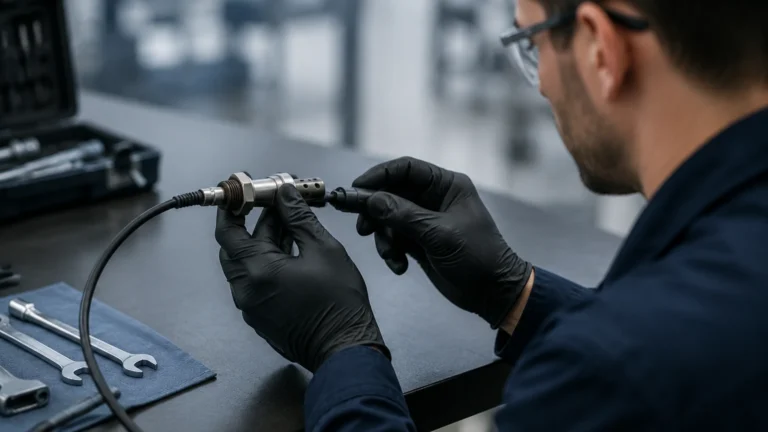
In-line Nir
In-line Nir
In modern industrial processing, the transition from laboratory-based quality control to real-time, continuous monitoring is a cornerstone of Industry 4.0. In-line NIR (Near-Infrared) spectroscopy has emerged as a primary technology for achieving this transition. By providing instantaneous data on chemical composition, moisture content, and physical properties directly within the production line, in-line NIR allows for immediate process adjustments, reducing waste and ensuring product consistency. This guide explores the principles, applications, and selection criteria for in-line NIR systems, particularly how they complement physical monitoring tools like level measurement instruments.
Fundamental Principles of NIR Spectroscopy
Near-Infrared spectroscopy operates in the wavelength range of approximately 780 nm to 2500 nm. This region of the electromagnetic spectrum is characterized by the absorption of light by molecular vibrations, specifically the overtones and combination bands of fundamental vibrations involving hydrogen atoms, such as C-H, O-H, N-H, and S-H bonds.
The Interaction of Light and Matter
When NIR light is directed at a sample, certain frequencies are absorbed by the molecular bonds, while others are reflected or transmitted. The resulting spectrum acts as a "chemical fingerprint." Because NIR light can penetrate deeper into materials than Mid-Infrared (MIR) light, it is uniquely suited for analyzing bulk materials, slurries, and liquids without extensive sample preparation.
Three primary measurement modes are used in in-line NIR:
1. Transmission: Light passes through a clear or semi-transparent liquid sample to a detector on the opposite side. This is ideal for measuring low-concentration components in clear liquids.
2. Reflectance: Light reflects off the surface of solids, powders, or opaque liquids. This is common in food processing and pharmaceutical manufacturing.
3. Transflectance: Light passes through a liquid, reflects off a mirror (reflector), and passes back through the liquid to the detector. This effectively doubles the path length and is used for complex liquid mixtures.
Quantitative Analysis and Chemometrics
Unlike simple sensors that provide a direct reading, NIR produces complex spectra. To translate these spectra into usable data (such as percentage of moisture or protein), manufacturers use chemometrics—mathematical and statistical methods to correlate spectral data with known laboratory reference values. Once a calibration model is established, the in-line NIR system can predict concentrations in real-time.
The Strategic Importance of In-line Monitoring
In-line NIR is a critical component of Process Analytical Technology (PAT). In traditional manufacturing, samples are pulled from the line and sent to a lab, a process that can take hours. If the lab results show the batch is out of specification, the entire volume produced during that window may be lost or require expensive reprocessing.
By implementing in-line NIR, facilities gain:
* Real-time Feedback Loops: Operators can adjust temperatures, flow rates, or feed ratios the moment a deviation is detected.
* Reduced Energy Consumption: In drying processes, for example, NIR can detect the exact moment the desired moisture level is reached, preventing over-drying.
* Enhanced Safety: Continuous monitoring of volatile chemical reactions reduces the risk of runaway reactions by detecting precursor changes before they become critical.
Integrating Chemical Analysis with Level Monitoring
While in-line NIR provides data on *what* is inside a vessel, industrial level measurement instruments provide data on *how much* is there. A holistic approach to process automation requires the integration of both chemical and physical data. For instance, in a chemical reactor, knowing the concentration of a reactant via NIR is only half the equation; knowing the total volume via a radar level meter or ultrasonic sensor allows for the calculation of the total mass balance.
Reliable process control relies on the synergy between these technologies. For engineers seeking to optimize their facility's inventory and process control, reviewing the Main Page of specialized level measurement manufacturers like Welk provides insight into how radar, ultrasonic, and hydrostatic sensors can be paired with analytical tools to create a comprehensive monitoring environment.
Selection Criteria for In-line NIR Systems
Choosing the right in-line NIR solution requires a detailed understanding of the process environment and the material being measured. The following table outlines key evaluation criteria for selecting an NIR system.
| Criterion | Consideration | Impact on Performance |
| :— | :— | :— |
| Wavelength Range | 780–2500 nm vs. 1100–1700 nm | Determines which chemical bonds can be detected. |
| Probe Interface | Immersion probe, flow cell, or non-contact | Affects ease of cleaning and potential for fouling. |
| Optical Fiber Length | Distance from spectrometer to probe | Longer fibers (e.g., >50 meters) may lead to signal attenuation. |
| Environmental Rating | IP67, ATEX/Ex-proof, NEMA 4X | Necessary for hazardous or wash-down environments. |
| Measurement Speed | Milliseconds to seconds | Crucial for fast-moving production lines or rapid reactions. |
Probe Design and Material Compatibility
The probe is the most vulnerable part of an in-line NIR system. In corrosive chemical environments, probes must be constructed from materials like Hastelloy or stainless steel 316L, with sapphire windows to resist abrasion and chemical attack. For food and pharmaceutical applications, hygienic designs with Tri-Clamp fittings are mandatory to prevent bacterial growth.

Installation and Engineering Considerations
Successful implementation of in-line NIR depends heavily on proper installation. Unlike a standard level switch, an NIR probe must be positioned where it encounters a representative sample of the process stream.
Location and Flow Dynamics
* Pipe Diameter: For transmission and transflectance, the pipe or flow cell must accommodate the required path length (typically 1 mm to 20 mm). If the pipe is too wide, the signal will be too weak; if too narrow, it may cause pressure drops.
* Turbulence: Probes should be installed in areas of turbulent flow to ensure the sample is well-mixed and to reduce the buildup of coatings on the sensor window.
* Avoid Air Pockets: In liquid lines, probes should be installed on the side or bottom of the pipe to ensure they are always submerged and not measuring air bubbles at the top of the line.
Temperature and Pressure Stability
NIR spectra are sensitive to temperature changes. While chemometric models can often compensate for temperature fluctuations, it is best practice to install the sensor in a location where the temperature is relatively stable. Furthermore, the probe must be rated for the maximum process pressure, often exceeding 40 bar (approx. 580 psi) in high-pressure reactors.
Addressing Common Limitations and Risks
Despite its advantages, in-line NIR is not a "plug-and-play" solution. Engineering teams must be aware of the following risks:
1. Calibration Drift: Over time, changes in the light source or environmental factors can cause the model to drift. Regular validation against laboratory reference methods is essential.
2. Window Fouling: In sticky or high-viscosity applications, material can build up on the sapphire window. This can be mitigated using automatic cleaning systems, such as mechanical wipers or high-pressure air/solvent purges.
3. Particle Size Effects: In solid and powder applications, variations in particle size can scatter light differently, potentially interfering with chemical concentration readings. Advanced chemometric pre-processing (such as Multiplicative Scatter Correction) is required to handle these variations.
4. Complex Matrix Effects: If the process involves a highly complex mixture where multiple components have overlapping NIR signatures, the accuracy of the measurement may decrease.
Frequently Asked Questions (FAQ)
Q: How often does an in-line NIR system need to be calibrated?
A: The initial calibration is intensive, requiring 30 to 100 samples for a robust model. Once established, the system should be validated weekly or monthly, but a full recalibration is typically only needed if the process chemistry or raw material source changes significantly.
Q: Can NIR measure inorganic compounds?
A: Generally, no. NIR is primarily sensitive to organic molecules with hydrogen bonds. It cannot directly measure minerals or metals unless they are part of an organic complex or affect the water structure in a detectable way.
Q: What is the typical lifespan of the light source?
A: Most in-line NIR systems use tungsten-halogen lamps, which typically last between 10,000 and 20,000 hours. Many modern systems include dual-lamp configurations for automatic failover to prevent downtime.
Q: How does NIR compare to level measurement in terms of maintenance?
A: In-line NIR is generally higher maintenance than physical sensors like radar level meters. While a radar sensor might require occasional cleaning, an NIR system requires light source replacement and ongoing software validation of the chemometric models.
Conclusion
In-line NIR spectroscopy is a transformative technology for process industries, offering a window into the chemical dynamics of production that was previously invisible in real-time. When integrated with robust physical monitoring tools—such as the level measurement solutions found on the Main Page of industrial instrumentation providers—it enables a level of process transparency that drives efficiency, safety, and quality. By understanding the measurement principles, selecting the appropriate hardware, and maintaining rigorous calibration standards, engineers can successfully deploy in-line NIR to achieve superior process control.