Industrial Thermometers for Sale
Industrial Thermometers for Sale
In the landscape of industrial process control, temperature and level measurement are inextricably linked. Whether managing a chemical reactor, a water treatment facility, or an oil storage terminal, accurate thermal data is essential not only for safety and product quality but also for the precision of level sensing equipment. When searching for industrial thermometers for sale, engineers and procurement specialists must look beyond the basic temperature reading and consider how these instruments integrate into a broader automation strategy.
Temperature fluctuations directly affect the physical properties of liquids and gases, which in turn impacts the accuracy of level measurement technologies such as hydrostatic transmitters, ultrasonic sensors, and radar meters. This guide provides a technical overview of industrial thermometry, its principles, and its critical role alongside level measurement solutions.
Core Principles of Temperature Measurement
Before evaluating specific industrial thermometers for sale, it is vital to understand the underlying physical principles that govern these devices. Industrial temperature sensors generally fall into two categories: contact and non-contact.
1. Resistance Temperature Detectors (RTDs)
RTDs operate on the principle that the electrical resistance of a metal increases as its temperature rises. Most industrial RTDs utilize platinum (Pt100 or Pt1000) due to its stability and linear resistance-to-temperature relationship.
- Pt100: 100 ohms at 0°C.
- Pt1000: 1000 ohms at 0°C, offering higher sensitivity in certain applications.
RTDs are known for high accuracy and repeatability, making them the preferred choice for precise process control.
2. Thermocouples
A thermocouple consists of two dissimilar metal wires joined at one end (the sensing junction). When there is a temperature gradient between the sensing junction and the reference junction, a voltage is produced (the Seebeck effect). Common types include:
- Type K (Chromel/Alumel): Versatile and inexpensive for general use.
- Type J (Iron/Constantan): Suitable for reducing atmospheres.
- Type R/S (Platinum/Rhodium): Used for extremely high-temperature applications.
3. Bimetallic Expansion
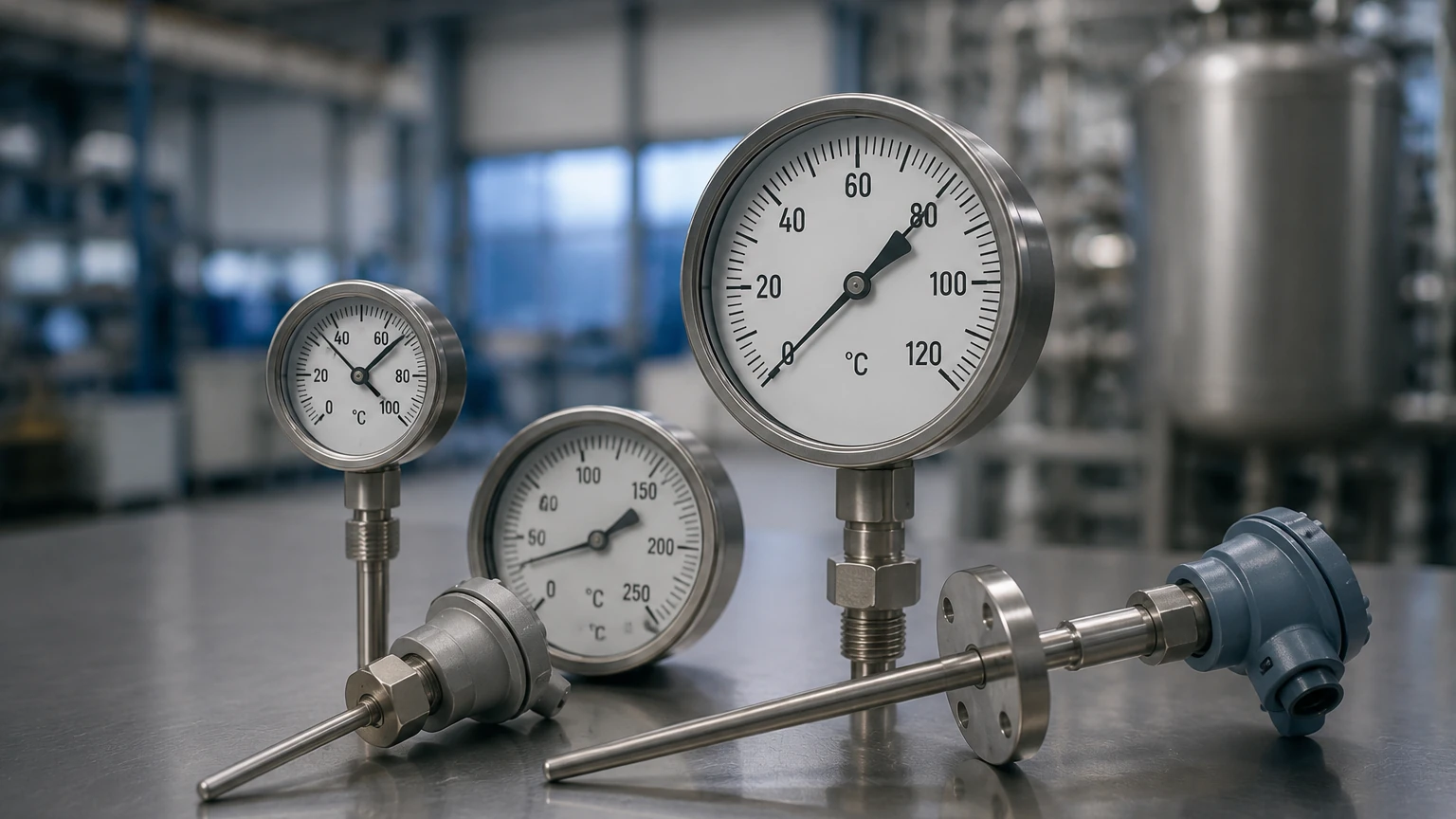
These mechanical thermometers use two bonded metal strips with different coefficients of thermal expansion. As temperature changes, the strip bends, moving a needle on a dial. These are typically used for local indication where electronic power is unavailable.
4. Infrared (IR) Thermometry
Non-contact IR thermometers measure the thermal radiation emitted by an object. These are essential for moving parts, extremely hot surfaces, or corrosive environments where contact sensors would fail quickly.
Common Types of Industrial Thermometers for Sale
When browsing the market for industrial thermometers for sale, you will encounter several configurations designed for specific industrial environments. Selecting the right one requires matching the instrument to the process media and the required output signal.
Digital Industrial Thermometers
Modern digital thermometers often include integrated transmitters that convert the raw sensor signal (ohms or mV) into a standard 4-20mA or digital bus signal (HART, Modbus). These are ideal for integration with PLC and SCADA systems. They offer high-visibility local displays and can be configured with dual-compartment housings to protect electronics from moisture and corrosion.
Bimetallic Dial Thermometers
For onsite monitoring of tanks and pipelines, bimetallic thermometers remain a staple. They are rugged, require no external power, and are available in various stem lengths and dial sizes (typically 75mm to 150mm). When purchasing these, it is crucial to specify the connection type—usually NPT or G threads—and whether a thermowell is required.
Sanitary Thermometers
In the food, beverage, and pharmaceutical industries, thermometers must meet 3-A or EHEDG standards. These feature polished stainless steel surfaces (Ra < 0.8 µm) and Tri-Clamp connections to prevent bacterial growth and allow for Clean-in-Place (CIP) procedures.
The Interdependence of Temperature and Level Measurement
As a professional manufacturer of level measurement instruments, Welk emphasizes that temperature data is often a prerequisite for accurate level readings. Many level technologies are "indirect," meaning they calculate level based on other physical properties that are temperature-dependent.
Hydrostatic Level Transmitters
Hydrostatic pressure is defined by the formula $P = \rho gh$, where $\rho$ is the density of the liquid. Because liquid density changes with temperature, a hydrostatic level transmitter may report an incorrect level if the temperature shifts significantly. Integrated temperature compensation allows the system to adjust the density value in real-time, ensuring the Main Page of your control interface displays the true volume.
Ultrasonic Level Sensors
The speed of sound in air (or gas) changes with temperature. An ultrasonic sensor measures the time of flight for a sound pulse to return from the liquid surface. If the air temperature in the tank head-space is not accurately measured and compensated for, the distance calculation will be flawed. Most high-quality ultrasonic sensors include a built-in temperature probe for this purpose.
Radar Level Meters
While radar signals are less affected by temperature than ultrasonic waves, extreme temperature gradients can still influence the dielectric constant of certain vapors or cause physical expansion of the tank itself. Monitoring temperature ensures that these subtle variables do not compromise the integrity of the level data.
Key Evaluation Criteria for Procurement
When reviewing industrial thermometers for sale, use the following criteria to ensure the selected hardware meets the demands of your facility:
1. Temperature Range: Ensure the sensor can handle both the normal operating temperature and potential process excursions (e.g., steam cleaning or runaway reactions).
2. Accuracy and Class: For RTDs, Class A (±0.15°C at 0°C) is standard for high precision, while Class B (±0.30°C at 0°C) suffices for general monitoring.
3. Response Time: In fast-moving processes, a thin-wall thermowell or a direct-immersion sensor may be necessary to minimize thermal lag.
4. Environmental Protection: Look for IP67 or IP68 ratings for outdoor or wash-down areas. For hazardous locations, ATEX or IECEx explosion-proof certifications are mandatory.
5. Output Protocol: Determine if you need a simple analog 4-20mA signal or a digital protocol like HART, which allows for remote diagnostics and calibration.
Installation and Maintenance Best Practices
Correct installation is as important as the quality of the thermometer itself. Poor placement can lead to "dead zones" where the sensor does not reflect the true bulk temperature of the fluid.
Thermowell Selection
A thermowell is a pressure-tight receptacle that protects the temperature sensor from the process media. It allows for the removal of the sensor without breaking the process seal.
- Material: Match the thermowell material to the process fluid (e.g., 316L Stainless Steel for water, Hastelloy for aggressive acids).
- Insertion Length: The sensing element should be immersed deep enough to avoid heat conduction errors from the pipe wall. A general rule is an immersion length of at least 10 times the diameter of the thermowell.
- Wake Frequency: In high-flow pipelines, the thermowell must be checked for wake frequency limits to prevent mechanical failure due to vibration.
Wiring and Shielding
For RTDs and thermocouples, using shielded twisted-pair cabling is essential to prevent electromagnetic interference (EMI) from motors and heavy machinery. For 3-wire RTDs, ensuring that all lead wires have the same resistance is critical for accurate lead-wire compensation.
Selection Comparison Table
| Feature | Bimetallic Dial | RTD (Pt100) | Thermocouple (Type K) | Infrared (IR) |
| :— | :— | :— | :— | :— |
| Measurement Type | Contact | Contact | Contact | Non-Contact |
| Standard Range | -50°C to 500°C | -200°C to 600°C | -200°C to 1250°C | -50°C to 3000°C |
| Accuracy | Moderate | Very High | High | Moderate |
| Stability | Low | Excellent | Moderate | Low |
| Power Required | No | Yes | No (Passive) | Yes |
| Typical Application | Local Tank Indication | Precision Process Control | High-Temp Furnaces | Moving Parts / Kilns |
Limitations and Risk Mitigation
No instrument is without limitations. When evaluating industrial thermometers for sale, be aware of these common risks:
- Calibration Drift: Over time, sensors (especially thermocouples) can drift from their calibrated values due to thermal cycling or contamination. Regular calibration against a traceable standard is required.
- Thermal Lag: The mass of a thermowell slows down the response time. If rapid temperature changes must be detected, consider a "reduced-tip" thermowell or a direct-contact probe if the media allows.
- Vibration Damage: In high-vibration environments, mechanical dial thermometers can fail. Filling the dial with glycerin or switching to a solid-state digital thermometer can mitigate this risk.
- Coating and Scaling: In water treatment or chemical processing, buildup on the thermowell can insulate the sensor, leading to sluggish and inaccurate readings. Periodic inspection and cleaning are necessary.
Frequently Asked Questions (FAQs)
Q: Can I use a standard industrial thermometer for corrosive chemicals?
A: Yes, but you must use a thermowell made from a compatible material, such as PTFE-lined stainless steel, Tantalum, or Titanium, depending on the chemical concentration and temperature.
Q: What is the difference between a 2-wire, 3-wire, and 4-wire RTD?
A: A 2-wire RTD does not compensate for lead-wire resistance, leading to errors. A 3-wire RTD is the industry standard, using a third wire to cancel out lead resistance. A 4-wire RTD provides the highest precision by completely isolating the measurement circuit from the lead-wire effects.
Q: How often should industrial thermometers be calibrated?
A: This depends on the criticality of the process. For most industrial applications, an annual calibration check is sufficient. However, for regulated industries like pharmaceuticals, semi-annual or quarterly calibration may be required.
Q: Why should I buy an industrial thermometer from a level measurement specialist?
A: Suppliers like Welk understand the systemic nature of process automation. By sourcing temperature and level instruments that are designed to work together, you ensure better data integration, simplified maintenance, and more accurate overall process control.
Conclusion
Finding the right industrial thermometers for sale involves a deep understanding of your process requirements and how temperature data will be utilized across your facility. Whether you are compensating for density changes in a hydrostatic level application or monitoring a high-temperature reaction, the choice of sensor, housing, and installation method will determine the reliability of your data. By prioritizing accuracy, material compatibility, and integration capabilities, you can build a robust measurement system that stands up to the rigors of industrial automation. For comprehensive support in selecting level and temperature solutions, engineers are encouraged to review the technical specifications and application guides available on the Main Page of our industrial resource center.