Infrared Thermometer for Industrial Use
Infrared Thermometer for Industrial Use
In the landscape of modern industrial automation, precision and safety are paramount. Non-contact temperature measurement has become a cornerstone of process control, particularly in environments where traditional contact probes—such as thermocouples or RTDs—are impractical, hazardous, or prone to rapid degradation. An infrared thermometer for industrial use offers a robust solution for monitoring thermal profiles across diverse sectors, including chemical processing, metallurgy, and water treatment.
While temperature measurement is a distinct discipline, it is frequently integrated with other process parameters. For engineers managing complex systems, understanding the thermal state of a medium is often essential for the accurate operation of other instruments, such as those found on the Main Page of a facility’s instrumentation suite. This article provides a technical overview of infrared (IR) thermometry, its measurement principles, selection criteria, and its critical role in industrial ecosystems.
Measurement Principles of Infrared Thermometry
Infrared thermometers operate on the principle of blackbody radiation. Every object with a temperature above absolute zero (0 Kelvin or -273.15°C) emits electromagnetic radiation in the infrared spectrum. The intensity and spectral distribution of this radiation are directly proportional to the object's temperature.
The Stefan-Boltzmann Law
At the heart of IR thermometry is the Stefan-Boltzmann Law, which states that the total energy radiated per unit surface area of a blackbody is proportional to the fourth power of its thermodynamic temperature ($E = \sigma T^4$). Industrial IR sensors detect this energy and convert it into an electrical signal, which is then processed into a temperature reading.
Emissivity ($ε$)
In practical industrial applications, few surfaces behave as perfect "blackbodies" (which absorb and emit all radiation). Most materials are "greybodies," meaning they emit only a fraction of the theoretical maximum energy. This fraction is known as emissivity.
* High Emissivity (ε ≈ 0.95): Organic materials, water, and matte-painted surfaces. These are easy to measure accurately.
* Low Emissivity (ε < 0.2): Polished metals like aluminum or stainless steel. These surfaces reflect ambient IR radiation, which can lead to significant measurement errors if not compensated for.
Spectral Response
The atmosphere contains gases like water vapor and CO2 that can absorb IR radiation at specific wavelengths. To ensure accuracy, an infrared thermometer for industrial use is designed to operate within "atmospheric windows"—wavelength ranges where the atmosphere is transparent. General-purpose sensors typically operate in the 8 to 14 μm range, while specialized sensors for metals or glass operate at shorter wavelengths (e.g., 1.0 μm or 5.0 μm) to minimize emissivity-related errors.
Key Evaluation Criteria for Industrial Selection
Selecting the right IR thermometer requires a detailed analysis of the process environment and the target material. Engineers must look beyond basic temperature ranges to ensure long-term reliability.
Distance-to-Spot Ratio (D:S)
The D:S ratio defines the size of the measurement area (the "spot") relative to the distance from the instrument. A 50:1 ratio means that at a distance of 5000 mm (5 meters), the sensor measures a spot with a diameter of 100 mm. For small targets or long-distance monitoring, a high D:S ratio is critical to prevent the background temperature from averaging into the target reading.
Response Time
In high-speed manufacturing, such as steel rolling or plastic extrusion, the response time of the sensor is vital. Industrial-grade IR thermometers typically offer response times ranging from 10 ms to 500 ms. Faster response times allow for real-time adjustments in closed-loop control systems.
Fixed vs. Handheld Devices
* Fixed Mount (Online): These are designed for continuous monitoring. They often feature ruggedized housings (IP65/IP67), analog outputs (4-20mA), or digital interfaces (Modbus, Profibus) for integration into a PLC or SCADA system.
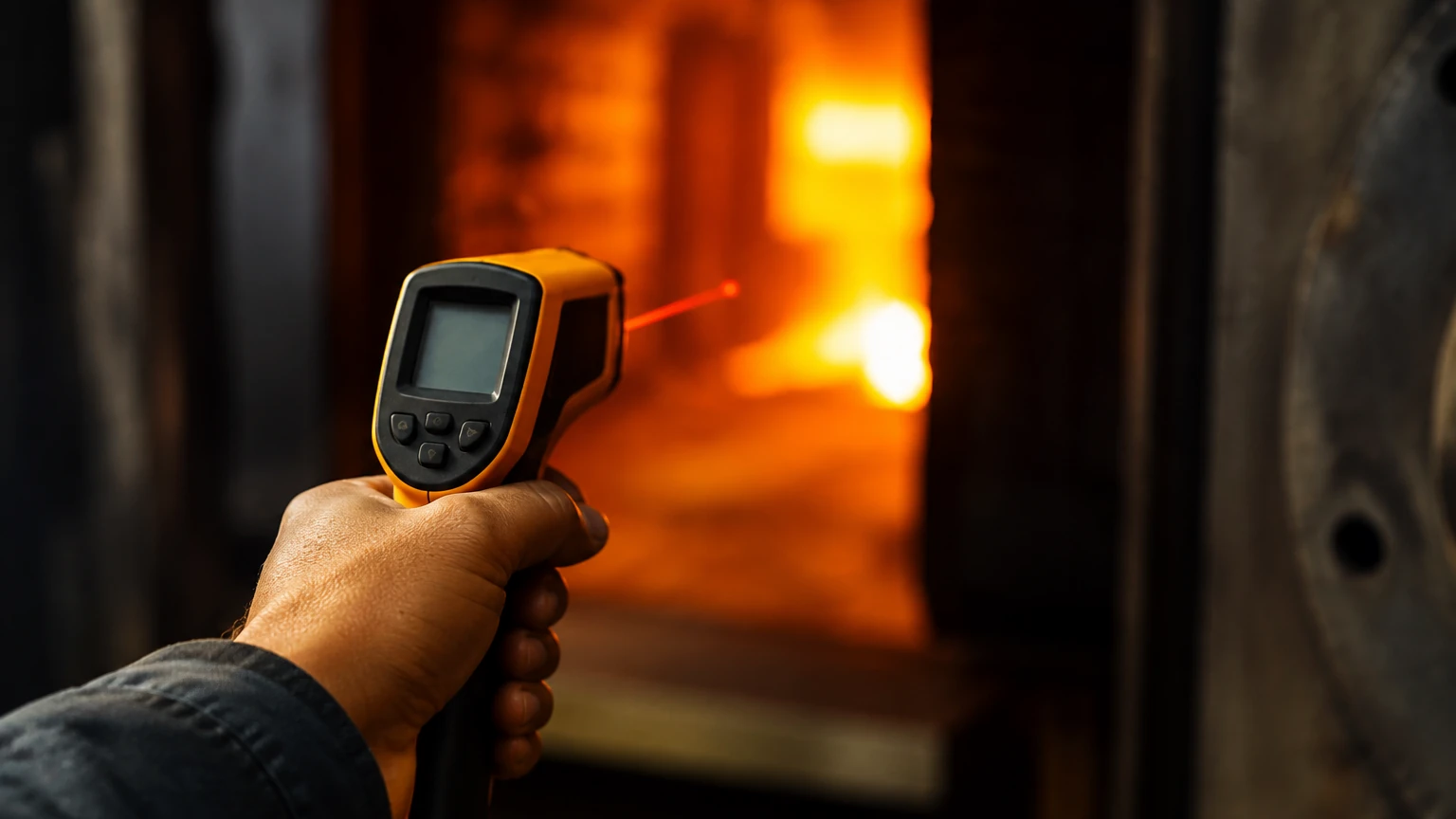
* Handheld (Portable): These are used for spot-checks, maintenance audits, and identifying "hot spots" in electrical panels or bearings. While versatile, they are not suitable for continuous process control.
Practical Selection Table
The following table outlines typical configurations for an infrared thermometer for industrial use across various applications:
| Application | Typical Temp Range | Spectral Range | Recommended D:S | Housing Requirement |
| :— | :— | :— | :— | :— |
| Water Treatment | -20°C to 80°C | 8 – 14 μm | 12:1 to 30:1 | IP65 / Plastic or SS |
| Molten Metal | 600°C to 1800°C | 0.85 – 1.1 μm | 100:1 or higher | Cooling Jacket / SS |
| Food Processing | -30°C to 200°C | 8 – 14 μm | 15:1 | Food-grade SS |
| Glass Forming | 200°C to 1500°C | 5.0 μm | 50:1 | Air Purge Collar |
| Chemical Storage| -40°C to 120°C | 8 – 14 μm | 30:1 | Explosion-proof (ATEX) |
Installation and Environmental Considerations
Industrial environments are rarely ideal for sensitive optics. Proper installation is the difference between a high-maintenance headache and a reliable data source.
1. Optical Path Obstructions: Dust, steam, and smoke can attenuate the IR signal. In such environments, an air purge collar is essential. This accessory uses compressed air to create a positive pressure zone in front of the lens, keeping it clean and clear.
2. Ambient Temperature Limits: Most IR sensor electronics are rated for operation up to 50°C or 60°C. If the sensor is mounted near a furnace or boiler, a water-cooled or air-cooled jacket must be used to prevent thermal damage.
3. Alignment: For fixed sensors, precise alignment is necessary. Many industrial units include integrated laser pointers or through-the-lens sighting to ensure the sensor is aimed exactly at the target.
Integration with Level Measurement Systems
In the B2B sector, instruments rarely work in isolation. As a manufacturer of level measurement solutions, Welk recognizes that temperature is a critical variable in level accuracy. Integrating an infrared thermometer for industrial use can enhance the performance of several level technologies:
* Ultrasonic Level Sensors: The speed of sound is temperature-dependent. While many ultrasonic sensors include an internal temperature probe, this only measures the air temperature at the sensor face. An IR thermometer can measure the actual surface temperature of the liquid, providing a more accurate compensation profile for the sound wave's travel time.
* Hydrostatic Level Transmitters: These sensors measure the pressure exerted by a liquid column. Since liquid density changes with temperature, real-time thermal data allows the control system to calculate the true mass or volume more effectively.
* Radar Level Meters: While radar is generally immune to temperature fluctuations, extreme thermal gradients can affect the dielectric constant of certain vapors. Monitoring the vessel's surface temperature helps in characterizing these process conditions.
For comprehensive process monitoring, engineers often review the latest technical specifications on the Main Page to ensure that temperature and level instruments are compatible in terms of signal output and environmental ratings.
Limitations and Risks
Despite their versatility, IR thermometers have specific limitations that must be addressed during the engineering phase:
* Reflection Errors: When measuring low-emissivity targets (like shiny metals), the sensor may pick up reflected heat from nearby high-temperature sources. This results in a "false high" reading.
* Surface Measurement Only: IR thermometers only measure the surface temperature. They cannot see through a vessel wall to measure the liquid inside, nor can they measure the internal temperature of a bulk solid unless the surface is representative of the core.
* Atmospheric Interference: Certain gases (like CO2) can be opaque to specific IR wavelengths. If the path between the sensor and the target is filled with such gases, the reading will be inaccurate.
Frequently Asked Questions (FAQ)
Q: Can an infrared thermometer measure through glass?
A: Standard 8-14 μm IR thermometers cannot measure through glass because glass is opaque in that spectral range; the sensor will measure the temperature of the glass surface itself. To measure through glass, a specialized sensor operating at a shorter wavelength (e.g., 1.0 to 3.9 μm) is required.
Q: How often should an industrial IR thermometer be calibrated?
A: For critical process control, annual calibration is recommended. In harsh environments with high dust or vibration, semi-annual checks using a portable blackbody calibrator may be necessary to ensure the optics haven't shifted or become obscured.
Q: What is the difference between a single-color and a two-color (ratio) pyrometer?
A: A single-color thermometer measures energy at one wavelength. A two-color pyrometer measures energy at two different wavelengths and calculates the ratio. Two-color units are superior in environments where the target is partially obscured by dust or where the target's emissivity changes during the process.
Q: How do I handle measurement on a stainless steel tank?
A: Because stainless steel has low and variable emissivity, it is best to apply a small patch of high-emissivity "IR tape" or matte black paint to the measurement spot. If the process allows, this provides a stable emissivity of 0.95, ensuring a highly accurate reading.
Conclusion
The implementation of an infrared thermometer for industrial use provides a non-invasive, fast, and reliable method for thermal monitoring. By understanding the underlying physics of emissivity and spectral response, and by carefully selecting hardware based on D:S ratios and environmental conditions, industrial operators can significantly improve process consistency. Whether used as a standalone tool or as a compensatory input for level measurement systems, IR thermometry remains an indispensable asset in the modern industrial toolkit. For further technical details on integrating these technologies into your specific application, we encourage you to explore the resources available on our Main Page.