Pressure Tranducer
Pressure Tranducer
In the field of industrial process control, the ability to accurately measure the height or volume of a liquid within a vessel is fundamental. While there are many technologies available for this task—ranging from non-contact radar to ultrasonic sensors—the use of a pressure tranducer remains one of the most reliable and cost-effective methods for liquid level monitoring. By leveraging the principles of hydrostatics, these instruments convert the physical force exerted by a liquid column into a standardized electrical signal, enabling precise automation and inventory management.
Selecting the right pressure tranducer requires a deep understanding of how pressure relates to depth, the mechanical construction of the sensor, and the specific environmental challenges of the application. This guide provides a technical overview of pressure measurement principles, selection criteria, and installation best practices for engineering professionals.
Fundamental Principles of Hydrostatic Level Measurement
Before selecting a sensor, it is essential to understand the physics that allow a pressure tranducer to function as a level meter. The most common method used is hydrostatic level measurement, which relies on the relationship between the weight of a liquid and the pressure it exerts at a specific depth.
The Hydrostatic Equation
The pressure at the bottom of a tank is directly proportional to the height of the liquid above it. This is expressed by the formula:
P = ρ × g × h
Where:
* P is the hydrostatic pressure (measured in Pascals or bar).
* ρ (Rho) is the density of the liquid (kg/m³).
* g is the acceleration due to gravity (approximately 9.81 m/s²).
* h is the height of the liquid column (meters).
Because gravity is constant and the density of many liquids (like water) is relatively stable, the pressure measured by the sensor correlates directly to the level. If the density of the liquid changes—for example, due to significant temperature fluctuations or chemical concentration changes—the pressure tranducer must be calibrated or compensated to maintain accuracy.
Transduction Mechanisms
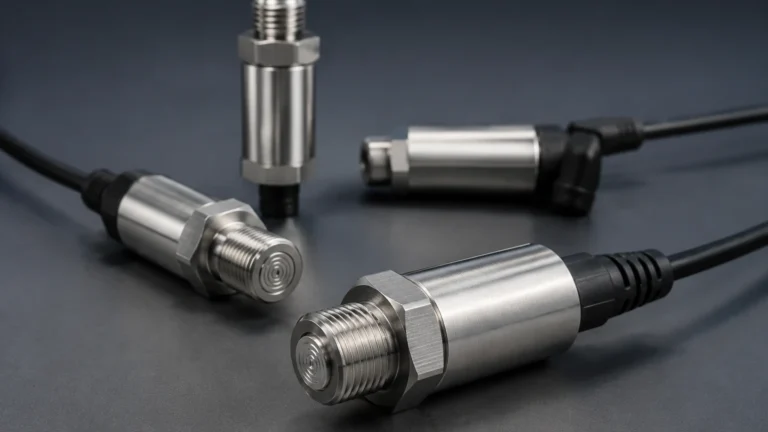
A pressure transducer typically contains a sensing element, such as a piezoresistive silicon chip or a ceramic capacitive diaphragm. When pressure is applied to the diaphragm, it deforms slightly. This mechanical deformation changes the electrical resistance or capacitance of the sensing element. The internal electronics of the device then convert this change into an electrical output, such as 4-20mA, 0-10V, or a digital signal like RS485 (Modbus).
Types of Pressure Transducers for Level Applications
Not all pressure sensors are installed the same way. Depending on the tank geometry and the nature of the liquid, engineers generally choose between two primary configurations.
Submersible Level Transmitters
These are designed to be lowered directly into the liquid. The sensor is housed in a waterproof stainless steel or plastic casing and is suspended by a specialized cable. This cable contains a vent tube that allows the sensor to reference atmospheric pressure, ensuring that changes in weather or altitude do not affect the level reading. Submersible units are ideal for open wells, reservoirs, and deep boreholes.
External (Threaded or Flanged) Transducers
For closed tanks or process vessels, a pressure tranducer is often mounted to the outside of the tank via a threaded NPT/G connection or a flange. The sensor is placed at the lowest point of the measurement range (the zero point). This configuration is easier to maintain as the sensor can be isolated from the tank using a valve without needing to empty the entire vessel.
Differential Pressure (DP) Transmitters
In pressurized tanks—such as those containing liquefied gases or chemical reactants—the air space above the liquid is often under pressure. A standard gauge pressure sensor would provide an incorrect reading because it would measure both the liquid weight and the headspace pressure. A differential pressure transmitter uses two ports to measure the difference between the bottom of the tank and the top, effectively "canceling out" the headspace pressure to isolate the liquid level.
Selection Criteria for Industrial Applications
Choosing a pressure tranducer involves more than just matching a pressure range. Engineers must evaluate the chemical compatibility, thermal environment, and required precision. The following table summarizes key evaluation criteria for different industrial scenarios.
Practical Selection Table
| Application | Recommended Sensor Type | Key Consideration | Material Recommendation |
| :— | :— | :— | :— |
| Clean Water Storage | Submersible Hydrostatic | Cost-effectiveness and ease of install | 304 or 316 Stainless Steel |
| Corrosive Chemicals | Flanged External Transducer | Chemical resistance of the diaphragm | PTFE, Hastelloy, or Ceramic |
| Wastewater / Sludge | Flush Diaphragm Transducer | Prevention of clogging and buildup | 316L SS with non-clogging design |
| High-Temperature Oil | Remote Seal DP Transmitter | Protecting electronics from heat | Capillary tube with high-temp fill fluid |
| Deep Boreholes | High-Pressure Submersible | Cable tensile strength and lightning protection | Polyurethane or ETFE cable |
Installation Considerations and Best Practices
Even the most accurate pressure tranducer will fail to provide reliable data if it is installed incorrectly. Proper placement and protection are vital for the longevity of the instrument.
1. Zero Point Calibration: The sensor should be installed at the lowest point of the liquid you wish to measure. If the sensor is mounted 10 cm above the bottom of the tank, it will not be able to detect the final 10 cm of liquid (the "dead zone").
2. Atmospheric Venting: For gauge pressure sensors, the vent tube in the cable must remain unobstructed. It should be terminated in a dry environment or protected by a desiccant filter to prevent moisture from entering the sensor housing, which can cause internal corrosion or signal drift.
3. Avoiding Turbulence: In tanks with agitators or high-velocity inlet flows, the pressure tranducer should be shielded. A "stilling well" (a vertical pipe with small holes) can be used to surround the sensor, protecting it from mechanical stress and ensuring a stable pressure reading.
4. Electrical Protection: In outdoor installations, such as reservoirs or water towers, sensors are susceptible to lightning strikes. Using a transducer with built-in surge protection and ensuring proper grounding of the cable shield is critical.

Limitations and Common Risks
While pressure transducers are versatile, they are not suitable for every environment. Understanding their limitations is key to avoiding project failures.
* Density Sensitivity: As noted in the hydrostatic equation, the sensor measures weight, not volume or height directly. If the liquid density changes significantly (e.g., a tank that switches between storing diesel and water), the level reading will be inaccurate unless the controller is updated with the new density value.
* Clogging and Fouling: In liquids with high solids content, such as paper pulp or thick wastewater, the small pressure port of a standard transducer can become blocked. In these cases, a flush diaphragm design—where the sensing surface is flat against the process—is required.
* Mechanical Damage: The diaphragms in these sensors are often very thin (to remain sensitive). Dropping a submersible sensor or poking the diaphragm with a tool during cleaning can permanently damage the unit.
For complex applications where pressure-based measurement may not be ideal, it is often helpful to Review product options and application support to compare hydrostatic methods with radar or ultrasonic alternatives.
Frequently Asked Questions (FAQs)
Q: Can a pressure tranducer be used in a vacuum tank?
A: Yes, but you must use an absolute pressure sensor or a differential pressure transmitter. A standard gauge sensor will not provide accurate readings in a vacuum because its reference point is the outside atmosphere.
Q: How often should a hydrostatic level sensor be calibrated?
A: For most industrial applications, an annual calibration check is recommended. However, in critical chemical processes or high-accuracy custody transfer, semi-annual checks may be necessary to account for potential sensor drift.
Q: What is the difference between a pressure transducer and a pressure transmitter?
A: Technically, a transducer converts pressure into a voltage signal (like 0-5V), while a transmitter converts it into a current signal (like 4-20mA). In modern industrial parlance, the terms are often used interchangeably, but 4-20mA "transmitters" are preferred for long-distance wiring because they are less susceptible to electrical noise.
Q: Can I cut the cable of a submersible pressure tranducer?
A: Most manufacturers discourage cutting the cable because it contains the atmospheric vent tube. If the cable is cut and spliced incorrectly, moisture can enter the tube, leading to sensor failure. If you must shorten the cable, use a specialized junction box designed for vented cables.
Conclusion
The pressure tranducer remains a cornerstone of industrial level measurement due to its simplicity and reliability. By understanding the relationship between pressure and depth, and by carefully selecting materials that match the process media, engineers can implement robust monitoring solutions. Whether you are managing a simple water tank or a complex chemical reactor, the data provided by these sensors is essential for maintaining safety, efficiency, and environmental compliance. For those seeking a comprehensive range of measurement technologies, visiting the Main Page of a professional manufacturer like Welk can provide further technical specifications and customized OEM/ODM options.