Ion Gauge Pressure Measurement
Ion Gauge Pressure Measurement
In the landscape of industrial process control, pressure measurement is often categorized by the environment in which it operates. While standard industrial applications deal with atmospheric or positive pressures—frequently monitored alongside level measurement solutions like those found on the Main Page—specialized sectors such as semiconductor manufacturing, aerospace testing, and high-energy physics require the measurement of high vacuum (HV) and ultra-high vacuum (UHV). At these extremes, mechanical sensors like diaphragms or bellows fail to provide the necessary sensitivity. This is where ion gauge pressure measurement becomes the primary standard.
Ionization gauges do not measure pressure by physical force. Instead, they measure the density of gas molecules by ionizing them and quantifying the resulting electrical current. This article provides a technical overview of ion gauge principles, selection criteria, and practical installation guidance for engineering professionals.
Fundamental Principles of Ionization Gauges
Pressure is traditionally defined as force per unit area. However, in a vacuum environment (below $10^{-3}$ mbar), the number of gas molecules is so small that the force they exert is negligible. Ion gauge pressure measurement relies on the principle of gas ionization. By converting neutral gas molecules into charged ions, the instrument can generate a measurable electrical signal proportional to the molecular density, which is then converted into a pressure reading.
The Ionization Process
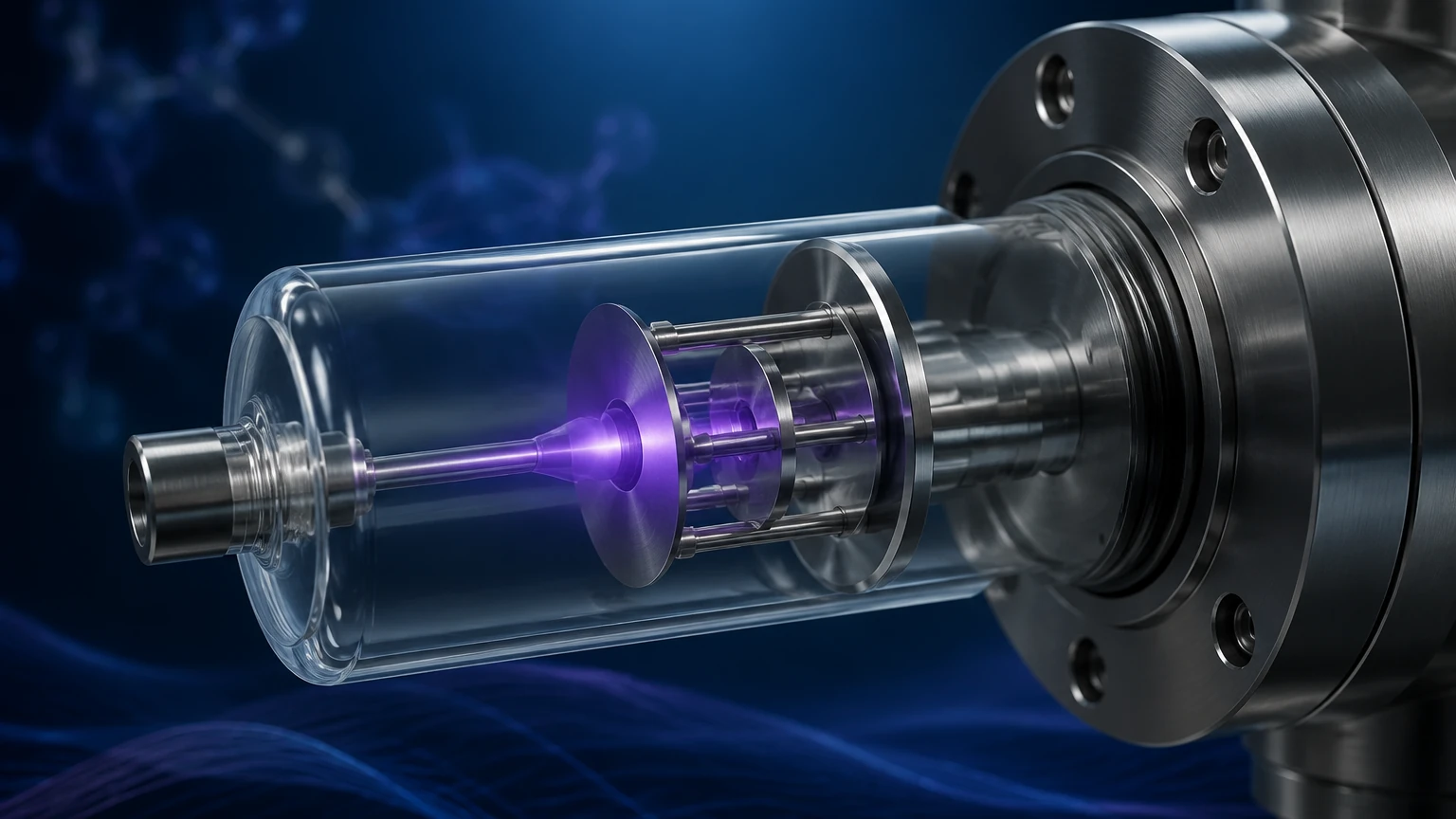
The core mechanism involves three main components: an electron source, an accelerating grid, and an ion collector.
1. Electron Emission: Electrons are generated either through thermionic emission (heating a filament) or a high-voltage cold discharge.
2. Collisional Ionization: These electrons are accelerated through the vacuum space. When an electron strikes a gas molecule, it may knock an electron loose, creating a positive ion.
3. Ion Collection: A negatively charged collector attracts these positive ions. The resulting "ion current" ($I_c$) is measured by sensitive electronics.
Mathematically, the relationship is expressed as:
$$I_c = S \cdot I_e \cdot P$$
Where:
* $I_c$ is the collector current.
* $S$ is the sensitivity factor (specific to the gauge design and gas type).
* $I_e$ is the emission current (the flow of electrons).
* $P$ is the pressure.
Because the sensitivity $S$ depends on the probability of an electron hitting a molecule, it varies based on the size and properties of the gas molecule being measured. Most gauges are calibrated for Nitrogen ($N_2$), requiring correction factors for other gases like Helium or Argon.
Types of Ion Gauge Pressure Measurement
There are two primary categories of ionization gauges used in industrial and laboratory vacuum systems: Hot Cathode and Cold Cathode.
Hot Cathode Gauges (Bayard-Alpert)
The Bayard-Alpert (B-A) gauge is the most common hot cathode design. It utilizes a thin heated filament (the cathode) to emit electrons. These electrons oscillate around a fine wire grid before eventually being collected. This long path length increases the probability of ionizing gas molecules.
* Advantages: High accuracy, stable calibration, and the ability to measure down to $10^{-11}$ mbar.
* Disadvantages: The filament is fragile and can burn out if exposed to high pressure (above $10^{-2}$ mbar). The heat from the filament can also cause outgassing, potentially affecting the local pressure reading.
Cold Cathode Gauges (Penning or Inverted Magnetron)
Cold cathode gauges do not use a heated filament. Instead, they apply a high voltage (typically 2–4 kV) between an anode and a cathode. A permanent magnetic field is used to constrain electrons into a spiral path, creating a self-sustaining plasma discharge even at low pressures.
* Advantages: Extremely rugged, no filament to burn out, and can be cleaned if contaminated. They are often preferred for industrial applications where the vacuum might be "dirty" or subject to sudden pressure spikes.
* Disadvantages: Less accurate than hot cathode gauges, prone to "starting" delays at very low pressures, and susceptible to calibration drift over time.
Technical Evaluation and Selection Criteria
Selecting the correct instrument for ion gauge pressure measurement requires an analysis of the specific vacuum process. Engineers must balance the need for precision against the environmental conditions of the vacuum chamber.
Measurement Range
Standard ion gauges typically operate from $10^{-3}$ mbar down to $10^{-10}$ mbar. For UHV applications requiring measurements in the $10^{-12}$ mbar range, specialized Extractor Gauges or Helmer Gauges are required to minimize the "X-ray limit"—a phenomenon where electrons hitting the grid produce X-rays that eject electrons from the collector, creating a false background current.
Gas Composition
Since ion gauges are gas-species dependent, the user must know the dominant gas in the system. For example, the sensitivity for Helium is approximately 0.18 times that of Nitrogen, while for Xenon, it is nearly 3 times higher. If the gas mixture is unknown, the pressure reading is only an approximation.
Selection Table: Hot Cathode vs. Cold Cathode
| Feature | Hot Cathode (Bayard-Alpert) | Cold Cathode (Inverted Magnetron) |
| :— | :— | :— |
| Typical Range | $10^{-3}$ to $10^{-11}$ mbar | $10^{-2}$ to $10^{-9}$ mbar |
| Accuracy | ±15% to ±20% | ±30% to ±50% |
| Robustness | Fragile (Filament) | Very High |
| Heat Generation | Significant | Minimal |
| Contamination Resistance | Low | High |
| Maintenance | Filament replacement | Periodic internal cleaning |
Installation and Operational Guidelines
Proper installation is critical for accurate ion gauge pressure measurement. Because the sensor measures local gas density, any factor that creates a pressure gradient between the gauge and the process chamber will result in error.
1. Orientation and Placement
* Port Location: The gauge should be mounted as close to the process volume as possible. Avoid placing it near vacuum pumps (where pressure is lower) or gas inlets (where pressure is higher).
* Debris Protection: Mount the gauge horizontally or with the opening facing downward. This prevents particulates or flakes from falling into the gauge structure, which can cause electrical shorts or noise.
* Line of Sight: In some processes, evaporated materials (like in thin-film deposition) can enter the gauge and coat the electrodes. Using an elbow or a baffle can protect the gauge, though it may slightly increase response time.
2. Electrical and Magnetic Interference
Ion gauges operate with very small currents (picoamps to nanoamps). They must be shielded from electromagnetic interference (EMI). Furthermore, because cold cathode gauges rely on internal magnets, they should not be placed near other sensitive magnetic equipment, nor should they be placed in strong external magnetic fields which could disrupt the electron trajectory.
3. Degassing
In high vacuum systems, gas molecules adsorb onto the metal surfaces of the gauge grid. This can lead to a higher local pressure reading than the actual chamber pressure. Hot cathode gauges often feature a "Degas" function, which passes a high current through the grid or uses electron bombardment to heat the electrodes and drive off these molecules. Degassing should be performed after the system reaches $10^{-5}$ mbar or lower.
Limitations and Common Risks
While ion gauge pressure measurement is the industry standard for high vacuum, it is not without limitations.
* The X-Ray Limit: As mentioned, X-rays produced within the gauge can create a photoelectric effect on the collector. This produces a constant background current that sets a "floor" for the lowest pressure the gauge can measure.
* Ion Pumping: The gauge itself acts as a small vacuum pump. Ions that strike the collector or walls are sometimes buried or chemically reacted, effectively removing gas from the system. In very small volumes, this can lead to an artificially low pressure reading.
* Chemical Sensitivity: Certain gases, such as hydrocarbons or silicones, can decompose on hot filaments, leading to the buildup of insulating layers. This changes the gauge sensitivity and can eventually lead to failure.
* Pressure Caps: Attempting to operate a hot cathode gauge at pressures above $10^{-2}$ mbar will lead to rapid oxidation of the filament (if it is Tungsten) or chemical changes that shorten its lifespan.
Integrating Vacuum and Process Level Control
In many B2B industrial environments, vacuum systems do not operate in isolation. They are often part of larger chemical processing or material storage units. For instance, a vacuum distillation column requires both precise vacuum monitoring and accurate liquid level measurement.
Welk provides a range of level measurement instruments—including radar and ultrasonic sensors—that integrate with industrial automation frameworks. While the ion gauge handles the internal vacuum state, Welk's instruments ensure that the physical media within the system are managed effectively. For more information on integrating these various measurement technologies into a cohesive control system, users should consult the Main Page for technical specifications on level transmitters and switches.
Frequently Asked Questions (FAQ)
Q: Can I use an ion gauge to measure atmospheric pressure?
No. Ion gauges are designed strictly for vacuum. Exposing a hot cathode gauge to atmosphere while powered on will destroy the filament instantly. Cold cathode gauges will not sustain a discharge at high pressures and may suffer from internal arcing.
Q: Why does my ion gauge show a different pressure than my Pirani gauge?
Pirani gauges measure thermal conductivity and are typically used for "rough" vacuum ($10^{-3}$ to 1000 mbar). There is often a small overlap where both gauges work. Differences are usually due to the different gas sensitivity factors of the two technologies or the fact that the Pirani gauge is nearing its lower limit while the ion gauge is at its upper limit.
Q: How do I know when to replace a hot cathode filament?
Most controllers will provide an error message if the filament is broken (open circuit). However, you should consider replacement if you notice significant calibration drift or if the filament requires increasing amounts of power to maintain the emission current.
Q: Are ion gauges sensitive to vibration?
Hot cathode gauges with fine filaments can be sensitive to extreme vibration or mechanical shock, which may cause the filament to sag or break. Cold cathode gauges are significantly more vibration-resistant and are preferred for mobile or high-vibration industrial equipment.
By understanding the physics and operational requirements of ion gauge pressure measurement, engineers can ensure high-accuracy data and long-term reliability in their vacuum-critical processes. Whether managing a semiconductor cleanroom or a large-scale industrial furnace, the proper application of these sensors is vital for maintaining process integrity.