Isfet Ph Meter
Isfet Ph Meter
In the landscape of industrial liquid analysis, the transition from traditional glass-based sensors to solid-state technology represents a significant shift in process reliability and safety. The Isfet ph meter (Ion-Sensitive Field-Effect Transistor) has emerged as a robust alternative to the standard glass electrode, particularly in environments where fragility, hygiene, and maintenance overhead are critical concerns. For engineers and plant managers integrated into the Welk ecosystem of industrial measurement, understanding the nuances of ISFET technology is essential for optimizing process control loops.
While Welk is widely recognized for precision in level measurement—ranging from radar level meters to ultrasonic sensors—the integration of liquid analytical parameters like pH is often a parallel requirement in water treatment, chemical processing, and food production. This guide provides a technical deep dive into the operation, selection, and application of ISFET pH sensors within an industrial context.
1. Measurement Principle of ISFET Technology
To understand the Isfet ph meter, one must first look at the traditional MOSFET (Metal-Oxide-Semiconductor Field-Effect Transistor). In a standard MOSFET, the current flowing between a source and a drain is controlled by the voltage applied to a metal gate. In an ISFET, the metal gate is removed, exposing the underlying insulator layer (typically silicon nitride, aluminum oxide, or tantalum pentoxide) directly to the process liquid.
The Semiconductor Interface
When the sensor is immersed in a solution, the surface of the insulator layer undergoes a chemical reaction with the hydrogen ions ($H^+$) present in the liquid. This reaction creates an electrical surface potential. Because the insulator is in direct contact with the semiconductor channel, this surface potential acts as the "gate voltage."
As the concentration of hydrogen ions changes (i.e., the pH changes), the gate voltage fluctuates accordingly, modulating the current flowing through the transistor. This change in current is measured and converted into a pH value. Unlike glass electrodes, which rely on the diffusion of ions into a hydrated gel layer on a glass membrane, the ISFET measures the charge effect at the interface, leading to a much faster response time.
The Reference System
Like all potentiometric pH measurements, the ISFET requires a reference electrode to provide a stable potential against which the gate voltage is measured. In most industrial Isfet ph meter designs, this is a standard silver/silver chloride (Ag/AgCl) reference system. The integration of a solid-state sensor with a high-quality reference junction is what determines the overall stability and lifespan of the instrument.
2. Advantages over Traditional Glass Electrodes
The adoption of ISFET technology is driven by several practical engineering advantages that address the inherent weaknesses of glass sensors.
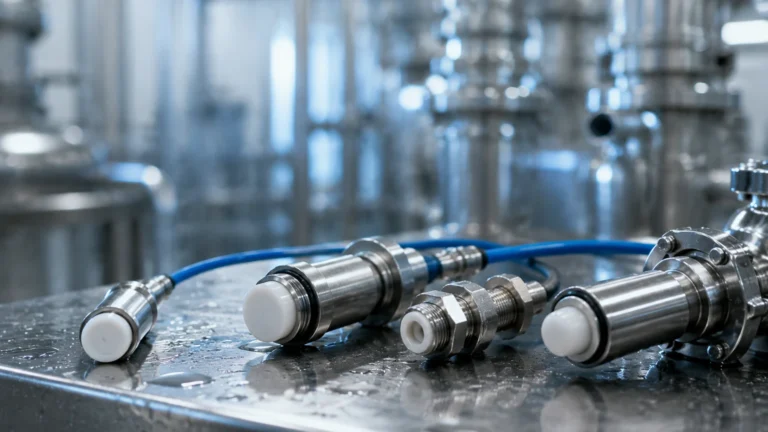
* Glass-Free Construction: The most significant benefit is the elimination of glass. In food and beverage production or pharmaceutical manufacturing, a broken glass electrode can lead to entire batch rejections due to contamination risks. ISFET sensors are typically housed in PEEK (Polyether ether ketone) or stainless steel, making them virtually unbreakable.
* Fast Response Times: Because the ion-sensing mechanism occurs at the surface of the semiconductor rather than through a membrane, ISFET sensors respond almost instantaneously to pH fluctuations. This is critical in high-speed dosing applications or neutralization tanks.
* Dry Storage Capabilities: Traditional glass electrodes must be kept hydrated to maintain the functionality of the glass membrane. If they dry out, they may require hours of rehydration or become permanently damaged. ISFET sensors can be stored dry for extended periods and returned to service with minimal conditioning.
* Low Temperature Performance: Glass electrodes often become sluggish at low temperatures due to increased impedance of the glass membrane. ISFET sensors maintain high sensitivity even in cold process fluids (e.g., 0°C to 10°C).
3. Selection Criteria for Industrial ISFET pH Meters
Selecting the right Isfet ph meter requires a detailed analysis of the process conditions. While the technology is robust, it is not a universal replacement for glass in every scenario. The following table outlines key selection parameters for industrial applications.
Selection Table: ISFET vs. Process Requirements
| Parameter | Requirement | ISFET Suitability | Engineering Consideration |
| :— | :— | :— | :— |
| Temperature | -5°C to 105°C | Excellent | Ensure the transmitter supports automatic temperature compensation (ATC). |
| Pressure | Up to 10 bar | High | Solid-state design handles pressure shocks better than glass bulbs. |
| Hygienic Standards | CIP/SIP Cleaning | Excellent | Choose sensors with 3-A or EHEDG certification and PEEK bodies. |
| Chemical Compatibility | Strong Solvents | Moderate | Check compatibility of the sensor body material (PEEK/Stainless) and the reference junction. |
| Light Sensitivity | Outdoor/Exposed | Moderate | ISFETs are light-sensitive; ensure the sensor housing provides adequate shielding. |
When evaluating these instruments, it is also important to consider the broader instrumentation architecture. For comprehensive process monitoring, reviewing the Main Page of your primary equipment provider can help identify compatible transmitters and mounting hardware that unify pH and level data into a single control interface.
4. Installation and Mounting Considerations
Proper installation is paramount to the longevity of an Isfet ph meter. Unlike level meters, which are often non-contact (like radar), pH sensors are analytical instruments that must be in direct contact with the process media.
Orientation
One of the unique advantages of ISFET sensors is their mounting flexibility. Traditional glass electrodes often have a limited mounting angle (usually within 15° to 90° from the horizontal) to ensure the internal electrolyte stays in contact with the bulb. Many ISFET designs can be mounted in any orientation, including upside down, which is particularly useful in tight piping configurations or specialized reactor vessels.
Flow Velocity and Placement
* Avoid Stagnation: Place the sensor in a location with consistent flow to ensure the sample is representative of the process.
* Minimize Turbulence: While ISFETs are physically rugged, extreme turbulence can cause cavitation at the sensor face, leading to signal noise.
* Accessibility: Ensure the sensor is mounted in a retractable housing if the process cannot be shut down for routine calibration and cleaning.
Integration with Level Systems
In many wastewater treatment applications, pH sensors are installed alongside hydrostatic level transmitters. While the level transmitter monitors the volume in a tank, the Isfet ph meter ensures the effluent meets regulatory standards before discharge. Centralizing these inputs into a single PLC (Programmable Logic Controller) via 4-20mA or Modbus RTU protocols simplifies site management.

5. Maintenance and Calibration Protocols
While ISFET sensors are "low maintenance" compared to glass, they are not "no maintenance." Factual data shows that the reference electrode remains the primary point of failure in almost all pH systems.
1. Cleaning: ISFET sensors are sensitive to fouling from oils, fats, and proteins. In food applications, a regular cleaning cycle using a mild detergent or specialized enzymatic cleaner is required. Because the sensor is solid-state, it can withstand more aggressive mechanical cleaning (soft brushing) than a fragile glass bulb.
2. Calibration: Regular two-point calibration using standard buffers (typically pH 4.01 and pH 7.00) is necessary. ISFETs can exhibit a slight "drift" during the first few days of operation as the semiconductor surface stabilizes.
3. Light Sensitivity: It is a physical property of semiconductors to react to photons. If the sensor is removed from a dark pipe for calibration in bright sunlight, the reading may shift. Always calibrate in lighting conditions similar to the process environment or use a light-shielded calibration cup.
6. Limitations and Known Constraints
To maintain an objective engineering perspective, one must acknowledge the limitations of the Isfet ph meter:
* Chemical Interference: Certain chemicals, particularly highly oxidizing agents or specific organic solvents, can degrade the insulator layer over time.
* Drift: While modern electronics have mitigated much of this, ISFETs may show higher long-term drift compared to high-end specialized glass electrodes in stable, laboratory-grade environments.
* Cost: The initial acquisition cost of an ISFET sensor and its dedicated transmitter is often higher than a basic glass electrode setup. However, the Total Cost of Ownership (TCO) is frequently lower due to reduced breakage and longer replacement intervals in harsh environments.
7. Frequently Asked Questions (FAQ)
Q: Can an Isfet ph meter be used in high-temperature CIP (Clean-in-Place) processes?
A: Yes, many industrial ISFET sensors are designed to withstand temperatures up to 130°C for short durations during sterilization or cleaning cycles, provided the housing material (like PEEK) is rated for such temperatures.
Q: Do I need a special transmitter for an ISFET sensor?
A: Yes. ISFET sensors require a power supply for the transistor and specific signal processing that differs from the high-impedance input used by glass electrodes. Most modern analytical transmitters are multi-protocol and can support both, but this must be verified during the procurement phase.
Q: How long does an ISFET sensor typically last?
A: In standard water treatment applications, a lifespan of 12 to 24 months is common. In harsh chemical or high-fouling environments, this may be shorter, but the sensor will typically outlast a glass equivalent that would be prone to physical cracking.
Q: Is the ISFET sensor affected by flow rate?
A: The pH measurement itself is independent of flow, but the "streaming potential" (static charge buildup) can affect the reference electrode. ISFETs are generally less sensitive to these effects than glass electrodes, but proper grounding of the process piping is still recommended.
Conclusion
The Isfet ph meter represents a pinnacle of solid-state liquid analysis, offering the durability and safety required for modern industrial automation. By removing the "weakest link"—the glass membrane—manufacturers can achieve higher uptime and better compliance with safety standards like HACCP. When integrated with reliable level measurement and process control hardware, such as those found on the Main Page of leading instrumentation providers, the ISFET sensor becomes a cornerstone of a robust analytical strategy.
For engineers designing new systems or retrofitting existing ones, the choice of pH technology should be based on a balance of chemical compatibility, physical risk, and integration requirements. As industrial processes become more automated and less tolerant of manual maintenance, the shift toward ISFET and similar solid-state technologies is expected to accelerate.