Ishm
Ishm
The International School of Hydrocarbon Measurement (ISHM) represents one of the most significant technical educational forums for the petroleum and natural gas industries. For engineers and technicians involved in industrial level measurement, the standards and technical papers disseminated through ISHM provide a framework for accuracy, safety, and fiscal responsibility. In the context of level measurement, the teachings of ISHM often focus on the precision required for custody transfer and inventory management, where even a small error in level detection can result in significant financial discrepancies.
Selecting the right instrumentation requires a deep understanding of measurement principles, environmental variables, and the specific requirements of the media being measured. This guide explores the core technologies used in level measurement—radar, ultrasonic, and hydrostatic—and how they align with the rigorous technical expectations found in the ISHM curriculum.
Core Measurement Principles
Before selecting a level meter for industrial or hydrocarbon applications, it is essential to understand the physical principles governing the technology. Most modern level measurement solutions fall into three categories: Time-of-Flight (ToF), Pressure-based, and Mechanical/Magnetic.
Radar Level Measurement (Non-Contact)
Radar level meters operate on the Time-of-Flight (ToF) principle. The device emits high-frequency electromagnetic waves (typically in the 26 GHz or 80 GHz range) toward the product surface. These waves are reflected back to the sensor. The distance ($D$) is calculated using the formula:
$$D = \frac{c \cdot t}{2}$$
Where $c$ is the speed of light and $t$ is the measured transit time. In the oil and gas industry, Frequency Modulated Continuous Wave (FMCW) radar is preferred for its high accuracy. FMCW radar transmits a continuous signal with a constantly changing frequency. The difference between the transmitted and received frequency is directly proportional to the distance, allowing for precision within ±1 mm (0.04 inches) in ideal conditions.
Ultrasonic Level Measurement
Ultrasonic sensors also use the ToF principle but utilize sound waves instead of electromagnetic waves. A transducer emits a pulse that reflects off the surface of the media. The speed of sound is significantly slower than the speed of light and is highly dependent on the temperature and composition of the gas through which it travels. Because of this, ultrasonic sensors are best suited for atmospheric water treatment or simple chemical storage rather than complex hydrocarbon tanks where vapor layers can fluctuate.
Hydrostatic Level Measurement
Hydrostatic measurement is based on the principle that the pressure at a specific depth in a liquid is proportional to the height of the liquid column above it. The formula used is:
$$P = \rho \cdot g \cdot h$$
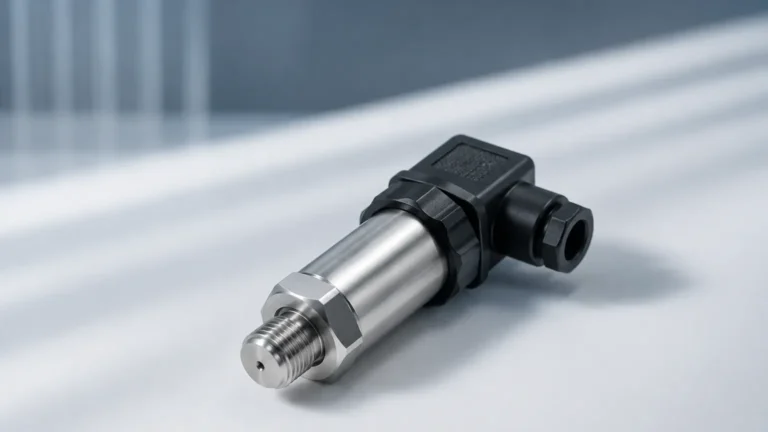
Where $P$ is the pressure, $\rho$ is the density of the liquid, $g$ is the gravitational constant, and $h$ is the height. This method is highly reliable for liquids with a constant density. However, in applications where the temperature fluctuates significantly, the density ($\rho$) changes, requiring compensation to maintain accuracy.
Technology Selection Criteria
When evaluating level measurement technologies for projects aligned with ISHM standards, engineers must compare the technical limitations against the process environment. The following table provides a comparison of the most common technologies offered by manufacturers like Welk.
| Feature | Radar (FMCW) | Ultrasonic | Hydrostatic | Magnetic Gauge |
| :— | :— | :— | :— | :— |
| Accuracy | High (±1mm) | Moderate (±0.25%) | High (±0.1%) | Moderate |
| Media Type | Liquids/Solids | Liquids | Liquids | Liquids |
| Pressure Limit | Up to 40 MPa | Atmospheric | Varies by sensor | Up to 32 MPa |
| Temp. Range | -60°C to +400°C | -40°C to +80°C | -40°C to +125°C | -196°C to +450°C |
| Vapor Impact | Minimal | High | None | None |
| Maintenance | Very Low | Low | Moderate | Moderate |
For a comprehensive look at specific product specifications and to find the right fit for your facility, you can review product options and application support on our Main Page.
ISHM and the Importance of Custody Transfer Accuracy
In the hydrocarbon industry, level measurement is often synonymous with "Custody Transfer." This is the point where ownership of the product changes hands. ISHM technical papers emphasize that measurement uncertainty must be minimized to prevent "shrinkage" or financial loss.
High-frequency radar (80 GHz) has become the industry standard for these applications. The narrow beam angle (often as small as 3 degrees) allows the signal to avoid internal tank obstructions such as heating coils, agitators, and ladders. This precision ensures that the volume calculations—derived from the level measurement and the tank strapping table—are as accurate as possible.
Installation Considerations and Best Practices
Even the most advanced level meter will fail to provide accurate data if installed incorrectly. Based on engineering best practices discussed at ISHM and similar technical forums, several factors must be considered during the design phase:
1. Nozzle Height and Diameter: For radar and ultrasonic sensors, the nozzle should be as short as possible. If a nozzle is too long or narrow, it can create "ringing" or parasitic reflections that interfere with the surface signal.
2. Obstruction Clearance: Sensors should be mounted away from the tank wall to avoid signal interference. A general rule is to maintain a distance of at least 200 mm (7.8 inches) from the wall for every 10 meters (32.8 feet) of tank height.
3. Stilling Wells: In tanks with heavy foam, turbulence, or floating roofs, a stilling well (a vertical pipe) is often used. The level sensor measures the liquid inside the pipe, which is protected from surface disturbances. This is a common practice in crude oil storage.
4. Density Compensation: For hydrostatic transmitters, if the tank is pressurized, a differential pressure (DP) setup or a dual-sensor system must be used to subtract the head pressure from the total pressure to isolate the liquid level.

Limitations and Technical Challenges
While modern instrumentation is robust, every technology has its "blind spots":
* Dielectric Constant (εr): Radar relies on the reflectivity of the media. Hydrocarbons often have low dielectric constants (εr < 2.0), which means they reflect less energy. Special high-sensitivity radar antennas or guided wave radar (GWR) may be required for these fluids.
* Vapor and Dust: Ultrasonic waves can be absorbed by heavy dust or scattered by dense vapors (such as steam or heavy hydrocarbon gases). In these environments, non-contact radar is generally more reliable.
* Coating and Buildup: In applications involving bitumen or heavy crude, material can build up on the sensor face. While some radar units feature "self-cleaning" designs or air purges, hydrostatic and magnetic gauges may require more frequent manual cleaning.
Frequently Asked Questions (FAQ)
Q: How often should level meters be calibrated according to ISHM-related standards?
A: Calibration frequency depends on whether the application is for process control or custody transfer. For custody transfer, annual or semi-annual verification against a manual dip tape or a master meter is common. For general process control, a check every 2 to 3 years may suffice.
Q: Can one sensor handle both liquid and foam levels?
A: Most radar sensors are designed to penetrate foam to measure the liquid level underneath. However, if the foam is extremely dense and metallic in nature, it may reflect the signal. Ultrasonic sensors almost always reflect off the top of the foam.
Q: What is the benefit of 80 GHz radar over 26 GHz radar?
A: The primary benefit is the narrow beam angle and the smaller antenna size. An 80 GHz radar can often be installed on smaller nozzles while providing better signal separation from noise and obstructions.
Q: Is hydrostatic measurement suitable for outdoor tanks in cold climates?
A: Yes, but the impulse lines or the sensor diaphragm must be protected from freezing. Additionally, if the liquid density changes significantly with temperature, the system needs a temperature probe to calculate the corrected level.
Conclusion
Understanding the technical nuances of ISHM standards is vital for any professional managing hydrocarbon assets. By selecting level measurement instruments that align with these rigorous requirements—whether it be high-accuracy radar for custody transfer or robust hydrostatic transmitters for deep-well monitoring—operators can ensure both safety and profitability. When planning your next installation, always prioritize the physical properties of your media and the environmental constraints of your site to select the most effective measurement technology.