Lake Level Monitoring Equipment
Lake Level Monitoring Equipment
Monitoring the water levels of lakes, reservoirs, and open basins is a critical task for environmental management, flood prevention, and industrial water resource planning. Unlike closed tanks, lake environments present unique challenges including vast surface areas, varying weather conditions, and the need for remote, low-power operation. Selecting the right lake level monitoring equipment requires a deep understanding of sensor physics and the specific environmental variables of the site.
Industrial-grade level measurement instruments, such as those provided by Welk, offer the precision and durability needed for these demanding applications. This guide explores the primary measurement technologies, selection criteria, and installation best practices for engineers and project managers.
Measurement Principles for Lake Level Monitoring
To choose the appropriate lake level monitoring equipment, one must first understand the underlying physics of the most common sensor types. The three primary technologies used in open-water environments are radar, ultrasonic, and hydrostatic pressure sensors.
Radar Level Measurement (Non-Contact)
Radar level meters operate on the Time-of-Flight (ToF) principle. The sensor emits high-frequency electromagnetic pulses (typically in the 26GHz or 80GHz range) toward the water surface. These pulses are reflected back to the sensor. By measuring the time it takes for the pulse to travel to the surface and back, the device calculates the distance based on the constant speed of light.
* Advantages: Radar is unaffected by air temperature, wind, or humidity. It provides high precision (often within ±2mm) and is ideal for long-range measurements up to 30 meters (approx. 98 feet) or more.
* Suitability: Best for large reservoirs and lakes where high accuracy is required regardless of weather conditions.
Ultrasonic Level Measurement (Non-Contact)
Similar to radar, ultrasonic sensors use the ToF principle but utilize sound waves instead of electromagnetic waves. The sensor emits an ultrasonic pulse that reflects off the water surface. The distance is calculated based on the speed of sound.
* Advantages: These sensors are generally more cost-effective than radar units and are suitable for shorter ranges (typically up to 15 meters or 49 feet).
* Limitations: The speed of sound is heavily influenced by air temperature. While most industrial ultrasonic sensors include temperature compensation, extreme gradients or high winds can still impact accuracy.
Hydrostatic Level Measurement (Contact)
Hydrostatic transmitters are submersible sensors that measure the liquid level by sensing the pressure exerted by the water column above the sensor. The relationship is defined by the formula: $P = \rho \cdot g \cdot h$, where $P$ is pressure, $\rho$ is the density of the water, $g$ is gravity, and $h$ is the height of the water column.
* Advantages: These are easy to install in deep water or near dams and are not affected by surface foam or floating debris.
* Considerations: They require a vented cable to compensate for changes in atmospheric pressure to ensure accurate readings of the water column alone.
Selection Criteria for Lake Level Monitoring Equipment
Selecting the correct instrument involves balancing technical requirements with site constraints. Use the following table as a preliminary reference for comparing technologies.
Technology Comparison Table
| Feature | Radar (80GHz) | Ultrasonic | Hydrostatic (Submersible) |
| :— | :— | :— | :— |
| Measurement Range | Up to 120m | Up to 15m | Up to 200m |
| Accuracy | ±2mm | ±0.25% of range | ±0.1% to ±0.5% of range |
| Environmental Sensitivity | Very Low | High (Wind/Temp) | Low (Density/Silt) |
| Installation Type | Above water (Top-down) | Above water (Top-down) | Submerged |
| Maintenance Needs | Minimal | Low | Moderate (Cleaning) |
| Power Consumption | Low (Pulsed) | Moderate | Very Low |
Key Evaluation Factors
1. Measurement Range: Determine the maximum and minimum expected water levels, including seasonal flooding and drought conditions. Radar is preferred for high-span bridges or steep embankments.
2. Accuracy Requirements: For billing or critical flood alerts, high-precision radar is often the standard. For general trend monitoring, ultrasonic or hydrostatic sensors may suffice.
3. Power Availability: Many lake monitoring sites are remote. Equipment must be compatible with solar power systems and low-power telemetry (such as 4G, LoRaWAN, or NB-IoT).
4. Water Characteristics: If the lake has significant sediment or is prone to freezing, non-contact methods (radar/ultrasonic) are generally safer than submerged sensors.
Installation and Engineering Considerations
Proper installation is as important as the sensor technology itself. Poorly mounted lake level monitoring equipment will yield inconsistent data regardless of its internal specifications.
Stilling Wells
In lakes with significant wave action or boat traffic, surface turbulence can cause "noise" in the level data. A stilling well—a vertical pipe with small intake holes—can be used to create a calm surface for the sensor to measure. This is particularly useful for ultrasonic and radar sensors to ensure a stable reflection point.
Mounting Infrastructure
* Bridges and Piers: These provide stable platforms for non-contact sensors. Ensure the sensor is mounted away from pillars to avoid false echoes.
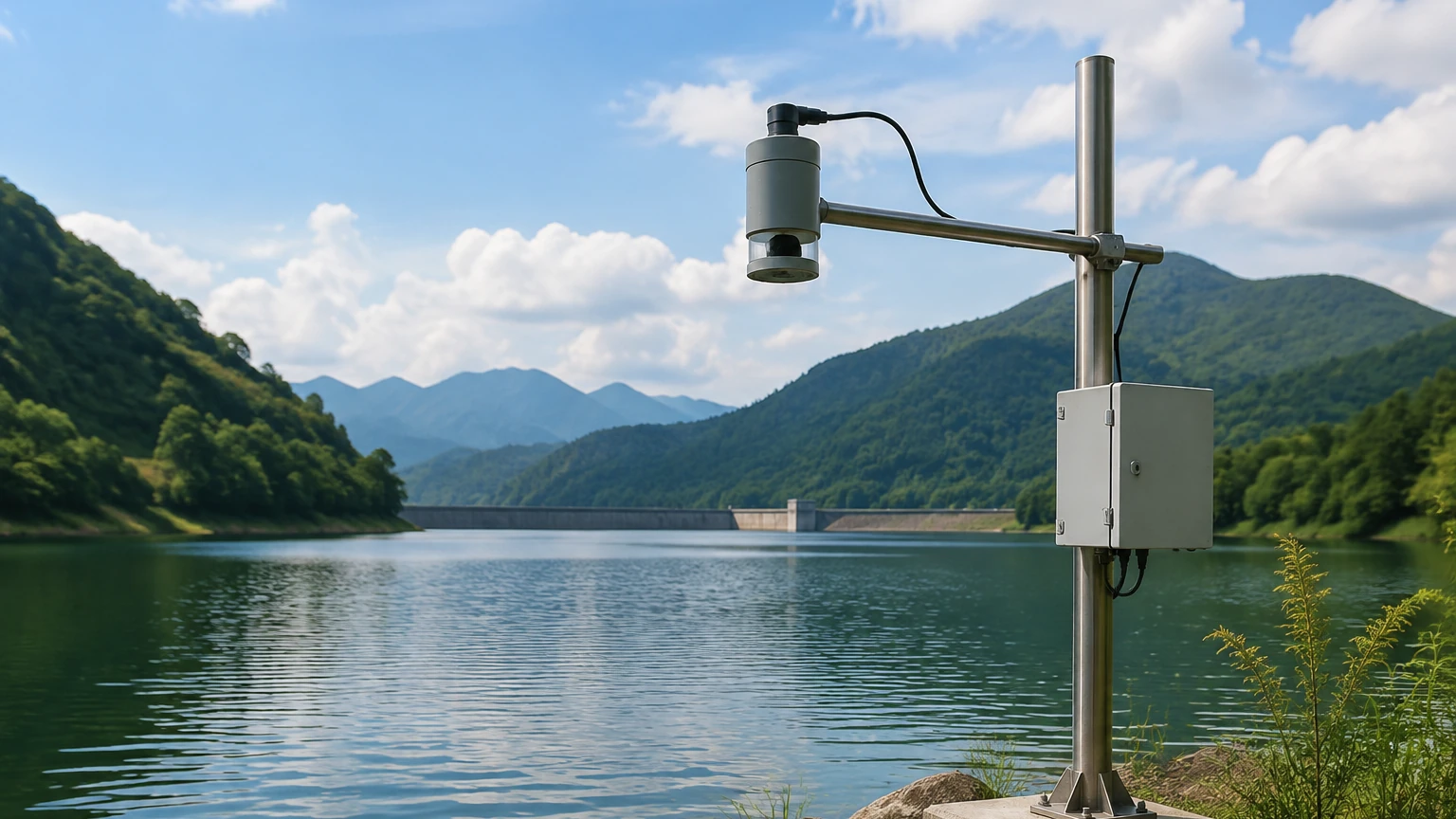
* Cantilever Arms: If no bridge is available, a cantilever arm extending from the shore can position the sensor over the water. The arm must be rigid to prevent vibration in high winds.
* Submerged Anchoring: For hydrostatic sensors, the probe should be anchored or placed inside a protective pipe to prevent it from moving with currents or being damaged by debris.
Data Transmission and Integration
Modern lake monitoring often requires real-time data access. Instruments should be integrated into a remote terminal unit (RTU) or a wireless gateway. Welk provides various output options, including 4-20mA, Modbus RS485, and HART protocols, to facilitate seamless integration into SCADA systems or cloud-based monitoring platforms. For more information on compatible controllers, visit the Main Page.
Environmental Limitations and Challenges
Engineers must account for external factors that can interfere with lake level monitoring equipment performance:
* Ice Formation: Surface ice can reflect radar and ultrasonic signals, but the reading will represent the top of the ice, not the water level. Hydrostatic sensors can be damaged if the water freezes around them. In cold climates, sensors may need to be installed below the frost line or equipped with heating elements.
* Biofouling: In nutrient-rich lakes, algae and barnacles can grow on submerged hydrostatic sensors, clogging the pressure diaphragm. Regular cleaning cycles are necessary for contact-based instruments.
* Atmospheric Pressure Changes: For hydrostatic sensors, a drop in barometric pressure can be misinterpreted as a rise in water level. Using a vented cable or a secondary barometric pressure sensor for compensation is mandatory for accuracy.
* Signal Obstruction: For non-contact sensors, overhanging trees or nesting birds can block the signal path. Selecting a radar with a narrow beam angle (e.g., 3° at 80GHz) helps focus the signal on the water surface and avoid peripheral interference.
Maintenance and Calibration
To ensure long-term reliability, a scheduled maintenance plan should be implemented:
1. Visual Inspection: Check mounting hardware for corrosion or loosening due to wind and vibration.
2. Sensor Cleaning: Wipe the face of ultrasonic and radar sensors to remove dust, spider webs, or salt spray. Clean hydrostatic diaphragms with a soft brush (avoid sharp objects).
3. Verification: Periodically verify the electronic reading against a manual staff gauge (a physical ruler installed in the water). If a discrepancy exists, the sensor offset may need adjustment in the software.
Frequently Asked Questions (FAQs)
Q: Can radar sensors measure lake levels through heavy rain or fog?
A: Yes. Unlike ultrasonic waves, radar electromagnetic waves are not significantly attenuated by rain or fog, making radar the superior choice for coastal or high-humidity lake environments.
Q: What is the best way to power a sensor in a remote location with no grid access?
A: Most industrial level meters can operate on 12-24V DC. A small solar panel (20W-50W) paired with a deep-cycle battery and a low-power RTU is the standard solution for remote lake level monitoring equipment.
Q: How do I handle a lake with very shallow edges?
A: If the water is too shallow for a submersible sensor and there is no structure for a top-down sensor, you may need to install a small jetty or use a horizontal pipe to extend a hydrostatic sensor into a deeper section of the lake.
Q: Does the salinity of the water affect the measurement?
A: Salinity affects the density of water, which impacts hydrostatic pressure sensors. If the lake is brackish or saltwater, the density constant $(\rho)$ must be adjusted in the transmitter's settings. Non-contact radar and ultrasonic sensors are unaffected by salinity.
Conclusion
Selecting lake level monitoring equipment involves a thorough assessment of the site's physical characteristics, accuracy requirements, and maintenance capabilities. While hydrostatic sensors offer a rugged and simple solution for many applications, the precision and environmental immunity of 80GHz radar make it the modern standard for critical water management. By understanding the measurement principles and following rigorous installation standards, engineers can ensure reliable data for years to come. For specific product specifications and application engineering support, please refer to the resources available on our Main Page.