Liquid Fertilizer Flow Meter
Liquid Fertilizer Flow Meter
In modern industrial agriculture and chemical processing, the precision of nutrient delivery is paramount. A liquid fertilizer flow meter is not merely a monitoring device; it is a critical component in ensuring crop yield optimization, environmental compliance, and cost efficiency. Liquid fertilizers, often composed of concentrated salts, acids, and various micronutrients, present unique challenges for instrumentation, including corrosivity, varying viscosities, and the presence of suspended solids.
Selecting the appropriate measurement technology requires a deep understanding of fluid dynamics and material science. This guide explores the fundamental principles of flow measurement as they apply to liquid fertilizers, providing engineers and facility managers with the technical foundation necessary to select, install, and maintain these essential instruments.
Understanding Measurement Principles for Liquid Fertilizer
Before selecting a liquid fertilizer flow meter, it is essential to understand the physics behind the various measurement technologies. Because liquid fertilizers vary significantly in their chemical makeup, no single principle is universal.
Electromagnetic Flow Meters (Magmeters)
Electromagnetic flow meters operate based on Faraday’s Law of Electromagnetic Induction. This law states that a conductor (the liquid) moving through a magnetic field produces an electrical voltage proportional to its velocity.
For liquid fertilizers, magmeters are often the preferred choice. Most fertilizers are aqueous solutions of salts (such as ammonium nitrate or potassium chloride), making them highly conductive. As long as the liquid has a minimum conductivity—typically >5 μS/cm—the magmeter can provide highly accurate readings. Since these meters have no moving parts and offer an unobstructed flow path, they are resistant to clogging and pressure drops.
Ultrasonic Flow Meters
Ultrasonic meters generally fall into two categories: transit-time and Doppler.
- Transit-time meters use transducers to send and receive ultrasonic pulses. The difference in time it takes for the signal to travel upstream versus downstream is proportional to the flow velocity. These are ideal for clean, homogenous liquid fertilizers.
- Doppler meters reflect sound waves off particles or bubbles in the fluid. If the fertilizer contains suspended solids or undissolved nutrients, Doppler technology is more effective.
The primary advantage of ultrasonic technology is the availability of "clamp-on" designs, which allow for measurement without cutting into existing piping, thereby preventing potential leak points for corrosive chemicals.
Turbine Flow Meters
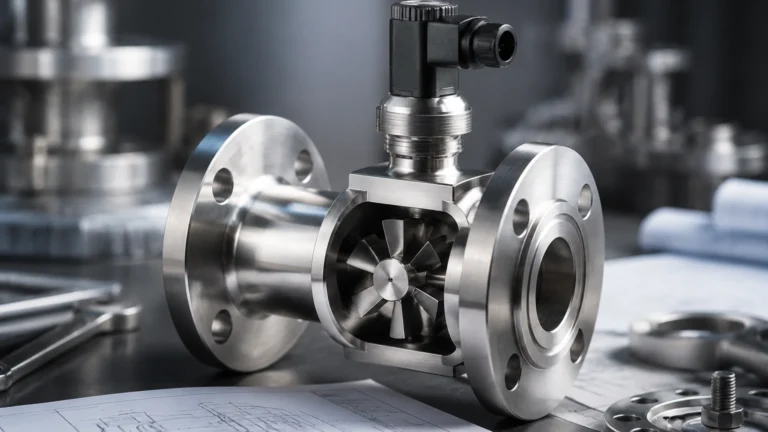
Turbine meters utilize a multi-bladed rotor suspended in the fluid stream. As the liquid fertilizer passes through the meter, it causes the rotor to spin at a speed proportional to the flow velocity. A sensor (often a magnetic pickup) detects the passage of the rotor blades.
While highly accurate for clean, low-viscosity liquids, turbine meters are susceptible to wear from abrasive particles and can be damaged by the corrosive nature of certain fertilizers if the internal bearings and rotors are not constructed from high-grade stainless steel or specialized polymers.
Coriolis Flow Meters
Coriolis meters measure mass flow directly rather than volume. They operate by inducing a vibration in a tube through which the fluid passes. The mass flow of the liquid causes a twist in the tube due to the Coriolis effect, which is measured by sensors. This technology is the gold standard for accuracy and is unaffected by changes in fluid density or viscosity, which is common when fertilizer concentrations change with temperature.
Key Evaluation Criteria for Selection
Choosing a liquid fertilizer flow meter involves more than just matching a pipe size. Engineers must evaluate several variables to ensure long-term reliability.
Chemical Compatibility
Liquid fertilizers can be highly aggressive. For example, phosphoric acid and nitrogen solutions can quickly degrade standard metals. It is vital to specify wetted materials that can withstand these chemicals. Common choices include:
- Liners: PTFE (Teflon), PFA, or Hard Rubber for electromagnetic meters.
- Electrodes: Hastelloy C, Tantalum, or Titanium.
- Meter Bodies: 316L Stainless Steel or specialized plastics like PVC and PVDF for lower-pressure applications.
Fluid Conductivity and Density
If choosing an electromagnetic meter, the conductivity of the fertilizer must be confirmed. While most liquid fertilizers are conductive, some organic or oil-based additives may reduce conductivity below the threshold of the meter. Conversely, if using volumetric meters like turbines, changes in density due to temperature fluctuations can lead to mass-balance errors, making Coriolis meters a better choice for high-value blending operations.
Flow Range and Turn-down Ratio
The "turn-down ratio" refers to the range over which the meter can measure accurately. If a process requires measuring both a high-speed bulk transfer (e.g., 500 L/min) and a slow precision injection (e.g., 5 L/min), the meter must have a wide turn-down ratio. Magmeters typically offer excellent turn-down ratios (up to 100:1 or more).
Practical Selection Table for Industrial Applications
The following table provides a comparison of common flow meter types used for liquid fertilizer applications.
| Meter Type | Typical Accuracy | Conductivity Required? | Moving Parts? | Best Use Case |
| :— | :— | :— | :— | :— |
| Electromagnetic | ±0.5% | Yes (>5 μS/cm) | No | Bulk transfer, conductive chemicals, slurries |
| Ultrasonic (Clamp-on) | ±1.0% to 2.0% | No | No | Retrofitting, non-invasive measurement |
| Turbine | ±0.25% to 0.5% | No | Yes | Clean, low-viscosity liquids, high-pressure lines |
| Coriolis | ±0.1% | No | No | High-precision blending, varying densities |
| Variable Area | ±2.0% to 5.0% | No | Yes | Simple visual monitoring, low-cost applications |
Installation Best Practices and Considerations
Proper installation is as critical as meter selection. Even the most expensive liquid fertilizer flow meter will fail to provide accurate data if installed incorrectly.
Straight Pipe Requirements
Most flow technologies require a "fully developed flow profile" to measure accurately. This usually means a specific length of straight pipe before (upstream) and after (downstream) the meter.
- Upstream: Typically 5 to 10 times the pipe diameter (5D–10D).
- Downstream: Typically 2 to 5 times the pipe diameter (2D–5D).
If the installation space is cramped, flow straighteners or specific "zero-D" electromagnetic meters may be required.
Ensuring a Full Pipe
Flow meters are calibrated to measure the velocity of a liquid filling the entire cross-section of the pipe. If the pipe is only partially full, the meter will over-read or provide erratic data. To prevent this, meters should be installed in low points of the piping system or in vertical lines with an upward flow direction.
Grounding and Interference
For electromagnetic flow meters, proper grounding is non-negotiable. Because the meter measures minute voltages, any stray electrical noise in the piping system can interfere with the signal. In plastic piping systems, grounding rings must be used to ensure the fluid is at the same electrical potential as the meter.
Integration with Level Measurement
In many industrial setups, flow data is cross-referenced with tank level data to ensure inventory accuracy. For comprehensive system design, integrating flow data with tank levels via the Main Page ensures holistic process control and leak detection. Using radar or ultrasonic level sensors in conjunction with a liquid fertilizer flow meter allows for a redundant check on total volume dispensed.
Common Risks and Operational Limitations
Operating in an agricultural or industrial chemical environment introduces several risks that can compromise measurement integrity.
1. Crystallization: Some liquid fertilizers, such as high-concentration potassium solutions, can crystallize if the temperature drops. These crystals can coat electrodes in magmeters or jam the rotors in turbine meters. Heat tracing or regular flushing cycles may be necessary.
2. Air Entrainment: Air bubbles trapped in the fertilizer (often caused by pumps or turbulent filling) will be read as liquid by most volumetric meters, leading to significant inaccuracies. Air eliminators should be installed upstream of the meter if entrained air is a known issue.
3. Scale Buildup: Over time, minerals can build up on the interior walls of the meter. In magmeters, a non-conductive coating on the electrodes will eventually cause the signal to fail. Choosing meters with "electrode cleaning" functions or implementing a preventative maintenance cleaning schedule is advised.
Frequently Asked Questions (FAQs)
Q: Can I use a standard water meter for liquid fertilizer?
A: Generally, no. Standard water meters often use brass or low-grade stainless steel internals that will corrode rapidly when exposed to the salts and acids in liquid fertilizer. Furthermore, the specific gravity of fertilizer is higher than water, which may affect the calibration of mechanical meters.
Q: How often should a liquid fertilizer flow meter be calibrated?
A: For standard applications, an annual calibration check is recommended. However, for high-value blending or custody transfer applications, semi-annual calibration may be required to maintain regulatory compliance and financial accuracy.
Q: What is the impact of viscosity on measurement?
A: Turbine and gear meters are highly sensitive to viscosity changes. As fertilizer thickens (often due to cold weather), the drag on the internal components increases, leading to errors. Electromagnetic and Coriolis meters are largely immune to viscosity changes.
Q: Are plastic flow meters durable enough for industrial fertilizer use?
A: High-quality plastic meters (like those made from PVDF or reinforced polypropylene) are excellent for corrosion resistance. However, they have lower pressure and temperature ratings than metal meters. They are best suited for fertigation systems rather than high-pressure industrial processing lines.
Conclusion
Selecting the right liquid fertilizer flow meter is a balance between chemical compatibility, required precision, and budget. By prioritizing technologies like electromagnetic meters for their reliability in conductive fluids or Coriolis meters for their unmatched mass-flow accuracy, operators can ensure that their nutrient management systems remain efficient and durable. When planning an installation, always account for the physical properties of the specific fertilizer blend and ensure that the meter is integrated into a broader monitoring strategy that includes reliable level instrumentation. For further technical specifications and product comparisons, reviewing the Main Page of specialized instrument providers can provide additional clarity on the latest advancements in fluid measurement technology.