Liquid Level Detection
Liquid Level Detection
In industrial process control, liquid level detection is a fundamental requirement for ensuring operational safety, inventory management, and process efficiency. Whether managing wastewater treatment plants, chemical storage tanks, or oil and gas refineries, selecting the correct measurement technology is critical to preventing overflows, protecting pumps from dry running, and maintaining accurate volumetric data.
As a professional manufacturer of industrial level measurement instruments, Welk provides a comprehensive range of technologies designed to address diverse media and environmental conditions. This guide examines the underlying principles of modern detection methods, provides practical selection criteria, and outlines installation best practices for engineering professionals.
Core Principles of Liquid Level Detection
Liquid level detection technologies are generally categorized into continuous measurement and point level detection. Continuous measurement provides real-time data on the level throughout the entire range of the vessel, while point level detection (switches) indicates whether a liquid has reached a specific height.
1. Radar Level Measurement (Non-Contact)
Radar level meters utilize electromagnetic waves, typically in the microwave frequency range (6GHz to 80GHz).
* Principle: The instrument emits a radar pulse that travels to the liquid surface, reflects, and returns to the sensor. The distance is calculated using the Time of Flight (ToF) principle or Frequency Modulated Continuous Wave (FMCW) technology. Since electromagnetic waves do not require a medium for travel, radar is unaffected by vacuum, pressure, or high temperatures.
* Key Factor: The Dielectric Constant ($ε_r$) of the liquid determines the strength of the reflected signal. Higher dielectric liquids (like water) reflect more energy than hydrocarbons.
2. Ultrasonic Level Measurement (Non-Contact)
Ultrasonic sensors use sound waves rather than electromagnetic pulses.
* Principle: The sensor transmits a high-frequency acoustic pulse. The time taken for the echo to return from the liquid surface is measured. Because the speed of sound is influenced by air temperature, these sensors typically include an integrated temperature probe to compensate for variations.
* Application: Ideal for water and wastewater applications where the environment is relatively stable. However, they are sensitive to heavy foam, dust, and vapor which can absorb or scatter the sound waves.
3. Hydrostatic Level Measurement (Contact)
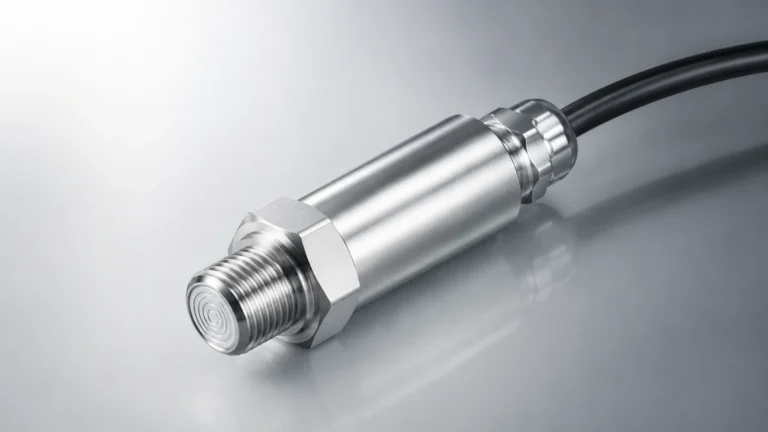
Hydrostatic transmitters measure the pressure exerted by a liquid column due to gravity.
* Principle: Based on the formula $P = ρ · g · h$ (where $P$ is pressure, $ρ$ is liquid density, $g$ is gravity, and $h$ is height). By measuring the pressure at the bottom of a tank and knowing the density of the fluid, the level can be accurately determined.
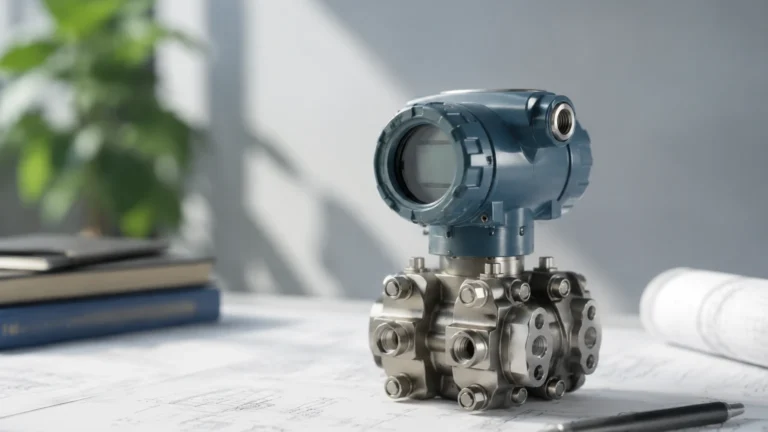
* Application: Commonly used in vented tanks or deep wells. In pressurized vessels, a differential pressure transmitter is required to subtract the headspace pressure from the total bottom pressure.
4. Magnetic Level Gauges (Contact)
These instruments provide both a local visual indication and an optional electronic output.
* Principle: A float containing a permanent magnet moves up and down a bypass chamber connected to the side of the tank. Outside the chamber, a series of magnetic flaps or a follower indicates the level. A reed chain or magnetostrictive transmitter can be attached to provide a 4-20mA signal.
* Application: Excellent for high-pressure or corrosive environments where direct contact with the process fluid must be managed through robust mechanical barriers.
Comparative Selection Matrix
Choosing the right technology requires balancing accuracy, cost, and environmental constraints. The following table provides a general comparison of common liquid level detection methods.
| Technology | Accuracy | Media Compatibility | Max Temperature | Pressure Resistance | Maintenance |
| :— | :— | :— | :— | :— | :— |
| Radar (80GHz) | ±1 mm | Corrosives, solids, liquids | Up to +450°C | Up to 160 bar | Very Low |
| Ultrasonic | ±0.25% of range | Water-based, non-foaming | Up to +80°C | Up to 3 bar | Low |
| Hydrostatic | ±0.1% to 0.5% | Clean liquids, slurries | Up to +100°C | High (submersible) | Moderate |
| Magnetic Gauge | ±5 mm to 10 mm | Clean liquids, oils | Up to +400°C | Up to 320 bar | Moderate |
| Level Switch | N/A (Point) | Most liquids | Up to +250°C | Up to 64 bar | Low |
For detailed specifications and to explore specific models for your industry, you can visit our Main Page for a full overview of available instrumentation.
Installation Considerations
Correct installation is as vital as selecting the right sensor. Even the most advanced liquid level detection system will fail if environmental factors are ignored.
Blocking Distance (Dead Zone)
All ToF sensors (Radar and Ultrasonic) have a "dead zone" directly beneath the sensor where measurements cannot be taken. For ultrasonic sensors, this is typically 0.2m to 0.5m (approx. 8 to 20 inches), while modern 80GHz radar sensors have significantly smaller dead zones, often less than 0.1m.
Mounting Position
* Avoid the Center: In cylindrical tanks, mounting a sensor in the exact center can lead to multiple reflections or signal interference from the tank walls.
* Inflow Interference: Never install a sensor directly above the liquid inlet. The turbulence and falling liquid will cause erratic readings or signal loss.
* Obstructions: Ensure the signal beam path is clear of internal structures like ladders, heating coils, or agitators. If obstructions are unavoidable, many modern radar units feature "false echo suppression" software to ignore these static reflections.
Nozzle Design
The height and diameter of the mounting nozzle can affect the signal. If a nozzle is too narrow and long, the signal may reflect off the nozzle walls before reaching the tank. Radar sensors with smaller beam angles (e.g., 3°) are much more tolerant of long nozzles.
Limitations and Common Risks
While technology has advanced, certain physical conditions remain challenging for liquid level detection:
1. Heavy Foam: Foam acts as an insulator for ultrasonic waves and can absorb radar signals. If thick foam is present, hydrostatic or guided wave radar (GWR) is often a more reliable choice.
2. Vapor and Condensation: High humidity or solvent vapors can change the speed of sound, affecting ultrasonic accuracy. Condensation on the sensor face can also attenuate signals. Radar is generally immune to vapor, but "dripping" condensation on the antenna can still cause noise.
3. Variable Density: Hydrostatic sensors rely on a constant liquid density. If the process involves mixing liquids of different densities or significant temperature swings that change the density, the level reading will drift unless compensated for by a secondary sensor.
4. Agitation and Turbulence: Rapidly moving liquid surfaces can scatter signals. In these cases, using a stilling well or a bypass pipe is recommended to provide a calm surface for measurement.
Frequently Asked Questions (FAQ)
Q: How do I choose between Radar and Ultrasonic sensors?
A: Use Ultrasonic for simple, open-air water applications where cost is a primary concern. Choose Radar for closed tanks, high temperatures, high pressures, or when the media produces vapor or dust. Radar is generally more versatile but carries a higher initial investment.
Q: Can liquid level detection be used for corrosive chemicals?
A: Yes. For highly corrosive media, non-contact radar or ultrasonic sensors are preferred as they do not touch the liquid. If a contact method like hydrostatic is used, the diaphragm must be made of compatible materials such as Tantalum, Hastelloy, or PTFE-coated stainless steel.
Q: What is the maximum range for these sensors?
A: Ultrasonic sensors typically reach up to 15-20 meters (approx. 50-65 feet). Radar level meters can measure distances up to 120 meters (approx. 393 feet) in specific configurations, making them suitable for very tall silos or deep reservoirs.
Q: Does the tank material affect the measurement?
A: For non-contact radar, the tank material matters. Plastic or fiberglass tanks allow radar waves to pass through, which may require the sensor to be mounted inside or have a metal plate behind it. Metal tanks reflect signals perfectly, which is ideal for radar and ultrasonic methods.
Engineering Support and Customization
Selecting a liquid level detection system requires an understanding of both the mechanical environment and the chemical properties of the media. At Welk, we provide customized OEM/ODM services to ensure that the instrumentation fits the specific geometry and communication requirements of your facility.
Whether you require a single hydrostatic transmitter for a borehole or a networked system of 80GHz radar meters for a chemical tank farm, our technical team provides the necessary guidance from initial selection through to commissioning. For more information on our full product line and technical capabilities, please refer to our Main Page to connect with an application engineer.