Lr80 0000
Lr80 0000
In the landscape of industrial process control, the precision of level measurement is a critical factor for operational safety, inventory management, and efficiency. The Lr80 0000 series represents a significant advancement in non-contact level sensing technology, specifically utilizing 80GHz Frequency Modulated Continuous Wave (FMCW) radar. As industries move toward more complex storage environments and narrower vessel geometries, understanding the technical nuances of the Lr80 0000 becomes essential for instrumentation engineers and plant managers.
This guide provides a comprehensive technical overview of the Lr80 0000, exploring its underlying measurement principles, application suitability, and the engineering considerations required for successful deployment in diverse industrial sectors.
Measurement Principles: The 80GHz FMCW Advantage
To understand the performance of the Lr80 0000, one must first examine the physics of Frequency Modulated Continuous Wave (FMCW) radar. Unlike pulse-based radar, which measures the time-of-flight of a single microwave burst, FMCW radar transmits a continuous signal with a frequency that increases linearly over time (a frequency sweep or "chirp").
Frequency Modulation and Signal Processing
When the transmitted signal hits the surface of the medium, it is reflected back to the sensor's antenna. Because the transmitter is constantly changing its frequency, there is a measurable difference between the frequency currently being transmitted and the frequency of the signal that has just returned. This frequency difference (beat frequency) is directly proportional to the distance between the sensor and the material surface.
The Significance of 80GHz
The "80" in Lr80 0000 denotes the operating frequency in the W-band (76–81 GHz). Compared to traditional 6GHz or 26GHz radar systems, the 80GHz frequency offers several distinct advantages:
1. Narrower Beam Angle: High-frequency signals allow for a much tighter beam focus using smaller antenna sizes. While a 26GHz radar might have a beam angle of 8° to 10°, an 80GHz unit like the Lr80 0000 can achieve a beam angle as narrow as 3°. This minimizes interference from internal tank obstructions such as agitators, heating coils, and ladders.
2. Higher Precision: The wider bandwidth available at 80GHz allows for superior range resolution. This results in measurement accuracies often within ±2 mm (approximately 0.08 inches), even over long distances.
3. Smaller Dead Zones: The Lr80 0000 features a very short blocking distance (dead zone), allowing for accurate measurements even when the tank is nearly full, which maximizes the usable volume of the vessel.
Technical Features of the Lr80 0000 Series
The Lr80 0000 is engineered to operate in environments where traditional sensors often fail. Its design focuses on robustness and signal clarity. On the Main Page of technical documentation for such instruments, several core specifications are typically highlighted to assist in engineering selection.
Signal Sensitivity and Dynamic Range
One of the standout features of the Lr80 0000 is its high dynamic range. This allows the sensor to detect weak echoes from media with low dielectric constants (εr), such as plastic pellets, oils, or liquefied gases. Even in the presence of surface foam or turbulence, the advanced signal processing algorithms can filter out noise to maintain a stable level reading.
Antenna Design and Material Compatibility
The Lr80 0000 often utilizes a lens antenna design. Because the wavelength at 80GHz is very short (approximately 3.75 mm), the antenna can be completely sealed behind a PTFE or PEEK window. This flush-mounted design prevents material buildup and makes the sensor highly resistant to corrosive chemicals and hygienic requirements in food and pharmaceutical applications.
Industrial Application Scenarios
The versatility of the Lr80 0000 makes it suitable for a wide range of industries, from heavy mining to delicate chemical processing.
1. Chemical and Petrochemical Processing
In chemical storage, tanks are often filled with aggressive substances that can corrode contact-based sensors. The non-contact nature of the Lr80 0000, combined with its ability to measure through plastic or glass windows, makes it an ideal choice. It is frequently used in small-to-medium-sized process vessels where narrow nozzles and internal structures would typically cause false echoes for lower-frequency radars.
2. Water and Wastewater Management
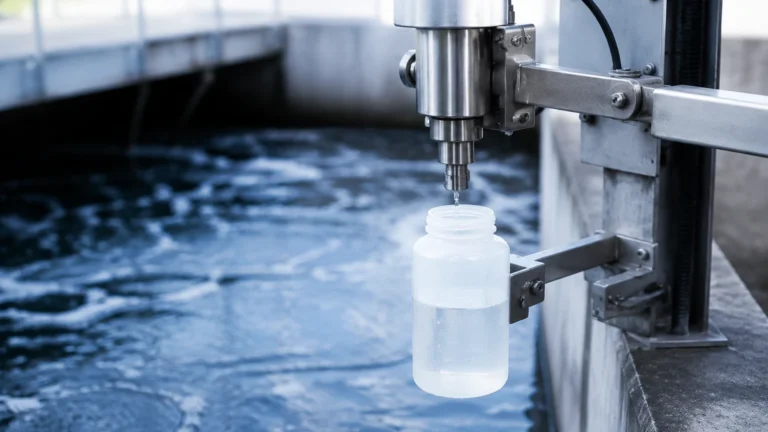
For water treatment plants, the Lr80 0000 provides reliable monitoring of open channels, chemical dosing tanks, and sludge pits. Its high frequency allows it to ignore the effects of condensation on the antenna, which is a common failure point for ultrasonic sensors in humid environments.
3. Solids and Bulk Material Handling
Measuring the level of solids in tall, narrow silos presents a unique challenge due to the uneven surface of the material (angle of repose) and the high amount of dust. The Lr80 0000’s narrow beam can be directed precisely at the material surface, avoiding the silo walls. The high-frequency signal also penetrates dust clouds more effectively than ultrasonic waves, which are often absorbed or scattered by airborne particulates.
Selection Criteria and Technology Comparison
Choosing the correct level measurement technology requires a comparison of environmental factors and material properties. The following table illustrates where the Lr80 0000 (80GHz Radar) stands relative to other common technologies.
| Feature | 80GHz Radar (Lr80 0000) | 26GHz Radar | Ultrasonic Sensors | Hydrostatic Pressure |
| :— | :— | :— | :— | :— |
| Beam Angle | Narrow (approx. 3°) | Medium (8° – 12°) | Wide (10° – 15°) | N/A (Contact) |
| Accuracy | ±2 mm | ±5 mm | ±0.25% of range | ±0.1% to 0.5% |
| Max Range | Up to 120m | Up to 30m – 70m | Up to 15m – 30m | Dependent on head |
| Dust/Vapor Resistance | Excellent | Good | Poor | Excellent |
| Internal Obstructions | Highly Resistant | Moderately Resistant | Poor | Excellent |
| Cost | Premium | Mid-range | Economical | Mid-range |

Engineering Installation and Mounting Guidelines
To achieve the specified accuracy of the Lr80 0000, proper installation is paramount. Engineers should adhere to the following guidelines during the design and mounting phase:
Nozzle Considerations
While the Lr80 0000 can handle longer nozzles than 26GHz radars, the nozzle should ideally be as short as possible. The end of the antenna should preferably extend slightly past the bottom of the nozzle to prevent "ringing" or internal reflections within the mounting pipe. However, due to the narrow beam, the Lr80 0000 is much more forgiving of tall nozzles than its predecessors.
Positioning and Orientation
* Avoid the Center: Do not mount the sensor in the exact center of a domed tank, as this can cause multiple reflections that amplify noise.
* Wall Distance: Maintain a minimum distance from the tank wall (typically 200 mm or more) to prevent interference from the wall itself, though the narrow beam of the 80GHz unit allows for closer mounting than lower-frequency models.
* Inflow Avoidance: Ensure the sensor is not positioned directly above the point where material enters the tank, as the falling stream will interfere with the radar signal.
Aiming in Solids Applications
For bulk solids, using an adjustable mounting flange (swivel holder) is recommended. This allows the engineer to aim the Lr80 0000 at the specific area of the material pile (such as the discharge cone) to get the most representative level reading.
Limitations and Operational Constraints
Despite its advanced capabilities, the Lr80 0000 is not a universal solution for every application. Certain limitations must be considered:
* Extremely Heavy Foam: While 80GHz radar can handle light-to-medium foam, extremely thick, dense foam (especially in some fermentation processes) may absorb the microwave signal entirely, leading to a loss of echo. In such cases, a guided wave radar or a mechanical float may be necessary.
* Vacuum Conditions: While the radar signal itself travels perfectly in a vacuum, the mechanical seals and housing of the Lr80 0000 must be specifically rated for vacuum pressure to prevent damage to the electronics.
* Dielectric Constant (εr): Materials with an extremely low dielectric constant (less than 1.4) may require a stilling well or a guided wave radar to ensure sufficient signal reflection.
Frequently Asked Questions (FAQ)
Q: Can the Lr80 0000 measure through a closed plastic tank lid?
A: Yes. Because 80GHz microwaves can penetrate non-conductive materials like plastics (PE, PP, PVC) and glass, the sensor can be mounted outside the tank, looking through a window or the tank roof, provided the material is not too thick and does not contain conductive reinforcements.
Q: Does temperature or pressure affect the accuracy of the Lr80 0000?
A: Radar technology is largely unaffected by changes in air temperature, pressure, or gas composition within the tank. This is a primary advantage over ultrasonic sensors, which rely on the speed of sound—a variable that changes significantly with temperature and gas density.
Q: Is the Lr80 0000 suitable for corrosive environments?
A: Yes, provided the wetted parts (usually a PTFE or PEEK lens) are compatible with the chemical in question. The non-contact nature significantly reduces the maintenance burden in corrosive applications.
Q: How does the Lr80 0000 handle condensation?
A: The high frequency and lens antenna design are specifically intended to minimize the impact of condensation. Small droplets on the lens typically do not scatter the 80GHz signal as severely as they do with lower-frequency pulse radars.
Conclusion
The Lr80 0000 represents the current state-of-the-art in non-contact level measurement. By leveraging the high-frequency 80GHz FMCW principle, it provides industrial users with a level of precision and reliability that was previously difficult to achieve in narrow or obstructed vessels. For engineers looking to optimize their processes, the Lr80 0000 offers a robust solution that minimizes maintenance while maximizing data accuracy across a vast array of media and environments. When selecting a level meter, it is always advisable to consult with a professional manufacturer like Welk to ensure the specific model configuration matches the chemical and physical properties of the application.