Magnetic Flow Meter Calibration
Magnetic Flow Meter Calibration
In the realm of industrial process control, accuracy is the cornerstone of operational efficiency, safety, and regulatory compliance. Magnetic flow meters, often referred to as magmeters, are widely utilized across industries such as water treatment, chemical processing, and oil and gas due to their ability to measure the flow of conductive liquids without moving parts. However, the reliability of these instruments depends heavily on precise magnetic flow meter calibration. This guide provides a comprehensive technical overview of the principles, methods, and best practices for calibrating magnetic flow meters to ensure long-term performance in demanding environments.
Understanding the Principle of Magnetic Flow Measurement
Before addressing calibration procedures, it is essential to understand how a magnetic flow meter functions. The technology is based on Faraday’s Law of Electromagnetic Induction. This law states that a voltage is induced when a conductive medium passes through a magnetic field.
In a magmeter, the flow tube is equipped with electromagnetic coils that generate a magnetic field. As a conductive liquid flows through this tube, it acts as a moving conductor. Two electrodes mounted on opposite sides of the tube pick up the induced voltage ($E$). The relationship is defined by the formula:
$$E = k \cdot B \cdot D \cdot v$$
Where:
- E is the induced voltage.
- k is a constant (meter factor).
- B is the magnetic field strength.
- D is the diameter of the pipe (distance between electrodes).
- v is the average velocity of the liquid.
Since $B$ and $D$ are fixed physical properties of the meter, and $k$ is determined during the initial factory setup, the induced voltage is directly proportional to the velocity of the fluid. Calibration is the process of verifying and adjusting this proportionality to ensure that the flow rate reported by the transmitter matches the actual volume of liquid passing through the sensor.
The Necessity of Magnetic Flow Meter Calibration
While magnetic flow meters are known for their stability, several factors necessitate periodic magnetic flow meter calibration:
1. Initial Characterization: Every new meter must be calibrated at the factory to establish its unique meter factor ($k$). No two meters are identical at the microscopic level of electrode placement and coil winding.
2. Regulatory Compliance: In industries like wastewater treatment or pharmaceutical manufacturing, local and international standards (such as ISO 17025 or EPA regulations) require documented proof of measurement accuracy.
3. Process Efficiency: In chemical dosing or custody transfer, even a 1% error can result in significant financial losses or compromised product quality.
4. Wear and Environmental Factors: Although magmeters lack moving parts, the lining can wear over time, or electrodes can become coated with deposits, altering the internal diameter or the electrical contact with the fluid.
For engineers seeking to optimize their entire measurement loop, reviewing comprehensive solutions on the Main Page can provide insights into how flow and level data integrate into automated systems.
Primary Methods of Calibration
There are two main categories of magnetic flow meter calibration: wet calibration (laboratory-based) and dry calibration (field verification).
1. Wet Calibration (The Gold Standard)
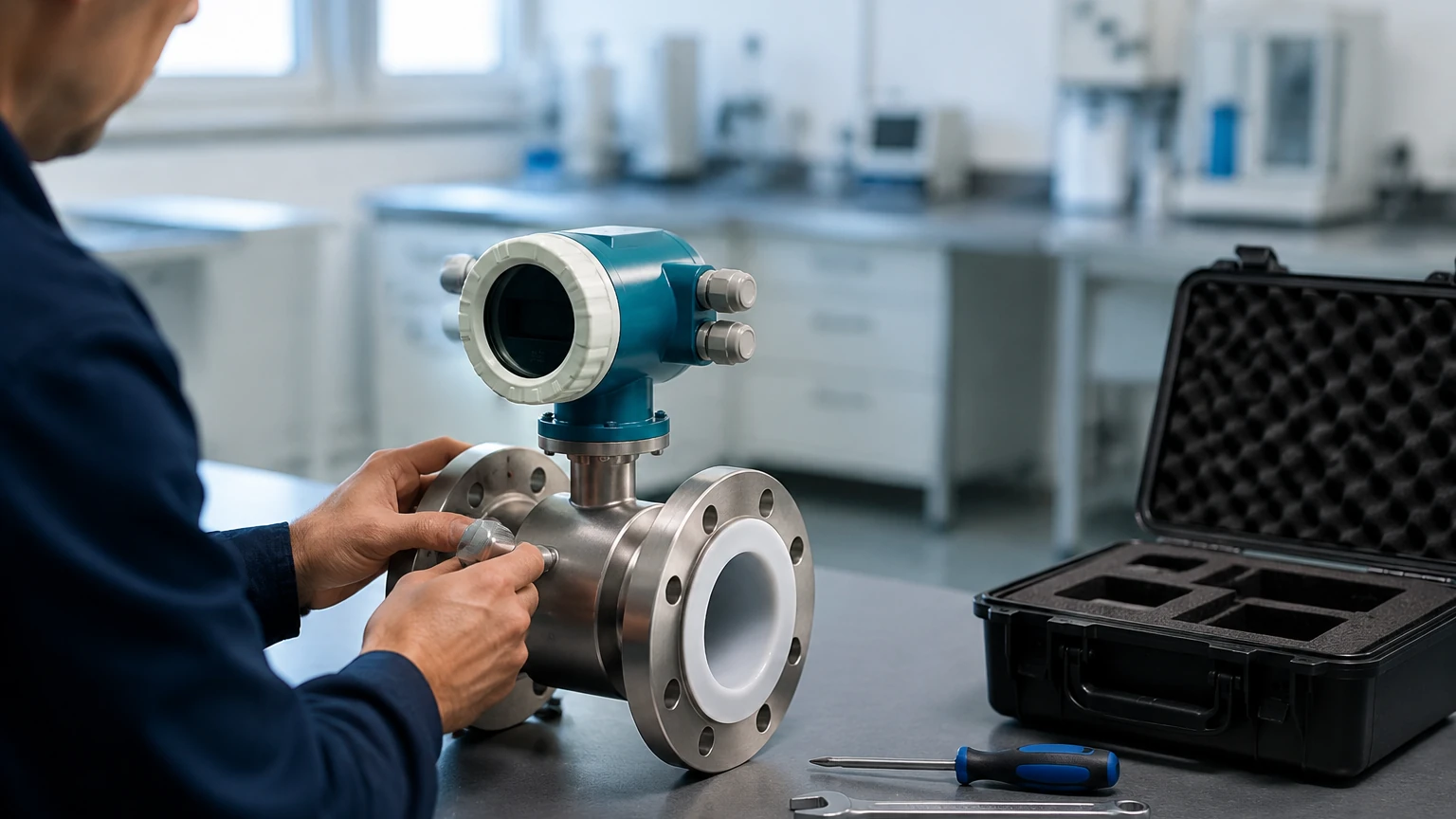
Wet calibration involves passing a known volume of fluid through the meter and comparing the meter’s reading to a traceable reference standard. This is typically performed in a controlled laboratory environment.
* Gravimetric Method: This is the most accurate method. The fluid passing through the meter is collected in a vessel on a high-precision scale. The mass of the fluid is measured over a specific time interval and converted to volume using the fluid's density. This result is then compared against the meter's output.
* Master Meter Method: The meter under test is placed in series with a "master meter" that has a much higher accuracy rating and a current calibration certificate. Both meters measure the same flow, and the results are compared. This method is faster than gravimetric calibration but depends entirely on the integrity of the master meter.
2. Field Verification (Dry Calibration)
In many industrial settings, removing a large-diameter flow meter for lab calibration is impractical and costly. Field verification uses sophisticated electronic tools to check the health of the meter without breaking the process seal.
* Electronics Testing: The transmitter is tested using a simulator that injects known voltages to verify that the signal processing unit is functioning correctly.
* Coil and Electrode Testing: Tools measure the resistance and insulation of the magnetic coils and the integrity of the electrode circuit to ensure no degradation has occurred.
Installation Factors Affecting Calibration Accuracy
A perfectly calibrated meter will still provide inaccurate data if installed incorrectly. To maintain the integrity of the magnetic flow meter calibration, the following engineering guidelines must be followed:
Grounding
Since the induced voltage in a magmeter is typically in the millivolt range, electrical noise can easily interfere with the signal. Proper grounding is mandatory. If the pipe is non-conductive (e.g., PVC or lined steel), grounding rings must be used to ensure the fluid is at the same electrical potential as the meter body.
Straight Pipe Runs
To ensure a stable velocity profile, magmeters require a minimum length of straight pipe before and after the sensor. A common standard is 5D upstream (five times the nominal diameter) and 3D downstream. If there are pumps or valves immediately preceding the meter, these requirements may increase to 10D or more to eliminate turbulence.
Full Pipe Condition
Magmeters cannot accurately measure flow in a partially filled pipe. The sensor must be installed in a location where the pipe remains completely full at all times, such as a low point in the piping system or a vertical run with upward flow.
Comparison of Calibration Techniques
The following table outlines the differences between the primary calibration and verification strategies used in industrial automation.
| Feature | Gravimetric Calibration | Master Meter Calibration | Field Verification |
| :— | :— | :— | :— |
| Accuracy | Highest (±0.1% or better) | High (±0.25% to ±0.5%) | Moderate (Verifies health, not flow) |
| Traceability | Direct to NIST/National Standards | Indirect via Master Meter | Electronic standards only |
| Cost | High (Shipping + Lab fees) | Moderate | Low (In-situ) |
| Downtime | Significant (Meter removal) | Moderate | Minimal |
| Best Use Case | Custody transfer, billing | General process control | Routine maintenance checks |
Common Risks and Limitations
While magnetic flow meter calibration ensures the device is accurate, certain application-specific risks can lead to measurement drift:
* Conductivity Limits: Magmeters require a minimum fluid conductivity (typically >5 μS/cm). If the fluid's conductivity drops below this threshold, the induced voltage becomes too weak to distinguish from background noise, rendering the calibration moot.
* Entrained Air: Air bubbles in the fluid are measured as volume but do not contribute to the mass flow. Large amounts of entrained air can cause significant over-reading and erratic signals.
* Electrode Coating: In applications like wastewater or slurry handling, non-conductive films can build up on the electrodes. This increases resistance and eventually "blinds" the meter. Regular verification can detect this before a total failure occurs.
* Magnetic Interference: High-power cables or large motors located too close to the flow meter can distort the magnetic field generated by the coils, leading to inaccurate readings that cannot be corrected by standard calibration alone.
Frequently Asked Questions (FAQ)
Q: How often should magnetic flow meter calibration be performed?
A: For most industrial applications, an annual calibration or verification is recommended. However, in critical applications like chemical dosing or high-value custody transfer, a six-month interval may be required by internal quality standards or regulatory bodies.
Q: Can I calibrate a magnetic flow meter using water if it will be used for chemicals?
A: Yes. Because magmeters measure velocity based on Faraday's Law, the measurement is generally independent of fluid density, viscosity, and pressure, provided the fluid meets the minimum conductivity requirement. Calibration on water is the industry standard for most conductive liquid applications.
Q: What is the difference between calibration and verification?
A: Calibration involves comparing the meter against a physical flow standard (wet test) and adjusting it. Verification is a diagnostic check of the meter's internal components (dry test) to confirm they are still within factory-defined tolerances.
Q: Does pipe orientation affect calibration?
A: While the calibration itself is independent of orientation, the installation is not. Vertical upward flow is preferred to ensure a full pipe and to prevent sediment buildup on the electrodes. If installed horizontally, the electrode axis must be horizontal to prevent air bubbles (at the top) or sediment (at the bottom) from interfering with the signal.
Conclusion and Next Steps
Maintaining the accuracy of industrial measurement systems requires a disciplined approach to magnetic flow meter calibration. By understanding the underlying physics of Faraday's Law and implementing a combination of factory-traceable wet calibration and regular field verification, engineers can ensure their processes remain efficient and compliant.
When selecting instrumentation for complex industrial environments, it is vital to partner with manufacturers who provide robust support and technical guidance. For those looking to explore a wide range of measurement technologies including radar, ultrasonic, and hydrostatic solutions, visiting the Main Page offers a comprehensive resource for industrial automation needs. Confirming the specific conductivity, chemical compatibility, and installation constraints of your application is the final step before implementing a calibration schedule that will protect your operational integrity for years to come.