Micro Ph Sensor
Micro Ph Sensor
In the landscape of industrial process control and laboratory analysis, the requirement for high-precision liquid analysis has evolved beyond large-scale tanks and open reservoirs. As industries move toward microfluidics, high-throughput screening, and localized chemical monitoring, the micro pH sensor has become a critical instrument. Unlike standard industrial pH probes, which may have diameters of 12mm or larger, micro pH sensors are designed to operate in confined spaces, often featuring tip diameters ranging from a few millimeters down to several micrometers.
Accurate pH measurement at the micro-scale is essential for maintaining product quality in biotechnology, pharmaceuticals, and specialized chemical synthesis. This guide explores the underlying measurement principles, the primary technologies available, and the practical considerations for selecting and installing these specialized sensors in industrial environments.
Measurement Principles of pH Sensing
To understand the operation of a micro pH sensor, it is necessary to first review the electrochemical principles that govern pH measurement. pH is a logarithmic measure of the hydrogen ion activity in a solution. Most industrial and laboratory sensors rely on one of three primary methods: potentiometric, field-effect, or optical sensing.
Potentiometric (Glass Electrode)
The most common method is the potentiometric measurement using a glass electrode. This system consists of a pH-sensitive glass membrane, an internal reference solution, and a reference electrode. When the glass membrane comes into contact with a liquid, a hydrated gel layer forms on both the inside and outside of the membrane. An ion exchange occurs, creating a potential difference (voltage) proportional to the hydrogen ion concentration. This relationship is defined by the Nernst equation:
**E = E0 + (2.303 RT / nF) * log(aH+)**
Where:
* E is the measured potential.
* E0 is the standard electrode potential.
* R is the gas constant.
* T is the absolute temperature in Kelvin.
* F is the Faraday constant.
* aH+ is the activity of hydrogen ions.
In a micro pH sensor, the challenge lies in miniaturizing the glass bulb and the reference junction without increasing electrical resistance to a point where the signal becomes unstable.
Ion-Sensitive Field-Effect Transistor (ISFET)
ISFET technology replaces the glass membrane with a semiconductor chip. The gate of the transistor is exposed to the solution. Hydrogen ions in the liquid interact with the gate oxide layer (typically silicon nitride or aluminum oxide), altering the electrical conductivity of the transistor. This change in current is measured and converted into a pH value. ISFET sensors are inherently more robust than glass and can be manufactured at extremely small scales using silicon fabrication techniques.
Optical (Fluorescence) Sensing
Optical micro pH sensors, often called optodes, use pH-sensitive fluorescent dyes immobilized in a polymer matrix at the tip of a fiber optic cable. When excited by a specific wavelength of light, the dye emits fluorescence, the intensity or decay time of which changes based on the pH of the surrounding medium. These sensors are immune to electromagnetic interference and do not require a reference electrode, making them ideal for very small volumes.
Key Technologies in Micro pH Sensors
When selecting a micro pH sensor for B2B applications, engineers must choose between different sensor architectures based on the specific constraints of the process.
1. Needle-Type Micro-Electrodes
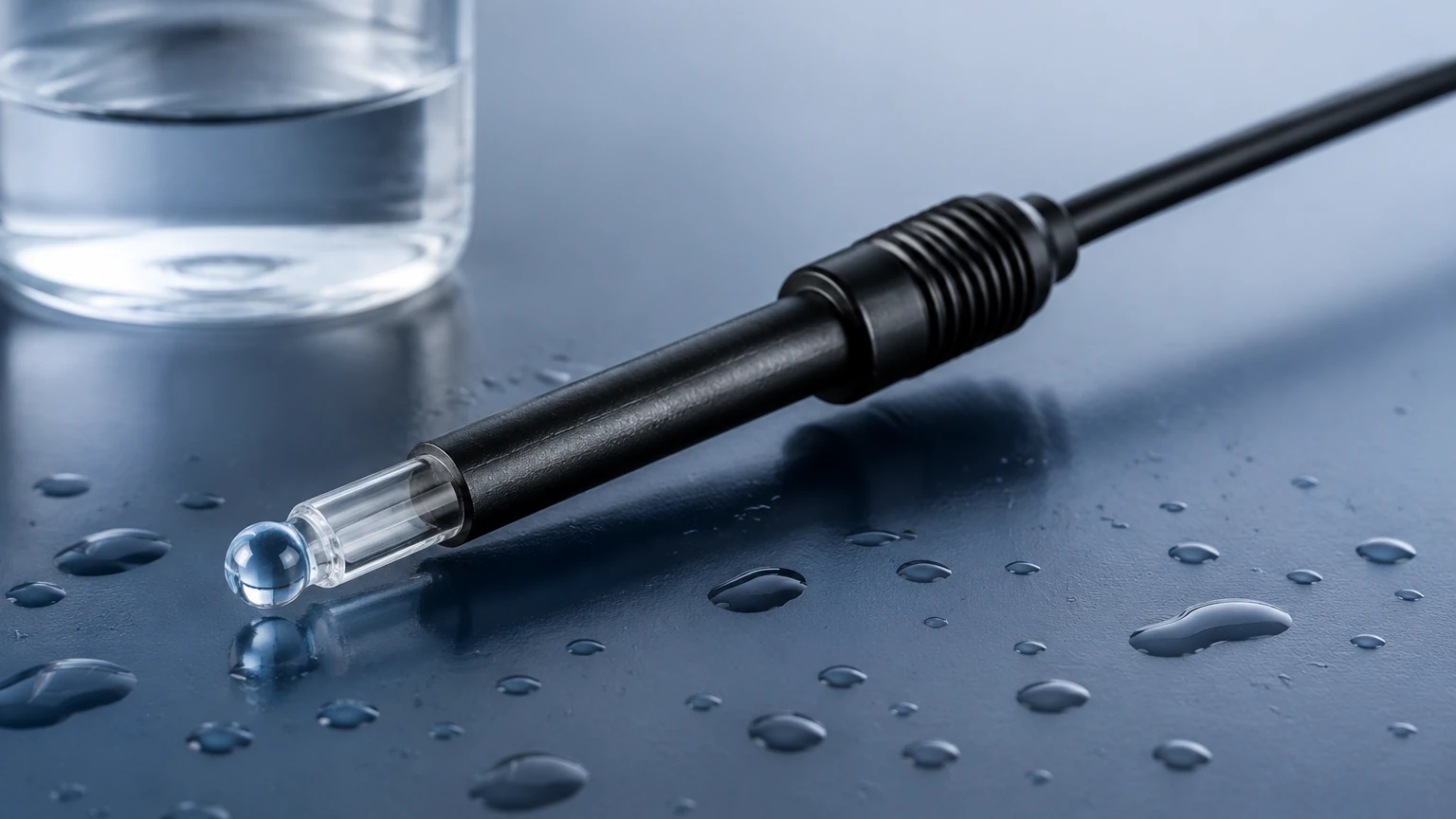
These are typically glass electrodes housed in a stainless steel needle. They are designed for piercing membranes or for insertion into very small vials. The tip diameter can be as small as 50 µm to 100 µm. They are frequently used in biological research and pharmaceutical R&D.
2. Chip-Based ISFET Sensors
ISFET sensors are solid-state devices. Because they lack a fragile glass bulb, they are suitable for "glass-free" environments, such as food production or high-pressure micro-reactors. They offer rapid response times and can be integrated directly onto microfluidic chips.
3. Fiber-Optic Micro-Probes
These sensors are used when electrical isolation is paramount. Since they transmit light rather than electrical signals, they are not affected by the presence of other electrochemical reactions in the solution. They are also useful for monitoring pH in vivo or in highly volatile chemical environments.
Technical Selection Criteria
Choosing the right micro pH sensor requires a comparison of technical specifications against the operational environment. The following table provides a generalized comparison of the three main technologies.
| Feature | Glass Micro-Electrode | ISFET Micro-Sensor | Fiber-Optic Micro-Probe |
| :— | :— | :— | :— |
| Minimum Tip Size | ~50 µm | ~100 µm (chip size) | ~20 µm |
| Response Time | Moderate (10-30s) | Fast (<5s) | Moderate (15-40s) |
| Durability | Fragile (Glass) | High (Solid-state) | Moderate (Polymer tip) |
| Temperature Range | 0°C to 80°C | -10°C to 110°C | 5°C to 50°C |
| Calibration Drift | Low | Moderate | Low to Moderate |
| EMC Interference | Susceptible | Low | Immune |
| Required Sample Volume | Microliters | Nanoliters | Nanoliters |
Installation and Integration Considerations
Integrating a micro pH sensor into an industrial process or a lab-on-a-chip system presents unique engineering challenges. Unlike standard level meters or flow sensors that mount via large flanges, micro sensors require precision handling.
Mounting and Positioning
Micro pH sensors are highly sensitive to positioning. In microfluidic applications, the sensor must be positioned to avoid air bubbles, which can become trapped at the sensor tip and cause signal dropouts. For needle-type sensors, specialized micromanipulators are often required to prevent breakage during insertion.
Signal Conditioning
Because micro-electrodes have very high impedance, the signal is prone to noise. Short cable lengths and high-quality shielding are mandatory. In many industrial setups, a pre-amplifier is located as close to the sensor as possible to convert the high-impedance signal into a more robust 4-20mA or digital signal (such as Modbus or HART) for the PLC.
Reference Electrode Stability
The reference electrode is often the "weak link" in micro-sensing. In standard sensors, a large reservoir of KCl electrolyte ensures stability. In micro-sensors, this reservoir is tiny, leading to faster depletion and potential junction clogging. Engineers should confirm the expected lifespan of the reference junction before deployment.
Maintenance, Calibration, and Troubleshooting
Maintenance protocols for micro pH sensors are more stringent than those for standard industrial probes.
1. Calibration Frequency: Due to the small surface area of the sensing element, micro-sensors can drift more quickly. Daily calibration using standard buffer solutions (pH 4.01, 7.00, and 10.01) is recommended for critical processes.
2. Cleaning: Protein buildup or mineral scaling can quickly coat a micro-tip. Cleaning must be performed using enzymatic cleaners or dilute acids, followed by thorough rinsing with deionized water. Mechanical scrubbing is never permitted on micro-tips.
3. Storage: Glass and ISFET micro-sensors must be kept hydrated. Storage in a 3M KCl solution is standard to maintain the hydrated gel layer of the glass or the stability of the ISFET gate oxide.
Relationship with Level Measurement and Process Control
In comprehensive industrial automation, pH monitoring is rarely a standalone task. It is often integrated into a broader control loop that includes flow, temperature, and level measurement. For example, in a chemical dosing tank, a micro pH sensor may monitor the reaction progress while hydrostatic or radar level transmitters ensure the tank does not overfill or run dry.
While Welk specializes in providing robust solutions for level measurement—including radar level meters and ultrasonic sensors—understanding the analytical parameters like pH is vital for process engineers. Accurate level data ensures that the volume of the medium is known, which is a prerequisite for calculating the concentration and dosing requirements based on pH readings. For more information on coordinating these measurement technologies, you may visit the Main Page to review product options and application support.
Frequently Asked Questions (FAQ)
1. How long does a micro pH sensor typically last?
In continuous industrial use, a micro pH sensor typically lasts between 3 to 9 months, depending on the chemical aggressiveness of the medium and the temperature. The reference junction usually fails before the sensing element.
2. Can micro pH sensors be used in high-pressure environments?
Standard glass micro-electrodes are limited to low pressures (typically <0.5 bar). However, specialized ISFET sensors can be designed to withstand pressures up to 10 bar or more, provided the housing is appropriately engineered.
3. What is the smallest sample volume required for measurement?
With fiber-optic micro-probes or micro-electrodes, measurements can be taken in volumes as small as a single drop (approx. 10-50 microliters), provided the tip is fully submerged and the reference junction (if external) is in electrical contact with the sample.
4. Why is my micro pH sensor reading drifting?
Drift in micro-sensors is often caused by temperature fluctuations or a clogged reference junction. Ensure that temperature compensation (ATC) is active and that the reference junction is not contaminated by oils or precipitates from the process fluid.
5. Are there wireless micro pH sensors?
While the sensing element itself is wired to a transmitter, many modern transmitters offer wireless output (e.g., WirelessHART or Bluetooth) to send data to a central control system, reducing the need for extensive cabling in laboratory or pilot plant environments.
By carefully considering the measurement principle, the specific technology, and the integration requirements, engineers can successfully implement micro pH sensing to achieve high-resolution process control in even the most constrained environments.