Mini Float Switch
Mini Float Switch
In the landscape of industrial automation and fluid management, the mini float switch represents one of the most reliable and cost-effective methods for point-level detection in small-scale applications. While large-scale tanks often require sophisticated radar or ultrasonic transmitters, compact equipment—such as medical devices, food processing machinery, and small cooling systems—demands a sensing solution that fits within tight spatial constraints without sacrificing accuracy.
As a professional manufacturer of industrial level measurement instruments, Welk provides a range of level switches designed to integrate seamlessly into diverse industrial environments. Understanding the mechanical principles, material compatibility, and installation requirements of a mini float switch is essential for engineers and procurement specialists looking to ensure long-term system reliability.
Measurement Principle of Mini Float Switches
The operation of a mini float switch is based on the fundamental principles of buoyancy and magnetism. Unlike electronic sensors that rely on conductivity or capacitance, the mini float switch is a mechanical assembly that requires no power to sense the liquid level, though it does require an electrical circuit to transmit the signal.
The Buoyancy Mechanism
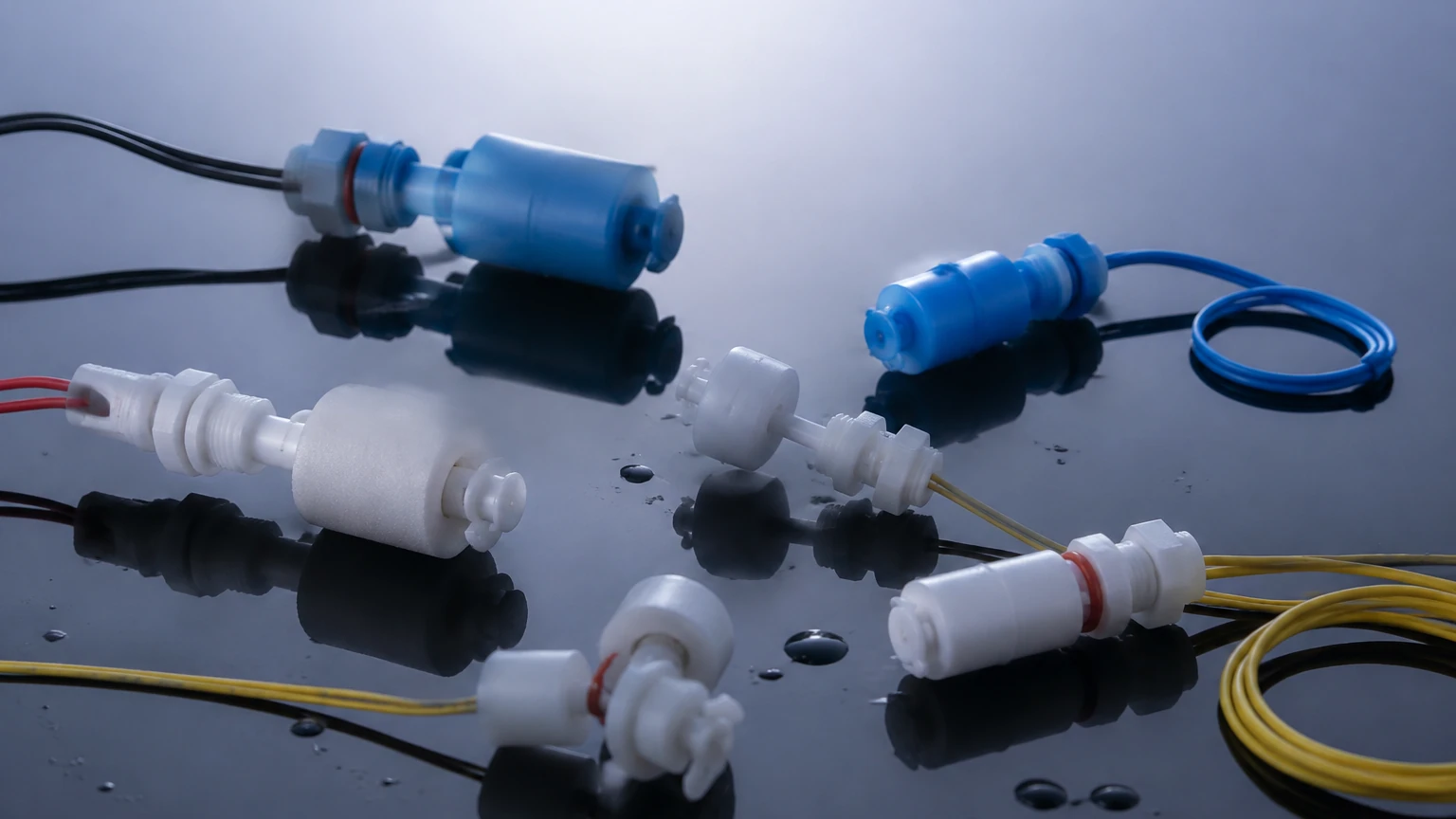
A mini float switch typically consists of a hollow float containing a permanent magnet and a stationary stem (or body) that houses a hermetically sealed reed switch. As the liquid level rises or falls within a vessel, the float moves vertically or swings on a hinge along the stem.
The Reed Switch Interaction
When the float moves into the proximity of the internal reed switch, the magnetic field causes the reed blades to either touch (closing the circuit) or separate (opening the circuit). This transition provides a digital signal—either Normally Open (NO) or Normally Closed (NC)—that can be used to trigger alarms, start or stop pumps, or open solenoid valves. Because the reed switch is sealed in an inert gas environment within the stem, it is protected from oxidation and corrosion, contributing to a high cycle life.
Technical Classifications and Materials
Selecting the right mini float switch depends heavily on the chemical nature of the fluid and the physical environment of the application. Welk offers various configurations to suit these needs.
1. Plastic Mini Float Switches (PP/PVDF)
Polypropylene (PP) is the most common material for general-purpose applications. It is lightweight, highly buoyant, and resistant to many acids and alkalis. For more aggressive chemical environments or higher temperature requirements, Polyvinylidene Fluoride (PVDF) is often utilized. These are frequently found in water treatment, laboratory equipment, and chemical dosing pumps.
2. Stainless Steel Mini Float Switches (SUS304/SUS316L)
For high-temperature, high-pressure, or food-grade applications, stainless steel is the industry standard. Stainless steel mini float switches can withstand temperatures exceeding 120°C and pressures up to 3.0 MPa (approx. 435 psi). They are essential in the pharmaceutical, food and beverage, and petrochemical sectors where hygiene and durability are paramount.
3. Mounting Orientations
* Vertical Mounting: The switch is installed through the top or bottom of a tank. These are ideal for deep tanks where the level needs to be sensed at a specific height.
* Horizontal (Side) Mounting: The switch is installed through the side wall of the tank. These are often used in small tanks where top access is restricted or where only a high/low limit is required.
Selection Criteria for Industrial Applications
When specifying a mini float switch for a project, engineers must evaluate several parameters to prevent premature failure. The following table provides a comparison of typical specifications for standard mini float switches.
| Feature | Polypropylene (PP) | Stainless Steel (304/316L) |
| :— | :— | :— |
| Max Temperature | 80°C (176°F) | 120°C – 200°C (392°F) |
| Max Pressure | 0.5 MPa (72 psi) | 3.0 MPa (435 psi) |
| Specific Gravity | > 0.55 | > 0.70 |
| Chemical Resistance | Excellent for acids/bases | Excellent for solvents/oils |
| Food Grade | Limited | Yes (316L) |
| Typical Application | Water tanks, humidifiers | Boilers, medical autoclaves |
Electrical Considerations
Mini float switches are generally designed for low-power signaling. Standard contact ratings often range from 10W to 50W. It is critical to note that these switches should not be used to drive high-current loads like large pumps or motors directly. Instead, they should be connected to a relay or a PLC (Programmable Logic Controller) input to ensure the reed switch does not weld shut due to arcing.
Installation and Engineering Considerations
Proper installation is the key to the longevity of a mini float switch. Even the most robust sensor will fail if environmental factors are ignored.
1. Turbulence and Sloshing
In tanks with high agitation or inflow, the float may bounce rapidly, causing "chatter" in the electrical signal. This can be mitigated by using a stilling well (a pipe surrounding the float) or by implementing a time-delay relay in the control circuit to filter out brief transitions.
2. Magnetic Interference
Since the switch relies on a magnetic field, it should be kept away from strong external magnetic sources, such as large motors or high-voltage transformers, which could cause false triggering.
3. Orientation and Logic Reversal
Most vertical mini float switches allow the user to change the logic from Normally Open to Normally Closed by simply removing a retaining clip and flipping the float 180 degrees. This flexibility is highly valued in the field for adapting to different control logic requirements.
4. Wiring and Sealing
Ensure that the lead wire exit is properly sealed, especially in humid environments. While the switch body is waterproof, the junction where the wires connect to the system must be protected to prevent moisture from wicking into the sensor stem.
Limitations of Mini Float Switches
While highly versatile, mini float switches are not suitable for every application. Engineers should consider alternative technologies from the Welk Main Page if the following conditions exist:
* Viscous Fluids: Highly thick or sticky liquids can cause the float to bind to the stem, preventing movement.
* Granular Solids: Float switches are designed for liquids only; powders or granules will jam the mechanical components.
* Coating and Buildup: If the liquid tends to crystallize or leave heavy deposits, the float may eventually become stuck. In such cases, non-contact methods like ultrasonic or radar level meters are preferred.
* High Vibration: Extreme mechanical vibration can cause the reed switch to vibrate, leading to signal instability.
Common Applications in Industry
Mini float switches are ubiquitous in modern industrial design due to their small footprint and reliability.
* HVAC Systems: Monitoring condensate levels in air conditioning units to prevent overflow.
* Medical Equipment: Controlling the level of reagents in clinical analyzers or water levels in sterilization units.
* Food & Beverage: High-level alarms in coffee machines, vending units, and small batch processing tanks.
* Automotive: Sensing coolant, washer fluid, and brake fluid levels.
* Industrial Automation: Integrated into hydraulic power units to signal low oil levels, protecting pumps from cavitation.
Frequently Asked Questions (FAQ)
Q: Can a mini float switch be used in deionized (DI) water?
A: Yes, but material choice is critical. Stainless steel or high-purity plastics like PVDF are recommended to prevent leaching and ensure the sensor does not contaminate the water.
Q: How do I choose between a 10W and a 50W switch?
A: This depends on your control circuit. If you are switching a small signal to a PLC, 10W is usually sufficient. If you are switching a small relay coil directly, a 50W rating provides a better safety margin against inrush currents.
Q: What is the minimum liquid density required for a mini float switch?
A: Most plastic floats require a specific gravity (SG) of at least 0.55, while stainless steel floats usually require an SG of 0.70 or higher. If the liquid is lighter than the float's buoyancy capability, the float will not rise.
Q: Can I install a mini float switch upside down?
A: Vertical switches can typically be mounted from the top or bottom of the tank. However, you must ensure the float is oriented correctly for the desired NO/NC logic in that specific mounting position.
Conclusion
The mini float switch remains a cornerstone of point-level detection because of its simplicity and effectiveness. By selecting the appropriate materials and adhering to sound installation practices, industrial operators can achieve reliable level control even in the most restricted spaces. For complex applications requiring continuous monitoring or non-contact sensing, exploring a broader range of radar, ultrasonic, and hydrostatic solutions is recommended.
To explore the full range of level measurement technologies and find the specific model that fits your technical requirements, visit the Welk Main Page for detailed product specifications and application support.