Proline Promass F 300 Coriolis Flowmeter
Proline Promass F 300 Coriolis Flowmeter
In the landscape of industrial process control, the Proline Promass F 300 Coriolis flowmeter stands as a benchmark for high-precision measurement. Designed to handle a wide variety of fluids—from corrosive chemicals to viscous hydrocarbons—this instrument provides multi-variable data including mass flow, density, and temperature. For engineers and plant managers, understanding the operational mechanics and integration requirements of this device is essential for optimizing process efficiency and ensuring long-term reliability.
While level measurement technologies, such as those provided by Welk, often focus on the volume and surface position of liquids in tanks, the addition of a Coriolis flowmeter allows for a complete mass-balance approach. This guide examines the technical foundations, application criteria, and installation best practices for the Promass F 300.
Measurement Principle: The Coriolis Effect
To appreciate the capabilities of the proline promass f 300 coriolis flowmeter, one must first understand the underlying physics. Unlike volumetric flowmeters that measure the space occupied by a fluid, Coriolis meters measure mass directly.
The Physics of Oscillation
The instrument consists of one or two measuring tubes that are vibrated by an electromagnetic drive coil at their resonant frequency. When a fluid flows through these vibrating tubes, the inertia of the moving mass causes a slight distortion or "twist" in the tube's oscillation. This phenomenon is known as the Coriolis effect.
Phase Shift and Mass Flow
Sensors located at the inlet and outlet of the tubes detect the oscillation. When there is no flow, the tubes vibrate in sync. As fluid begins to move, the inlet and outlet sections of the tube vibrate with a time delay, or phase shift. This phase shift is directly proportional to the mass flow rate. Because mass is an intrinsic property of the fluid that does not change with temperature or pressure, the Coriolis principle offers inherently higher accuracy than volumetric methods in varying process conditions.
Density and Temperature Measurement
In addition to mass flow, the resonant frequency of the tubes changes based on the density of the fluid inside them. A denser fluid increases the mass of the vibrating system, lowering the frequency. By measuring this frequency, the proline promass f 300 coriolis flowmeter provides real-time density data. Integrated Pt1000 sensors also monitor the tube temperature to compensate for thermal expansion and provide a secondary process variable.
Technical Capabilities of the Promass F 300
The "300" designation refers to the transmitter electronics housing, which is designed for compact installation and advanced digital communication. The Promass F sensor itself is renowned for its robustness and performance in demanding environments.
Key Performance Specifications
* Mass Flow Accuracy: Up to ±0.05% of the reading for liquids and ±0.35% for gases.
* Density Accuracy: Standard calibration provides ±0.0005 g/cm³.
* Turndown Ratio: Capable of maintaining accuracy over a wide range, often exceeding 100:1.
* Process Temperature: Standard models handle -50 °C to +150 °C, with high-temperature variants reaching +350 °C.
* Pressure Rating: Suitable for processes up to 100 bar (1450 psi), depending on the flange rating and tube material.
Heartbeat Technology
One of the most significant advancements in the 300-series transmitter is the inclusion of Heartbeat Technology. This suite of diagnostic tools allows for continuous self-monitoring and verification of the instrument’s health without interrupting the process. It provides documented proof of measurement integrity, which is vital for industries subject to strict regulatory compliance or safety integrity level (SIL) requirements.
Application in Level and Inventory Management
In many industrial settings, flow measurement and level measurement are used in tandem to provide a comprehensive view of inventory. While a radar level meter or a hydrostatic transmitter on the Main Page provides the physical height of the liquid in a vessel, the proline promass f 300 coriolis flowmeter provides the precise mass entering or leaving that vessel.
Mass Balance and Density Compensation
In chemical blending or oil storage, the volume of a liquid changes with temperature. Relying solely on level measurement can lead to inaccuracies in inventory accounting if the density is not constant. By integrating the density and mass flow data from a Coriolis meter with the level data from a tank gauge, engineers can calculate the exact mass of the product in storage, regardless of thermal expansion.
Loading and Unloading Stations
Coriolis meters are the preferred choice for custody transfer and loading racks. When filling a tanker truck or railcar, the F 300 ensures that the exact mass of the product is delivered. This prevents overfilling (a safety risk) and underfilling (a commercial loss), providing a secondary check against the vehicle's onboard level sensors.
Selection Criteria and Technical Table
Choosing the correct proline promass f 300 coriolis flowmeter requires an analysis of flow rates, pressure drop, and chemical compatibility. The following table provides a general overview of the sizing and performance for common DN (Diameter Nominal) sizes.
| Nominal Diameter (DN) | Max Flow Rate (kg/h) | Typical Pressure Drop (bar) | Liquid Accuracy (%) | Housing Material |
| :— | :— | :— | :— | :— |
| DN 8 (3/8") | 2,000 | 0.8 | ±0.05 | Stainless Steel / Alloy C22 |
| DN 25 (1") | 18,000 | 0.7 | ±0.05 | Stainless Steel / Alloy C22 |
| DN 50 (2") | 70,000 | 0.6 | ±0.05 | Stainless Steel / Alloy C22 |
| DN 100 (4") | 350,000 | 0.5 | ±0.05 | Stainless Steel / Alloy C22 |
| DN 250 (10") | 2,200,000 | 0.4 | ±0.05 | Stainless Steel |
*Note: Pressure drop values are estimates based on water at 20°C. Actual pressure drop depends on fluid viscosity and density.*
Installation Considerations
To maintain the high accuracy of a Coriolis flowmeter, proper installation is critical. Unlike magnetic flowmeters, Coriolis meters are sensitive to mechanical stress and vibration.
Orientation and Entrained Gas
The orientation of the measuring tubes is the most important factor in installation:
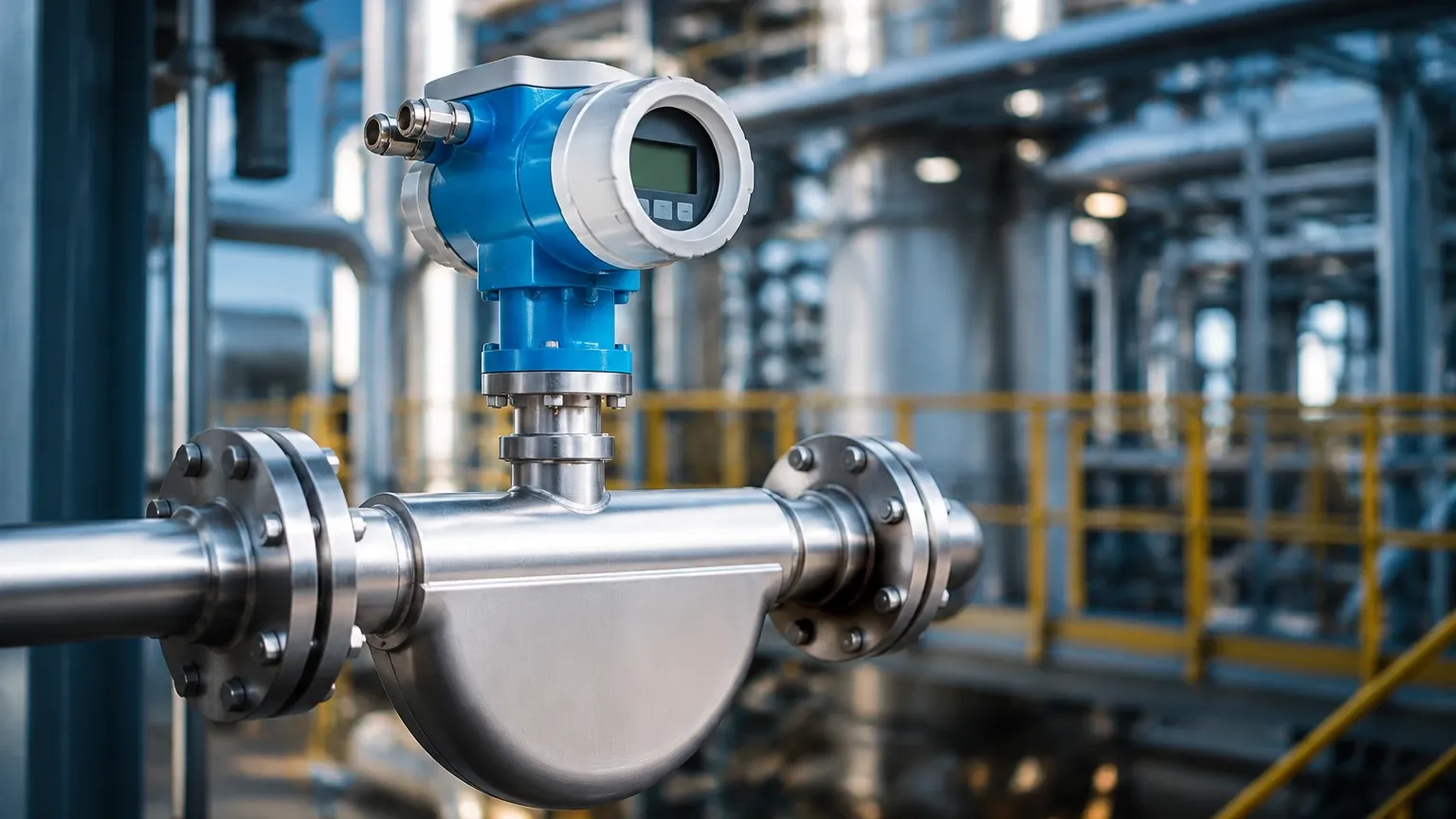
1. Liquids: For liquid applications, the tubes should ideally point downward (the "U" shape facing down). This prevents gas bubbles from becoming trapped in the tubes, which can cause measurement errors or signal loss.
2. Gases: For gas applications, the tubes should point upward. This allows any condensate or liquid droplets to drain out of the tubes by gravity.
3. Vertical Installation: If installing in a vertical pipe, the flow should always be upward to ensure the pipe remains full and to facilitate the passage of bubbles.
Piping Stress and Support
The flowmeter must be installed in a way that minimizes pipe stress. Flanges should be perfectly aligned, and the piping on both sides of the meter should be securely supported. Rigid supports help isolate the meter from external vibrations that might interfere with the tube's natural resonance frequency.
Straight Pipe Runs
One of the advantages of the proline promass f 300 coriolis flowmeter is that it is relatively insensitive to flow profile distortions. Unlike ultrasonic or turbine meters, it generally does not require long straight runs of pipe before and after the meter. However, it is still recommended to avoid installing the meter immediately after a high-pressure drop valve or a pump to minimize cavitation and turbulence.
Limitations and Common Risks
While highly versatile, the Coriolis meter is not a universal solution for every application. Engineers must be aware of its limitations.
* Initial Cost: Coriolis meters represent a significant capital investment compared to magnetic or differential pressure meters. They are typically reserved for applications where high accuracy or multi-variable data is required.
* Pressure Drop: Because the fluid must be split into two smaller measuring tubes, there is an inherent pressure drop across the device. This must be accounted for in the pump sizing and system design.
* Entrained Gas: While the F 300 is better at handling entrained gas than older models, a high volume of gas bubbles in a liquid (slug flow) can dampen the tube vibration and lead to measurement errors. In such cases, air eliminators may be required upstream.
* Erosion and Corrosion: While available in Alloy C22, highly abrasive slurries can wear down the thin-walled measuring tubes over time, eventually leading to tube failure.
Frequently Asked Questions (FAQ)
Q: Can the Promass F 300 measure the flow of non-conductive liquids?
A: Yes. Unlike electromagnetic flowmeters, Coriolis meters do not require the fluid to be conductive. They work equally well with deionized water, hydrocarbons, and pure chemicals.
Q: How often does the meter need to be recalibrated?
A: In many applications, the meter can operate for several years without physical recalibration. Using Heartbeat Technology, users can perform internal verifications that confirm the meter is still within factory specifications, potentially extending the intervals between external calibrations.
Q: Is the 300-series transmitter compatible with modern digital protocols?
A: Yes, the transmitter supports a wide range of protocols, including HART, Modbus RS485, EtherNet/IP, PROFINET, and Foundation Fieldbus. It also features a built-in WLAN server for wireless configuration via a laptop or tablet.
Q: How does the F 300 handle high-viscosity fluids?
A: The F 300 is excellent for high-viscosity fluids. However, as viscosity increases, the pressure drop across the meter will also increase. Sizing software should be used to ensure the pressure drop remains within acceptable limits for the process.
Conclusion
The proline promass f 300 coriolis flowmeter is a sophisticated instrument that provides more than just flow data; it offers a window into the physical properties of the process fluid. By delivering accurate mass, density, and temperature measurements, it enables tighter process control and more reliable inventory management. When combined with specialized level measurement solutions from manufacturers like Welk, it forms the backbone of a robust industrial automation strategy.
For those seeking to integrate these high-precision instruments into their facility, careful attention to sizing, fluid properties, and installation orientation is required. For further information on how flow and level measurement can be optimized for your specific application, you may Review product options and application support to find the most suitable technology for your process requirements.