Fmr20
Fmr20
In the field of industrial automation, the transition from traditional contact-based level measurement to non-contact radar technology has been accelerated by the development of compact, high-frequency sensors. The FMR20 represents a significant milestone in this evolution, specifically designed to meet the requirements of the water and wastewater industry, as well as utility applications across various process sectors. As a compact radar sensor utilizing Frequency Modulated Continuous Wave (FMCW) technology, it offers a blend of precision and ease of use that was previously reserved for high-end process instrumentation.
Understanding the Measurement Principle
To appreciate the capabilities of the FMR20, it is essential to understand the underlying physics of radar level measurement. Radar sensors operate on the Time of Flight (ToF) principle, but the FMR20 specifically utilizes the FMCW method rather than the simpler pulse radar approach.
The FMCW Principle
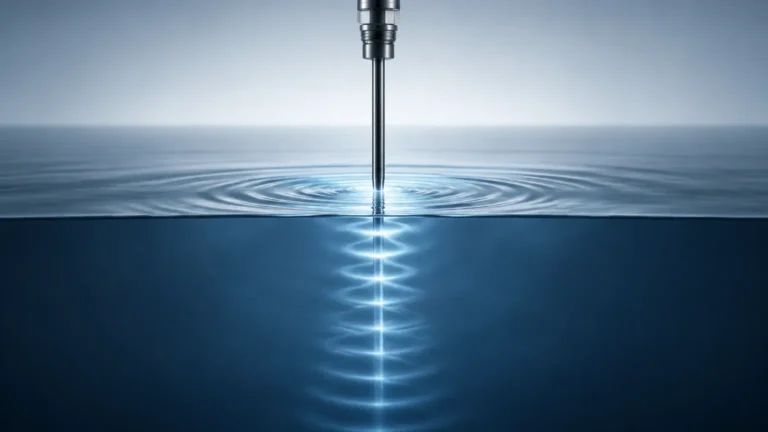
In FMCW radar, the sensor emits a continuous high-frequency signal whose frequency increases linearly over time, creating a "sweep." This signal is reflected by the surface of the medium and received by the antenna. Because the transmitter is constantly changing the frequency of the emitted signal, there is a measurable difference between the frequency currently being transmitted and the frequency of the reflected signal that has just returned. This frequency difference ($Δf$) is directly proportional to the time it took for the signal to travel to the surface and back, which in turn allows the device to calculate the distance with high accuracy.
The Advantage of 80 GHz Frequency
The FMR20 operates in the 80 GHz W-band. In radar engineering, higher frequencies allow for smaller antenna sizes while maintaining a narrow beam angle. A narrow beam is critical in industrial environments because it minimizes the risk of "false echoes" from tank internals such as ladders, pipes, or agitators. While older 6 GHz or 26 GHz radars required large horn antennas to achieve a focused beam, the 80 GHz technology in the FMR20 allows for a compact, fully encapsulated design that can fit into tight spaces without sacrificing signal integrity.
Key Features and Technical Specifications
The FMR20 is characterized by its robust construction and simplified integration. It is often positioned as a direct replacement for ultrasonic sensors, offering better performance in environments where dust, temperature fluctuations, or vapors might interfere with sound waves.
* Measuring Range: Typically up to 10 meters (33 feet) for the standard version, with extended versions reaching up to 20 meters (66 feet).
* Accuracy: Standard accuracy is within ±2 mm (0.08 inches), providing reliable data for inventory control and process monitoring.
* Housing Material: Usually constructed from PVDF (Polyvinylidene fluoride), which offers excellent resistance to UV radiation and chemical corrosion.
* Ingress Protection: Rated at IP66/IP68, making it suitable for outdoor installation and areas prone to flooding.
* Connectivity: Support for 4-20mA HART, Modbus RS485, and increasingly, Bluetooth for wireless commissioning and maintenance.
Application Suitability and Selection Criteria
Selecting the right level transmitter requires an analysis of the medium, the vessel geometry, and the environmental conditions. The FMR20 is highly versatile but excels in specific scenarios.
Primary Applications
1. Water and Wastewater: Monitoring levels in storage tanks, pump stations, and open channels. Its non-contact nature prevents sensor fouling from sewage or debris.
2. Chemical Storage: Ideal for small plastic tanks containing acids or alkalis, as the radar signal can often measure through the plastic roof of a tank (depending on material thickness and dielectric constant).
3. Utilities: Monitoring fuel oil tanks, cooling water basins, and demineralized water storage.
Selection Table: Radar vs. Ultrasonic
When evaluating whether to use the FMR20 or a traditional ultrasonic sensor, consider the following technical factors:
| Feature | FMR20 (80 GHz Radar) | Ultrasonic Sensors |
| :— | :— | :— |
| Medium Influence | Unaffected by air density or vapors | Highly sensitive to air temperature and vapors |
| Accuracy | ±2 mm | Typically ±0.2% of range |
| Blocking Distance | Very small (approx. 50 mm) | Significant (250 mm to 500 mm) |
| Surface Turbulence | High resistance | Limited performance |
| Foam | Moderate resistance (frequency dependent) | Poor performance (absorbs sound) |
| Vacuum/Pressure | Works in vacuum | Requires air medium to function |
For engineers looking to compare these technologies against a broader range of industrial level measurement instruments, including magnetic gauges or hydrostatic transmitters, reviewing comprehensive Main Page resources is recommended to ensure the selected technology aligns with the specific process safety and accuracy requirements.
Installation Considerations
Proper installation is the most critical factor in ensuring the longevity and accuracy of a radar level sensor. While the 80 GHz beam is narrow, certain geometric rules must be followed.
1. Nozzle Height and Diameter: The antenna should ideally extend slightly below the nozzle to prevent signal interference from the nozzle edge. However, due to the 80 GHz narrow beam, the FMR20 is more forgiving of high nozzles than lower-frequency radars.
2. Mounting Position: The sensor should not be mounted in the center of a tank (to avoid multiple reflections from the tank walls) nor too close to the wall (to avoid signal attenuation). A position at 1/6th to 1/4th of the tank diameter from the wall is generally optimal.
3. Obstructions: Ensure the signal beam does not intersect with inflow streams, internal pipes, or heating coils. Even with a narrow beam, a metal pipe directly in the path will create a significant false echo.
4. Alignment: The sensor should be mounted perpendicular to the liquid surface. While the FMR20 can handle some slight misalignment, a perpendicular orientation ensures the maximum signal strength is returned to the receiver.
Limitations and Technical Constraints
Despite its advanced technology, the FMR20 is not a universal solution for every level measurement challenge. Engineers must be aware of its limitations:
* Dielectric Constant (Dk): Radar relies on the reflection of electromagnetic waves. Media with a very low dielectric constant (such as certain liquified gases or pure oils) may not reflect enough energy for a reliable signal. The FMR20 typically requires a Dk > 1.6.
* Heavy Foam: While radar is superior to ultrasonic in many foamy applications, extremely dense, thick foam can still absorb the 80 GHz signal, leading to signal loss.
* Extreme Temperatures: As a compact, plastic-housed sensor, the FMR20 is generally limited to process temperatures between -40°C and +80°C. For high-temperature molten metals or high-pressure steam boilers, stainless steel radar units with specialized cooling or isolation are required.
Commissioning via Bluetooth
One of the defining features of the FMR20 series is the integration of Bluetooth wireless technology. This allows technicians to configure the device from a distance of up to 10 meters using a smartphone or tablet. This is particularly valuable in wastewater applications where the sensor might be mounted over a wet well or in a confined space, eliminating the need for climbing harnesses or specialized communication cables.
Through a dedicated app, users can:
* Set the empty and full calibration points.
* View the envelope curve (the visual representation of the radar signal).
* Perform "mapping" to ignore fixed internal obstructions that cause false echoes.
* Download diagnostic reports for maintenance records.
Frequently Asked Questions (FAQ)
Q: Can the FMR20 measure solids?
A: While primarily designed for liquids, the FMR20 can measure some fine-grained solids in small silos. However, for large-scale bulk solids with significant dust and steep angles of repose, a dedicated solids radar with a higher power output and different signal processing algorithms is usually preferred.
Q: Does the sensor require periodic recalibration?
A: No. Radar sensors are solid-state electronic devices with no moving parts. Once calibrated to the tank geometry, they do not suffer from "drift" in the same way that pressure-based or mechanical systems might.
Q: How does rain or condensation affect the measurement?
A: The FMR20 antenna is typically encapsulated in a smooth PVDF surface. While a single drop of water on the lens has minimal impact on an 80 GHz signal, heavy condensation can cause some signal attenuation. The software includes algorithms to compensate for these effects, and the narrow beam helps maintain a strong signal-to-noise ratio.
Q: Is it possible to use the FMR20 in hazardous areas?
A: Yes, specific versions of the FMR20 are available with ATEX, IECEx, and CSA approvals for use in explosive atmospheres (Zone 0, 1, or 2). Always verify the specific marking on the device nameplate before installation in a hazardous zone.
Conclusion
The FMR20 serves as a bridge between basic level switches and high-end, expensive process radars. By leveraging 80 GHz FMCW technology, it provides a high level of reliability in a compact, cost-effective package. For B2B procurement and engineering teams, the decision to implement FMR20 technology often results in reduced maintenance costs and improved process uptime, particularly when replacing aging ultrasonic or mechanical level measurement systems. When planning a facility-wide upgrade, it is beneficial to consult the Main Page to compare these radar units with other complementary technologies like magnetic level gauges or ultrasonic transmitters to ensure a robust and redundant instrumentation strategy.