Proline Prosonic Flow 93t
Proline Prosonic Flow 93t
In the landscape of industrial process control, non-invasive measurement technologies have become essential for maintaining system integrity while gathering precise data. The Proline Prosonic Flow 93t represents a specific category of ultrasonic flow measurement designed for portable, temporary, or verification-based applications. Unlike permanent inline meters, this clamp-on system allows engineers to measure liquid flow rates without interrupting the process or cutting into piping.
For professionals managing complex fluid systems, understanding the underlying physics of ultrasonic technology—and how it differs from related technologies like ultrasonic level measurement—is critical for selecting the right instrumentation. This guide provides a technical analysis of the Proline Prosonic Flow 93t, its operational principles, and its application within industrial environments.
Measurement Principles: Transit-Time Technology
To understand the utility of the Proline Prosonic Flow 93t, one must first distinguish between the various methods of ultrasonic measurement. While manufacturers like Welk specialize in ultrasonic level sensors that utilize the "Time of Flight" (ToF) principle to measure distance to a liquid surface, flowmeters like the 93t typically utilize the "Transit-Time" or "Differential Travel Time" principle.
Transit-Time Difference
In a transit-time system, two ultrasonic transducers are mounted on the exterior of a pipe. These transducers act as both emitters and receivers. They transmit ultrasonic pulses diagonally across the pipe, both upstream and downstream.
1. Upstream Pulse: The signal traveling against the flow of the liquid is slowed down by the fluid's velocity.
2. Downstream Pulse: The signal traveling with the flow is accelerated.
The electronic transmitter (the 93t) measures the extremely small time difference between these two pulses. This difference is directly proportional to the average flow velocity of the liquid. Once the velocity is known, and the internal cross-sectional area of the pipe is calculated (based on user-entered pipe diameter and wall thickness), the volumetric flow rate can be determined.
Reynolds Number Compensation
Flow profiles within a pipe are rarely perfectly uniform. Depending on the fluid's viscosity and velocity, the flow may be laminar, transitional, or turbulent. The Proline Prosonic Flow 93t incorporates sophisticated software algorithms to compensate for these flow profiles by calculating the Reynolds number in real-time. This ensures that the velocity measured along the acoustic path is accurately converted into a true volumetric flow rate.
Technical Overview of the Proline Prosonic Flow 93t
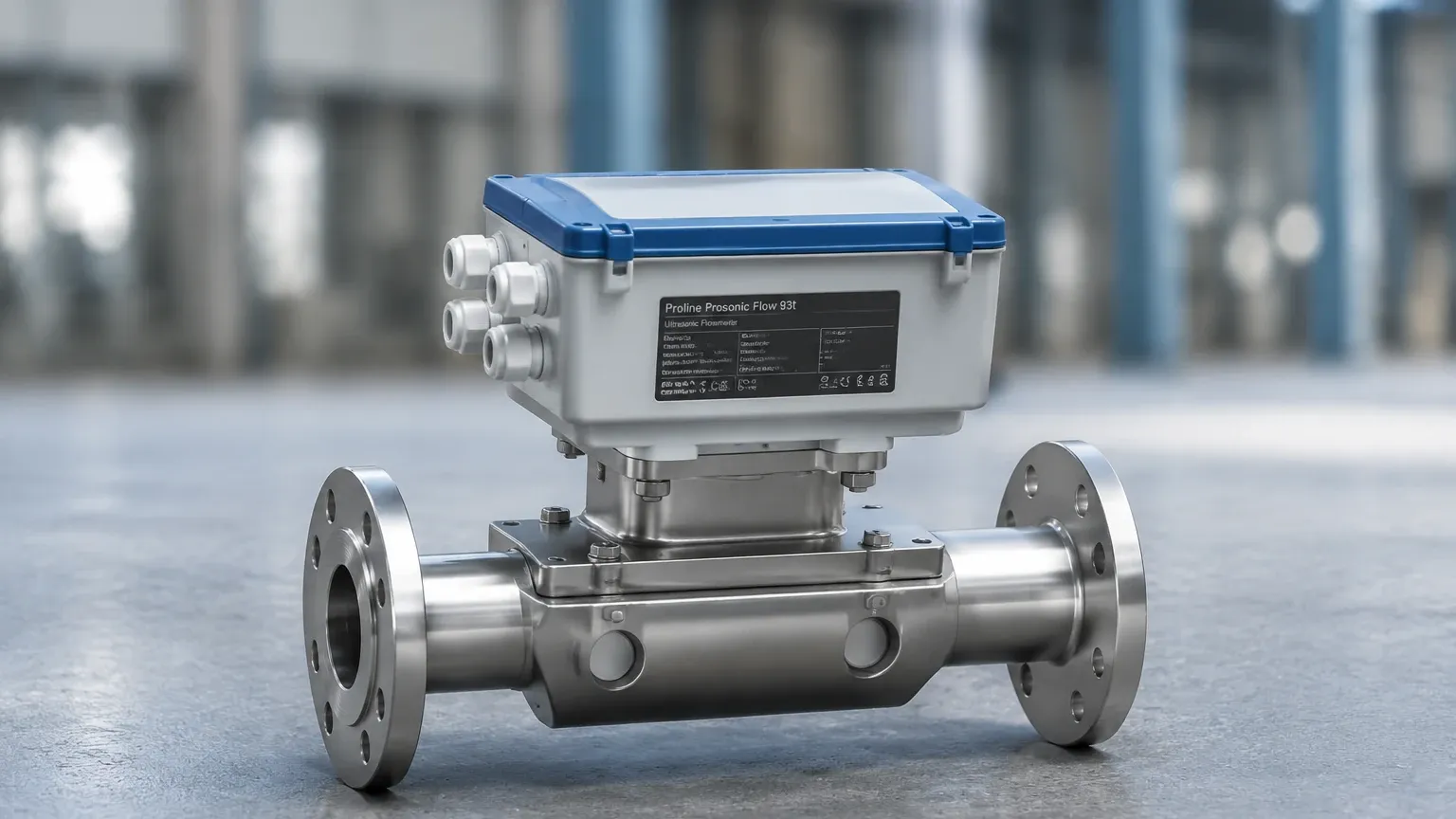
The 93t is the transmitter component of a portable measurement system. It is usually paired with clamp-on sensors (such as the Prosonic Flow P or W) that are strapped to the outside of the pipe. This configuration is particularly valued for commissioning, maintenance, and the verification of existing flowmeters.
Key Features and Capabilities
- Dual-Channel Measurement: The 93t can often handle two sets of sensors simultaneously. This allows for the measurement of two different pipes or the use of two paths on a single pipe to increase accuracy in unstable flow conditions.
- Data Logging: Integrated memory allows for the recording of flow data over time, which can then be exported for analysis via specialized software.
- Touch Control: The interface is designed for field use, often featuring a backlit display and touch-sensitive keys that can be operated through the housing glass, maintaining the device's environmental seal.
- Wide Fluid Compatibility: It is capable of measuring virtually any clean, sonically conductive liquid, including water, chemicals, solvents, and hydrocarbons.
Technical Specifications Table
| Feature | Specification |
| :— | :— |
| Measurement Principle | Ultrasonic Transit-Time |
| Pipe Diameter Range | 15 mm to 4000 mm (0.5 in to 160 in) |
| Fluid Temperature | -40°C to +170°C (-40°F to +338°F) |
| Accuracy | ±0.5% to ±2.0% of rate (depending on installation) |
| Repeatability | 0.3% |
| Outputs | 0/4-20mA, Pulse/Frequency/Status |
| Data Storage | Integrated logger (e.g., 10,000+ measured values) |
Selection Criteria for Portable Ultrasonic Flowmeters
When evaluating the Proline Prosonic Flow 93t against other measurement solutions, engineers must consider several application-specific factors. The choice of a portable ultrasonic meter is usually driven by the need for flexibility and the avoidance of process downtime.
1. Fluid Characteristics
Transit-time meters require the fluid to be relatively clean. While the 93t can handle a small percentage of solids or entrained gas bubbles (typically less than 1% to 2% by volume), excessive aeration or high turbidity will scatter the ultrasonic signal, leading to a loss of signal strength. For fluids with high solids content, a Doppler-style meter or an electromagnetic flowmeter might be more appropriate.
2. Pipe Material and Condition
The ultrasonic signal must pass through the pipe wall, through the liquid, and through the opposite pipe wall. Therefore, the pipe material must be sonically conductive. Materials like carbon steel, stainless steel, ductile iron, and most plastics (PVC, PE) are excellent candidates. However, pipes with internal liners (like cement or thick bitumen) or pipes that are heavily corroded internally can pose challenges, as the air gaps or irregular surfaces can attenuate the signal.
3. Accuracy Requirements
While inline ultrasonic meters can achieve accuracies better than ±0.5%, clamp-on meters like the 93t typically operate in the ±1% to ±3% range. The accuracy is highly dependent on the precision of the site data provided by the user (exact pipe OD, wall thickness, and fluid properties).
Installation and Commissioning Best Practices
The performance of the Proline Prosonic Flow 93t is heavily reliant on proper installation. Because the sensors are not in direct contact with the fluid, the physical mounting process is the most critical step in ensuring reliable data.
Pipe Preparation and Straight Runs
To achieve a stable flow profile, the sensors must be placed on a straight section of pipe. The general rule of thumb is the "15D/5D" rule:
- Upstream: At least 10 to 15 pipe diameters of straight pipe after any elbows, pumps, or valves.
- Downstream: At least 5 pipe diameters of straight pipe before the next obstruction.
If these distances are not met, the flow profile may be distorted, leading to significant measurement errors.
Sensor Mounting Modes
Depending on the pipe size and liquid attenuation, the sensors can be mounted in different configurations:
- V-Mode (2 Traverses): The signal bounces off the opposite wall once. This is the standard for medium-sized pipes (50 mm to 600 mm).
- Z-Mode (1 Traverse): Sensors are mounted on opposite sides of the pipe. This is used for large pipes or highly attenuating liquids where a shorter signal path is required.
- W-Mode (4 Traverses): The signal bounces three times. This is used for very small pipes to increase the transit time and improve resolution.
Acoustic Coupling
An acoustic coupling agent (grease or gel) must be applied between the sensor face and the pipe wall. This eliminates any air gaps, which would otherwise reflect 100% of the ultrasonic energy. For long-term portable studies, high-temperature or long-lasting acoustic pads may be used.
Comparing Ultrasonic Flow and Level Measurement
In many industrial plants, such as those in water treatment or chemical processing, both ultrasonic flow and level measurement are used. While they share the same fundamental technology—piezoelectric crystals generating high-frequency sound waves—their application and hardware differ significantly.
| Feature | Ultrasonic Flow (e.g., 93t) | Ultrasonic Level (e.g., Welk Sensors) |
| :— | :— | :— |
| Primary Goal | Velocity and Volume Flow | Distance to Surface / Volume in Tank |
| Medium | Liquid in a full pipe | Air/Gas space above a liquid/solid |
| Sensor Contact | External (Non-invasive) | Top-mounted (Non-contact or invasive) |
| Frequency | Typically 0.5 MHz to 4 MHz | Typically 20 kHz to 80 kHz |
| Signal Path | Through pipe wall and liquid | Through air to surface and back |
For facilities looking to integrate comprehensive monitoring, reviewing the range of available technologies is essential. For more information on industrial-grade measurement instruments, including those for level and flow applications, you may visit the Main Page of specialized instrument manufacturers.
Limitations and Operational Risks
Despite the versatility of the Proline Prosonic Flow 93t, there are specific limitations that engineers must account for during the planning phase.
1. Pipe Wall Interference: If the pipe wall thickness is not uniform or if there is significant scaling/pitting on the inside, the ultrasonic signal may be refracted or absorbed.
2. Partially Filled Pipes: Transit-time flowmeters require a full pipe to function. If the pipe is only partially full, the signal path through the liquid is broken, and the meter will report an error. For open channels or partially filled pipes, ultrasonic level sensors combined with a flume or weir are the standard solution.
3. Signal Attenuation in High-Viscosity Liquids: Highly viscous fluids can absorb ultrasonic energy more rapidly than water-like fluids, sometimes requiring higher-power transducers or Z-mode mounting.
4. Ambient Noise: In environments with extreme mechanical vibration or high-frequency electrical noise, the sensitive electronics of the 93t may require additional shielding or filtered power supplies to maintain signal integrity.
Frequently Asked Questions (FAQ)
Q: Can the Proline Prosonic Flow 93t measure gas flow?
A: No, the 93t is specifically designed for liquid applications. Gas flow measurement requires different transducer frequencies and much higher signal amplification due to the low density of gases.
Q: How often does the unit need to be calibrated?
A: As a portable verification tool, it is recommended to have the transmitter and its associated sensors calibrated annually against a master meter to ensure the electronics and transducer sensitivity remain within factory specifications.
Q: Does the pipe material affect the accuracy?
A: Yes. The transmitter must know the "Sound Velocity" of the pipe material to calculate the refraction angle of the ultrasonic beam. If the material is unknown or its properties have changed due to extreme heat, the accuracy will decrease.
Q: Can it be used on plastic pipes?
A: Yes, it works effectively on PVC, HDPE, and PP pipes, provided they are not multi-layered with air gaps between the layers.
Conclusion
The Proline Prosonic Flow 93t serves as a vital tool for industrial diagnostic and verification tasks. By leveraging transit-time ultrasonic technology, it provides a non-invasive window into the flow dynamics of a piping system. However, successful measurement depends on a thorough understanding of the fluid properties, pipe condition, and the physical principles of acoustic propagation. For engineers tasked with optimizing plant performance, the 93t offers a balance of portability and precision that inline meters cannot match, provided that installation guidelines and fluid limitations are strictly observed. When integrated alongside reliable level measurement systems, these instruments form the backbone of modern industrial automation and process control.