Remote Water Level Monitoring System
Remote Water Level Monitoring System
In modern industrial and municipal infrastructure, the ability to monitor fluid levels from a distance is no longer a luxury but a fundamental requirement for operational efficiency and safety. A remote water level monitoring system integrates field-level sensing technology with data transmission hardware and software platforms to provide real-time visibility into water resources, industrial tanks, and wastewater networks.
For engineers and facility managers, selecting the right system involves understanding the interplay between measurement physics, environmental constraints, and data telemetry. This guide examines the core technologies used in remote monitoring, provides selection frameworks, and outlines the technical considerations necessary for successful deployment.
Measurement Principles in Water Level Sensing
Before implementing a remote water level monitoring system, it is essential to understand the physical principles governing the sensors. Most industrial systems rely on one of three primary technologies: radar, ultrasonic, or hydrostatic pressure.
1. Radar Level Measurement (Non-Contact)
Radar level meters operate on the Time-of-Flight (ToF) principle using high-frequency electromagnetic waves (typically in the 26 GHz or 80 GHz range). The sensor emits a microwave pulse that travels to the water surface, reflects, and returns to the receiver. Since the speed of light is constant, the time taken for the round trip is directly proportional to the distance.
* Advantages: Radar is unaffected by air temperature, pressure, or vapor. It provides high precision (often within ±2 mm) and is ideal for volatile or high-pressure environments.
* Application: Large reservoirs, chemical storage tanks, and open-channel flow where high accuracy is paramount.
2. Ultrasonic Level Measurement (Non-Contact)
Ultrasonic sensors also use the Time-of-Flight principle but employ sound waves instead of electromagnetic waves. The transducer emits a mechanical sound pulse (ultrasound) that reflects off the water surface.
* Advantages: Highly cost-effective and easy to install. It is a standard choice for basic water and wastewater applications.
* Limitations: Sound speed varies with air temperature and humidity. Furthermore, ultrasonic waves can be scattered by heavy foam, steam, or significant surface turbulence.
3. Hydrostatic Level Measurement (Contact)
Hydrostatic transmitters measure the pressure exerted by the liquid column above the sensor. Based on the principle that $P = \rho gh$ (where P is pressure, $\rho$ is liquid density, $g$ is gravity, and $h$ is height), the sensor converts the measured pressure into a level reading.
* Advantages: Unaffected by surface foam or turbulence. Excellent for deep-well monitoring or narrow boreholes where non-contact sensors cannot "see" the surface.
* Limitations: The sensor must be submerged (contacting the media), and changes in liquid density (due to temperature or chemical composition) can affect accuracy unless compensated.
System Architecture and Data Telemetry
A complete remote water level monitoring system consists of more than just the sensor. The architecture typically follows a four-layer model:
1. Sensing Layer: The radar, ultrasonic, or hydrostatic instrument installed at the measurement point.
2. Transmission/RTU Layer: A Remote Terminal Unit (RTU) or Data Logger that collects the signal (usually 4-20mA, RS485/Modbus, or SDI-12) from the sensor. This unit often includes a cellular (NB-IoT/LTE-M), LoRaWAN, or satellite modem.
3. Network Layer: The communication infrastructure that carries the data from the field to the server.
4. Application Layer: The software interface or SCADA system where users view dashboards, receive SMS/email alerts, and generate reports.
For many organizations, the integration of these layers is simplified by sourcing components from specialized manufacturers. For a comprehensive overview of available industrial hardware, you can visit the Main Page to explore specific sensor configurations and compatibility options.
Selection Criteria for Remote Monitoring
Choosing the appropriate technology depends on the specific requirements of the site. The following table provides a practical comparison for engineering selection.
| Feature | Radar (Non-Contact) | Ultrasonic (Non-Contact) | Hydrostatic (Contact) |
| :— | :— | :— | :— |
| Accuracy | Very High (±2mm to ±5mm) | Moderate (±0.25% of range) | High (±0.1% to ±0.5% FS) |
| Measurement Range | Up to 30m – 120m | Typically up to 15m | Up to 200m+ (cable dependent) |
| Surface Conditions | Tolerates foam/turbulence | Sensitive to foam/vapor | Unaffected by surface state |
| Maintenance | Low (no moving parts) | Low | Moderate (cleaning of diaphragm) |
| Power Consumption | Moderate | Low | Low |
| Cost | Higher | Lower | Moderate |
| Best Use Case | Process tanks, high precision | Open channels, sumps | Deep wells, boreholes, reservoirs |
Installation Considerations and Best Practices
Proper installation is the most critical factor in ensuring the longevity and accuracy of a remote water level monitoring system. Engineers should adhere to the following guidelines:
Beam Angle and Obstructions
For non-contact sensors (Radar and Ultrasonic), the "beam angle" defines the conical area where the signal spreads. If internal tank structures (ladders, pipes, agitators) enter this cone, they will cause false echoes.
* Guideline: Always install the sensor at a distance from the wall (typically at least 200mm) and ensure a clear line of sight to the lowest expected water level.
Dead Zones (Blocking Distance)
Every non-contact sensor has a "dead zone" directly beneath the transducer where it cannot measure. If the water level rises into this zone, the sensor will provide an error or an incorrect reading.
* Guideline: Mount the sensor high enough so that the maximum water level never enters the dead zone (usually 0.2m to 0.5m depending on the model).
Environmental Protection
Remote systems are often located outdoors. Sensors should have an IP68 rating for submersion or high-pressure washdown. Additionally, surge protection (lightning protection) is vital for systems connected to long cable runs or located in open fields.
Power Management
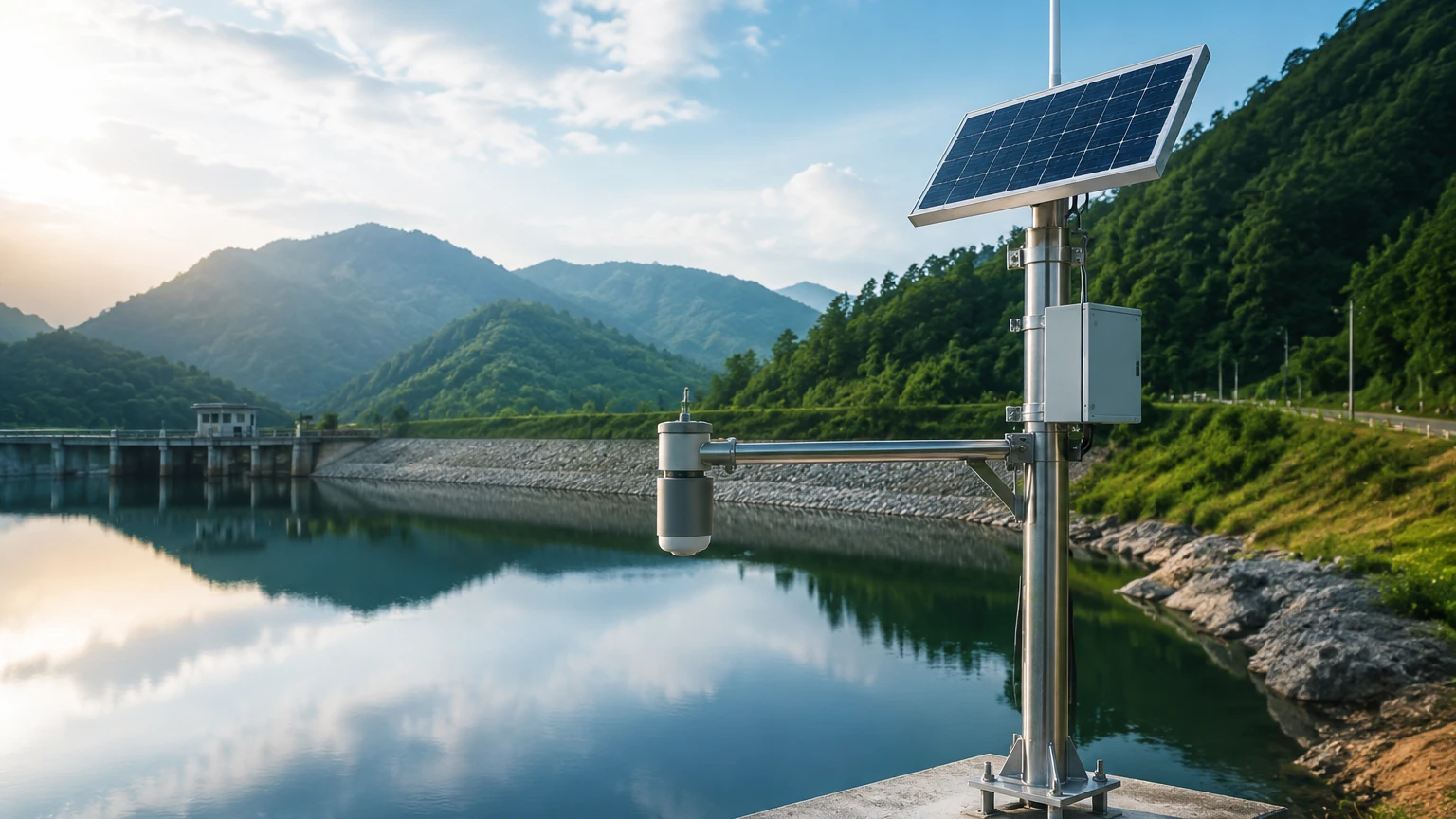
In remote areas without grid power, systems must rely on batteries or solar panels.
* Tip: Utilize "sleep modes" on the RTU where the sensor is only powered up for a few seconds to take a reading before transmitting the data and returning to low-power mode. This can extend battery life from weeks to years.
Limitations and Common Risks
While remote water level monitoring systems are robust, they are not without limitations. Recognizing these risks early can prevent system failure.
1. Signal Attenuation: In ultrasonic systems, heavy steam or dust can absorb the sound energy, leading to a loss of signal. In such cases, radar is the preferred alternative.
2. Atmospheric Venting: Hydrostatic sensors require a vent tube in the cable to compensate for changes in atmospheric pressure. If this tube becomes blocked or moisture enters it, the level reading will drift significantly.
3. Connectivity Gaps: Remote sites may have intermittent cellular coverage. It is recommended to use data loggers with internal memory that can store data locally and "backfill" the server once the connection is restored.
4. Biofouling: In wastewater or natural water bodies, algae and barnacles can grow on submerged hydrostatic diaphragms. Regular cleaning cycles must be factored into the maintenance budget.
Frequently Asked Questions (FAQ)
Q: How often should a remote water level sensor be calibrated?
A: Most modern digital sensors (radar and ultrasonic) are calibrated at the factory and do not drift significantly. However, a manual "dip-tape" verification is recommended every 6 to 12 months to ensure the mounting position has not shifted and the system remains accurate.
Q: Can these systems monitor fluids other than water?
A: Yes. However, for hydrostatic sensors, the specific gravity (density) of the fluid must be programmed into the transmitter. For radar and ultrasonic, the dielectric constant or reflective properties of the fluid may affect the signal strength.
Q: What is the maximum distance for remote data transmission?
A: With cellular (NB-IoT) or satellite communication, the distance is virtually unlimited as long as there is network coverage. For local private networks like LoRaWAN, the range is typically 2–5 km in urban areas and up to 15 km in line-of-sight rural conditions.
Q: Is radar better than ultrasonic for outdoor applications?
A: Generally, yes. Radar is not affected by wind, temperature fluctuations, or fog, which are common environmental factors that can degrade the accuracy of ultrasonic sensors outdoors.
Conclusion
Implementing a remote water level monitoring system requires a balanced approach to hardware selection and environmental assessment. By understanding the measurement principles of radar, ultrasonic, and hydrostatic technologies, and by accounting for installation nuances like beam angles and power management, organizations can build reliable data networks. These systems provide the critical insights needed for flood prevention, industrial process control, and sustainable water management. For further technical specifications and to compare different instrument models, visiting the Main Page will provide the necessary data to move from the planning phase to implementation.