Reuse Industrial Wastewater
Reuse Industrial Wastewater
In the modern industrial landscape, water is no longer viewed as a disposable resource but as a critical asset that requires circular management. The drive to reuse industrial wastewater is fueled by a combination of tightening environmental regulations, increasing water scarcity, and the economic necessity of reducing operational costs. For process engineers and plant managers, implementing a successful water reclamation system depends heavily on the precision of automation, where level measurement serves as the primary feedback loop for every stage of treatment and storage.
To effectively reuse industrial wastewater, facilities must transition from simple discharge models to complex multi-stage treatment processes. These processes—ranging from pH adjustment and sedimentation to advanced membrane filtration—require reliable instrumentation to prevent overflows, protect pumps from dry running, and ensure the optimal dosage of treatment chemicals. This guide explores the engineering principles and instrument selection criteria essential for building robust wastewater reuse infrastructure.
Principles of Level Measurement in Wastewater Treatment
Before selecting hardware for a wastewater reuse project, it is essential to understand the physics behind the primary measurement technologies. In industrial wastewater environments, the media can vary from clear permeate to thick, corrosive sludge, necessitating different sensing principles.
Radar Level Measurement (Non-Contact)
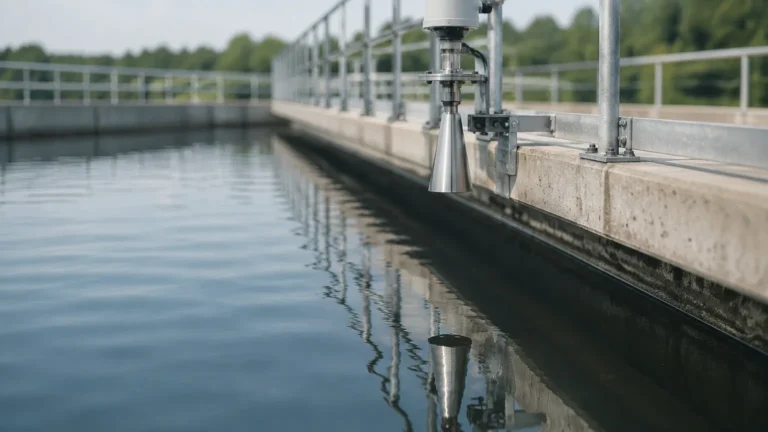
Radar level meters operate on the Time of Flight (ToF) principle. The sensor emits high-frequency microwave pulses (typically in the 26GHz or 80GHz range) that travel at the speed of light. When these pulses hit the surface of the wastewater, they are reflected back to the sensor. The device measures the time interval between emission and reception to calculate the distance.
Radar is highly preferred for industrial reuse applications because it is unaffected by changes in process temperature, pressure, or the presence of vapors. 80GHz radar, in particular, offers a narrow beam angle, which is advantageous in narrow tanks or those with internal obstructions like agitators.
Ultrasonic Level Measurement
Similar to radar, ultrasonic sensors use the ToF principle but utilize sound waves instead of electromagnetic waves. The sensor emits an ultrasonic pulse that reflects off the liquid surface. Because the speed of sound is influenced by air temperature, these sensors include integrated temperature compensation.
Ultrasonic technology is a cost-effective solution for open-air applications, such as flumes, weirs, and open equalization tanks. However, it is sensitive to heavy foam, surface turbulence, and significant temperature gradients, which can attenuate or deflect the sound signal.
Hydrostatic Pressure Measurement
This principle relies on the relationship between liquid height and the pressure exerted at the bottom of a vessel ($P =
ho gh$). A submersible pressure transmitter or a flange-mounted diaphragm measures the head pressure of the liquid column. Since the density ($
ho$) of wastewater can change depending on the concentration of suspended solids, hydrostatic sensors are best used in applications where the fluid density remains relatively constant, such as final effluent storage tanks.
Magnetic Level Gauges
Magnetic level gauges provide both a visual indication and a remote signal. A float containing a permanent magnet moves with the liquid level inside a bypass chamber. This magnet flips external flags for local viewing and can interact with a reed chain or magnetostrictive transmitter for continuous electronic monitoring. This is an ideal solution for chemical reagent tanks used in wastewater neutralization.
Selecting Instruments to Reuse Industrial Wastewater
Choosing the correct instrument depends on the specific stage of the reuse cycle. The following table provides a selection framework based on common industrial wastewater scenarios.
| Application Stage | Typical Media | Recommended Technology | Key Selection Factor |
| :— | :— | :— | :— |
| Equalization Tanks | Raw effluent, debris, foam | 80GHz Radar | Resistance to foam and steam |
| Chemical Dosing | Acids, bases, flocculants | Magnetic Level Gauge / Ultrasonic | Chemical compatibility of wetted parts |
| Sedimentation/Clarifiers | Sludge, high solids | Hydrostatic / Radar | Ability to ignore surface scum |
| Filtration (RO/UF) | Clear permeate | Radar / Pressure Transmitters | High precision for process control |
| Open Channels | Treated discharge | Ultrasonic | Ease of installation over weirs |
| Deep Sumps/Wells | Stormwater, runoff | Submersible Hydrostatic | Durability in submerged conditions |
| Sludge Holding | Thickened sludge | Radar | Non-contact to prevent clogging |
When planning to reuse industrial wastewater, engineers must evaluate the dielectric constant of the fluid for radar applications and the potential for coating or scaling on contact-type sensors. For more detailed technical specifications on these technologies, you can review product options and application support on the Main Page.
Practical Installation Considerations
Even the most advanced level meter will fail to provide accurate data if installed incorrectly. When setting up systems to reuse industrial wastewater, consider the following engineering guidelines:
1. Dead Zones (Blocking Distance): Every non-contact sensor has a "dead zone" directly beneath the transducer face where measurement is impossible. Ensure the maximum expected liquid level does not enter this zone. For ultrasonic sensors, this is typically 0.25m to 0.8m, while modern high-frequency radars have much smaller dead zones (often less than 0.1m).
2. Beam Angle and Obstructions: Ensure the signal beam does not intersect with tank ladders, pipes, or agitator blades. If obstructions are unavoidable, use instruments with "False Echo Suppression" software to map out and ignore static reflections.
3. Mounting Position: Sensors should generally be mounted at least 200mm away from the tank wall to prevent signal interference. They should also be positioned away from the inlet flow to avoid measuring the turbulence of the incoming water rather than the actual tank level.
4. Stilling Wells: In tanks with heavy agitation or surface vortexes, installing the level sensor inside a stilling well (a vertical pipe) can provide a calm surface for more accurate measurement. This is particularly useful for hydrostatic and radar sensors in turbulent equalization basins.
Challenges and Limitations in Wastewater Environments
Industrial wastewater is rarely "clean." Several factors can challenge the reliability of level instrumentation:
* Foam: Heavy chemical or biological foam can absorb ultrasonic signals and scatter radar signals. In such cases, high-power radar or contact-based displacement sensors may be required.
* Vapor and Condensation: In hot wastewater pits, condensation can form on the sensor face. Selecting a radar sensor with a PTFE drip-off antenna design helps prevent water droplets from interfering with the signal.
* Build-up and Scaling: Wastewater often contains minerals or biological matter that can coat sensors. Non-contact sensors are preferred here, but they must still be checked periodically for heavy crusting on the antenna.
* Chemical Aggression: If the reuse process involves aggressive chemicals like sulfuric acid or sodium hydroxide, all wetted parts (flanges, diaphragms, or probes) must be made of compatible materials such as PVDF, Hastelloy, or PTFE-lined stainless steel.
Strategic Steps to Efficiently Reuse Industrial Wastewater
To move toward a zero-liquid discharge (ZLD) or high-recovery reuse model, facilities should follow a structured evaluation process:
1. Wastewater Characterization
Conduct a thorough analysis of the wastewater stream, including TSS (Total Suspended Solids), TDS (Total Dissolved Solids), BOD/COD levels, and pH fluctuations. This data determines which treatment technologies (e.g., Dissolved Air Flotation, Membrane Bioreactors) are necessary and, consequently, what type of level control those units will require.
2. Mass Balance and Storage Capacity
Calculate the volume of water generated versus the volume required for reuse (e.g., cooling tower makeup, boiler feed, or floor washing). Level sensors in storage tanks are critical here to manage the buffer between supply and demand, ensuring that the treatment plant does not overflow during peak production.
3. Integration with Automation
Level data should be integrated into a centralized PLC or SCADA system. This allows for automated pump control, chemical dosing proportional to flow/level, and real-time monitoring of filter backwash cycles. Accurate level measurement is the heartbeat of this automation.
4. Regulatory Compliance
Ensure that the reuse system meets local environmental standards. In many jurisdictions, the volume of water reused must be logged and reported. Reliable level and flow instrumentation provide the necessary documentation for these audits.
Frequently Asked Questions (FAQs)
Q: Can ultrasonic sensors be used in closed tanks with high pressure?
A: Generally, no. Ultrasonic waves require a medium (air) to travel, and changes in pressure significantly affect the speed of sound and the sensor's ability to operate. Radar or hydrostatic pressure sensors are much better suited for pressurized vessels.
Q: How do I measure the level of wastewater if there is a thick layer of oil on top?
A: This is a common challenge in the oil and gas or food processing industries. A magnetic level gauge with a float weighted specifically for the water/oil interface, or a guided wave radar (GWR) capable of interface measurement, are the best solutions.
Q: What is the maintenance cycle for a radar level meter in a wastewater plant?
A: Because they are non-contact, radar meters require very little maintenance. A visual inspection every 6 to 12 months to check for heavy buildup on the antenna is usually sufficient. Recalibration is rarely needed unless the process conditions change drastically.
Q: Is it better to use a submersible pressure sensor or a non-contact radar for a deep lift station?
A: Submersible hydrostatic sensors are often easier to install in very deep, narrow wells. However, if the wastewater contains high levels of fats, oils, and grease (FOG), the sensor diaphragm may become clogged. In those instances, a non-contact radar mounted at the top of the station is a more reliable, albeit more expensive, long-term solution.
Conclusion
The decision to reuse industrial wastewater is a significant step toward operational sustainability. By implementing precise level measurement strategies, plants can optimize their treatment processes, protect expensive filtration equipment, and ensure a reliable supply of reclaimed water. Whether utilizing the high-frequency precision of 80GHz radar or the rugged reliability of hydrostatic transmitters, selecting the right tool for the specific wastewater environment is the foundation of a successful water management strategy. For assistance in selecting the specific hardware for your facility, visit the Main Page to explore professional-grade measurement solutions.