Rheonik Rhm 02
Rheonik Rhm 02
In the field of high-precision process control, the measurement of low flow rates presents a unique set of challenges for engineers. Whether managing chemical injection, high-pressure additives, or laboratory-scale pilot plants, the accuracy of mass flow data directly impacts the efficiency of the entire system, including inventory management and level control. The Rheonik RHM 02 is a specialized Coriolis mass flow meter designed specifically for these low-flow applications.
Understanding how this instrument operates, its technical boundaries, and its relationship to broader process monitoring—such as the level measurement solutions found on our Main Page—is essential for selecting the right instrumentation for a facility.
Understanding Coriolis Mass Flow Measurement Principles
Before evaluating the specific capabilities of the rheonik rhm 02, it is necessary to understand the underlying physics of Coriolis measurement. Unlike volumetric flow meters (such as turbines or ultrasonic meters that measure speed and volume), Coriolis meters measure mass directly.
The Coriolis Effect
The measurement principle relies on the Coriolis effect, an inertial force described by the formula $F_c = -2m(\omega \times v)$, where $m$ is the mass, $\omega$ is the angular velocity, and $v$ is the velocity of the fluid. In a Coriolis meter, the fluid passes through one or two vibrating tubes. These tubes are driven to oscillate at their resonant frequency by an electromagnetic drive coil.
As fluid flows through the vibrating tube, the momentum of the fluid causes the tube to twist. This twisting motion results in a phase shift between the inlet and outlet sides of the tube. Sensors (pick-offs) detect this phase difference, which is directly proportional to the mass flow rate. Because mass is an intrinsic property that does not change with temperature or pressure, Coriolis meters provide highly stable and accurate data regardless of fluid property fluctuations.
Density and Temperature Integration
In addition to mass flow, Coriolis meters like the RHM 02 measure the resonant frequency of the tube oscillation. Since the frequency is a function of the total mass of the tube and the fluid within it, the instrument can calculate the fluid's density in real-time. Furthermore, internal RTD (Resistance Temperature Detector) sensors monitor the tube temperature to compensate for changes in material elasticity. This multi-parameter data is critical for engineers who must correlate mass flow with tank level and volume.
The Rheonik RHM 02: Design and Specifications
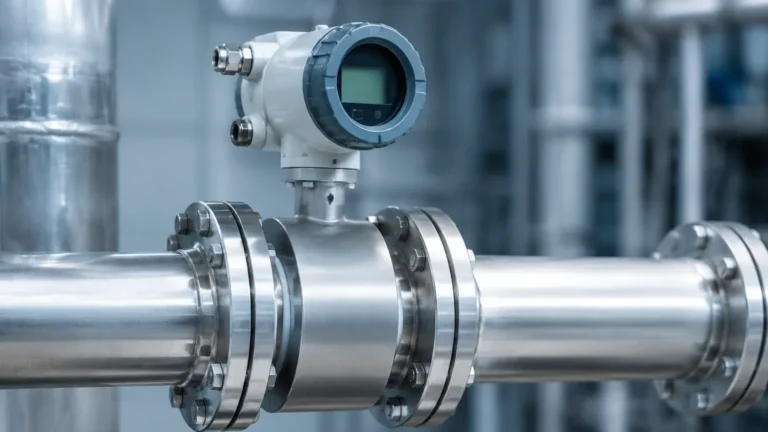
The Rheonik RHM 02 is part of the "Small Size" series of meters, optimized for flow rates that are often too low for standard industrial meters. A distinguishing feature of Rheonik instruments is the "Omega" shape of the measuring tubes. This design provides several mechanical advantages, including high sensitivity to low flow and excellent resistance to external pipe vibrations.
Technical Performance
The RHM 02 is engineered for precision in micro-flow ranges. While specific configurations vary, the general performance characteristics include:
* Flow Range: Typically handles flow rates from as low as 0.002 kg/min (2 g/min) up to approximately 0.6 kg/min (600 g/min).
* Accuracy: Standard mass flow accuracy is often within ±0.2% of the rate, with high-precision versions reaching ±0.1%.
* Pressure Ratings: One of the strongest attributes of the RHM 02 is its ability to operate under extreme pressure. Depending on the material and wall thickness, models can handle up to 900 bar (13,053 psi) or higher.
* Temperature Range: Capable of operating in environments ranging from cryogenic temperatures (-196°C) to high-heat applications (+350°C).
Material Construction
To ensure compatibility with aggressive chemicals or high-purity fluids, the RHM 02 is available in various wetted materials:
1. Stainless Steel (1.4571 / 316Ti): The standard for most industrial applications, offering good corrosion resistance.
2. Alloy C22 (Hastelloy): Used for highly corrosive media such as acids and chlorides.
3. Tantalum: Reserved for the most extreme chemical environments where even high-grade alloys might fail.
Applications in Process Level and Inventory Control
While the rheonik rhm 02 is a flow meter, its data is frequently used in conjunction with level measurement technologies to maintain process equilibrium. In many B2B industrial environments, such as those serviced by Welk's level measurement solutions, mass flow and level are two sides of the same coin.
Mass Balance Level Monitoring
In pressurized reactors or small-scale batching tanks, installing a traditional level sensor (such as a radar or ultrasonic transmitter) can be challenging due to internal obstructions or extreme pressures. In these scenarios, engineers use the "Mass Balance" method. By measuring the exact mass of fluid entering the vessel via an RHM 02 and comparing it to the mass exiting, the current inventory (and thus the level) can be calculated with high precision. This is particularly useful for high-value catalysts or specialty chemicals.
Chemical Injection and Dosing
In water treatment and oil and gas production, chemicals must be injected into a main stream at precise rates. If the injection rate is too low, the process fails; if it is too high, chemicals are wasted. The RHM 02 ensures the dosing is exact. When paired with a level switch or a hydrostatic level transmitter on the chemical supply tank, the system provides a redundant check: the flow meter tracks the rate, while the level sensor tracks the total consumption.
Technical Selection and Comparison
Selecting the correct meter requires comparing the RHM 02 against other low-flow technologies. The following table highlights the differences between Coriolis, Thermal Mass, and traditional level-based dosing monitoring.
| Feature | Rheonik RHM 02 (Coriolis) | Thermal Mass Flow Meter | Level-Based Dosing (Hydrostatic) |
| :— | :— | :— | :— |
| Primary Measurement | Direct Mass Flow | Heat Transfer / Mass | Liquid Level / Head Pressure |
| Accuracy | High (0.1% – 0.2%) | Moderate (1% – 3%) | Moderate (0.5% – 1%) |
| Fluid Independence | High (Works with most fluids) | Low (Requires fluid property data) | High (Density dependent) |
| Pressure Drop | Moderate | Low | N/A |
| High Pressure Capability | Excellent (Up to 900+ bar) | Moderate | Moderate |
| Cost | High | Low to Moderate | Low |
When to Choose the RHM 02
The RHM 02 is the preferred choice when the fluid density is unknown or changing, when the process pressure is exceptionally high, or when the highest possible accuracy is required for custody transfer or critical chemical reactions. If the application involves simple water level monitoring in an atmospheric tank, a hydrostatic level transmitter or ultrasonic sensor from the Main Page would be a more cost-effective solution.

Installation Best Practices for High-Precision Meters
To maintain the ±0.1% accuracy of a rheonik rhm 02, proper installation is mandatory. Coriolis meters are sensitive to how they are mounted and how the fluid enters the sensor.
1. Mechanical Support: The meter should be mounted on a rigid, vibration-free structure. Because the RHM 02 operates on vibration, external mechanical noise can interfere with the pick-off signals.
2. Orientation:
* Liquids: For liquid applications, the meter should ideally be installed with the tubes pointing downward (the "flag" or "U" position) to prevent gas bubbles from becoming trapped in the tubes.
* Gases: For gas applications, the tubes should point upward to allow any condensed liquids to drain out.
3. Stress-Free Piping: Use flexible connectors or ensure that the piping is perfectly aligned before tightening flanges. Stress on the meter body can distort the measuring tubes and cause zero-point drift.
4. Zero Calibration: Once installed and under full process pressure and temperature (but with zero flow), a "zero-point calibration" must be performed. This tells the transmitter what the "no-flow" state looks like in the specific installation environment.
Limitations and Operational Challenges
Despite its precision, the RHM 02 is not a universal solution for every process. Engineers must be aware of its limitations:
* Gas Entrainment: Coriolis meters struggle when there is a mixture of gas and liquid (two-phase flow). Large bubbles can dampen the tube oscillation, leading to "slug flow" errors. While Rheonik's electronics have advanced algorithms to handle some entrainment, it is best to avoid it using air eliminators.
* Pressure Drop: Because the fluid must pass through relatively small-diameter tubes (often 2mm or smaller in the RHM 02), there is a measurable pressure drop. System pumps must be sized to overcome this resistance.
* Initial Cost: The sophisticated construction and electronics make Coriolis meters significantly more expensive than magnetic or ultrasonic flow meters.
Frequently Asked Questions
Q: Can the Rheonik RHM 02 measure the flow of gases?
A: Yes. It is highly effective for high-pressure gas dosing, provided the gas density is sufficient to create a measurable Coriolis force. It is frequently used in hydrogen refueling and CO2 injection.
Q: How often does the meter need recalibration?
A: In stable processes, the RHM 02 can maintain its calibration for several years. However, in critical B2B applications, annual verification is recommended. Many users perform a field check by comparing the meter's totalized mass against the weight change in a supply tank measured by a high-precision level sensor.
Q: Is the RHM 02 compatible with hygienic applications?
A: Yes, there are versions available with polished internals and Tri-Clamp connections that meet food and pharmaceutical standards.
Q: What happens if the fluid contains solids?
A: Small amounts of fine solids can usually be handled, but abrasive particles will wear down the thin-walled measuring tubes over time. Large solids can block the small-diameter tubes of the RHM 02. Upstream filtration is always recommended for micro-flow meters.
For engineers looking to integrate these high-precision flow measurements into a broader level control strategy, reviewing the various sensor technologies available for tank and vessel monitoring is a logical next step. You can Review product options and application support to see how different level measurement instruments can complement your mass flow data for a complete process solution.