Rtd and Thermowell
Rtd and Thermowell
In the landscape of industrial process control, the accurate measurement of temperature is as fundamental as the measurement of pressure or level. For engineers and technicians, the assembly of an rtd and thermowell represents the standard for reliable, high-precision temperature monitoring in challenging environments. While Resistance Temperature Detectors (RTDs) provide the electrical signal necessary for control systems, the thermowell acts as the essential physical barrier, protecting the sensitive instrument from the rigors of the process media.
Understanding the synergy between these two components is critical for ensuring long-term stability and accuracy. This guide explores the principles, selection criteria, and installation best practices for RTD and thermowell assemblies, particularly within the context of industrial automation and level measurement systems where temperature data is often used for density compensation.
Measurement Principles: How RTDs and Thermowells Function
Before selecting hardware, it is necessary to understand the underlying physics that govern these devices. An RTD operates on the principle that the electrical resistance of a metal increases as its temperature rises. This relationship is highly predictable and repeatable.
RTD Operation
Most industrial RTDs utilize platinum as the sensing element due to its chemical stability and linear resistance-temperature relationship. The most common type is the Pt100, which has a resistance of 100 ohms at 0°C. The relationship is defined by the Callendar-Van Dusen equation, which allows transmitters to convert resistance readings into precise temperature values. RTDs are preferred over thermocouples in applications requiring high accuracy and stability over time, typically within a range of -200°C to +600°C.
The Role of the Thermowell
A thermowell is a cylindrical pressure-tight fitting used to protect temperature sensors inserted into industrial processes. It serves three primary functions:
1. Pressure Containment: It acts as a boundary, allowing the sensor to be removed or replaced without breaking the process seal or draining the tank.
2. Mechanical Protection: It shields the delicate RTD element from high-velocity flows, abrasive particles, and corrosive chemicals.
3. Heat Transfer: It must efficiently conduct heat from the process media to the RTD sensor to ensure a rapid and accurate response.
Components of the Assembly
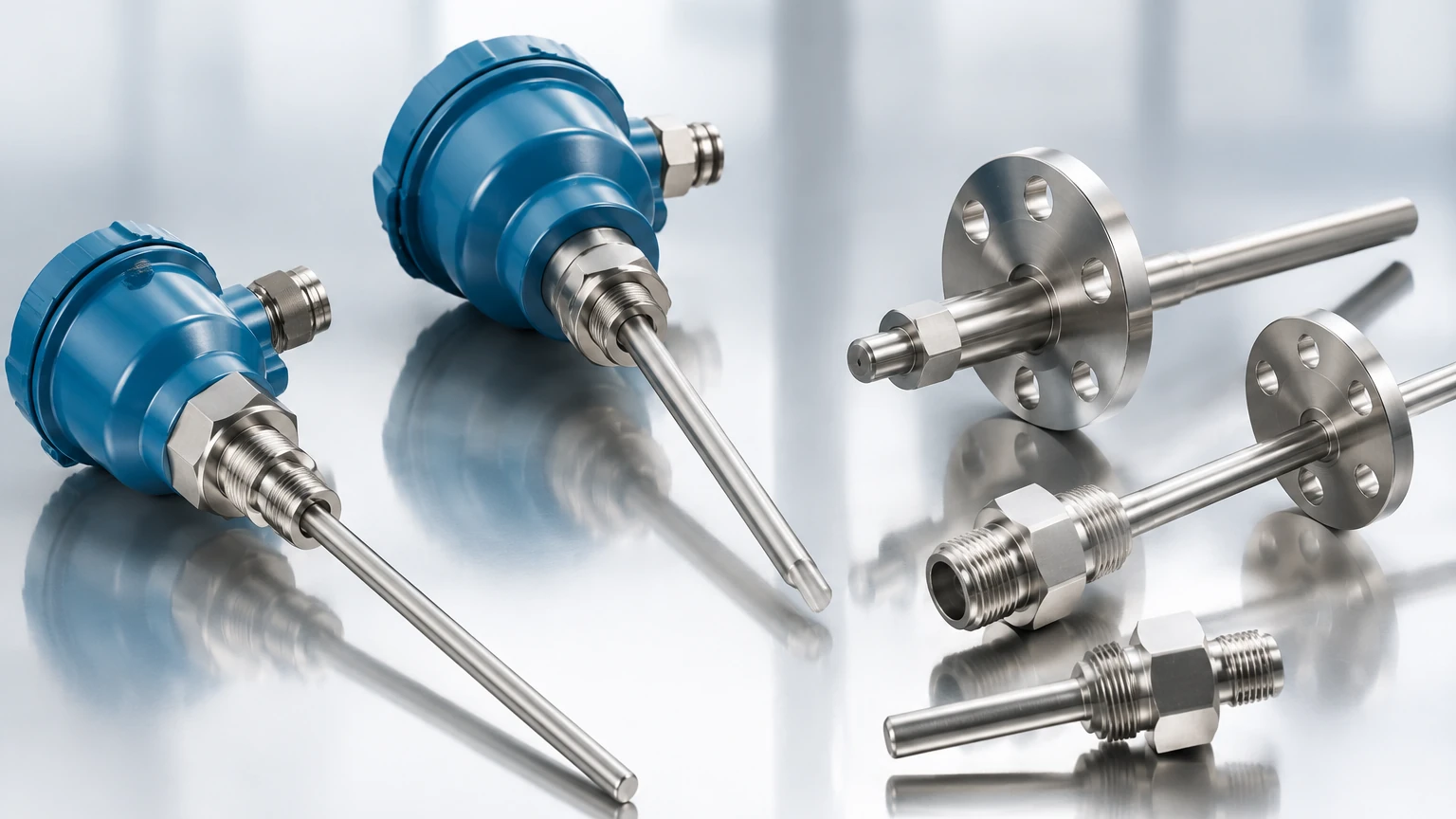
A complete rtd and thermowell assembly typically consists of the following parts:
* The RTD Sensor: The sensing element (wire-wound or thin-film) housed in a metal sheath, usually filled with compacted magnesium oxide (MgO) for insulation and heat transfer.
* The Thermowell: The outer protective housing, which can be machined from solid bar stock or fabricated from tubing.
* The Extension: A pipe or nipple that connects the thermowell to the connection head, often used to move the electronics away from a hot process or through insulation.
* The Connection Head: An enclosure (often aluminum or stainless steel) that houses the terminal block or temperature transmitter.
Selection Criteria for RTD and Thermowell Assemblies
Choosing the right combination requires a balance between mechanical strength and thermal responsiveness. A thermowell that is too thick will have a slow response time, while one that is too thin may fail under process pressure or vibration.
RTD Element Selection
Engineers must first decide on the wiring configuration and accuracy class:
* Wiring: 3-wire and 4-wire configurations are standard in B2B applications to compensate for lead wire resistance, which can otherwise introduce significant errors.
* Accuracy: IEC 60751 defines Class A and Class B tolerances. Class A is generally recommended for critical process control where precision is paramount.
Thermowell Shank Design
The geometry of the thermowell affects its performance in flowing media:
* Straight: Provides uniform strength along the entire length.
* Stepped: Offers a faster response time by reducing the mass at the tip while maintaining a robust base.
* Tapered: The most common choice for high-velocity applications, providing a high strength-to-weight ratio and better resistance to vortex-induced vibrations.
Material Compatibility
Material selection is governed by the chemical nature of the process fluid. Common materials include:
* 316/316L Stainless Steel: The standard for water treatment and general chemical applications.
* Hastelloy C-276: Used for highly corrosive environments involving acids or chlorides.
* Monel 400: Preferred for applications involving sea water or hydrofluoric acid.
Practical Selection Table
| Application Requirement | Recommended RTD Type | Recommended Thermowell Design | Material Consideration |
| :— | :— | :— | :— |
| High Accuracy / Lab Grade | Pt100 Class A (4-wire) | Stepped Shank | 316SS |
| High Velocity Steam | Pt100 Class B (3-wire) | Tapered Shank | Chrome-Moly Steel |
| Corrosive Chemical Tank | Pt100 with PTFE Coating | Straight Shank | Hastelloy or Tantalum |
| General Water Storage | Pt100 Class B (3-wire) | Straight Shank | 304/316SS |
| Cryogenic Storage | Pt1000 | Straight Shank | 316SS |
Installation Considerations and Best Practices
Proper installation is vital to ensure that the rtd and thermowell assembly provides a representative measurement of the process temperature.
Immersion Depth
To minimize conduction errors (heat traveling up the thermowell to the ambient air), the sensor must be sufficiently immersed. A general rule of thumb is an immersion length (U-length) of at least 10 times the thermowell tip diameter for RTDs. In small pipes, the thermowell should be installed at an elbow or inclined against the flow to maximize contact.
Wake Frequency Calculations
In flowing liquids or gases, the fluid passing the thermowell creates vortices (Von Karman trails). If the frequency of these vortices matches the natural frequency of the thermowell, resonance occurs, leading to catastrophic fatigue failure. Engineers should perform a wake frequency calculation according to ASME PTC 19.3 TW to verify that the chosen design can withstand the process velocity.
Process Connections
* Threaded: Common for low-pressure applications; easy to install but prone to leaks if not properly sealed.
* Flanged: The standard for high-pressure and critical chemical processes, offering a robust, leak-proof seal.
* Socket Weld: Used in permanent installations where leakage must be absolutely prevented, though maintenance is more difficult.
Limitations and Common Risks
While RTDs are highly reliable, they are not without limitations:
1. Thermal Lag: The mass of the thermowell introduces a delay in temperature sensing. In rapidly changing processes, this lag must be accounted for in the control loop tuning.
2. Vibration: High-vibration environments can damage the internal RTD element. In such cases, vibration-resistant thin-film elements or spring-loaded sensors should be used.
3. Corrosion: Even "corrosion-resistant" materials can fail if the wrong alloy is chosen for a specific chemical concentration or temperature.
The Relationship Between Temperature and Level Measurement
In many industrial setups, temperature measurement is not an isolated task. For instance, when using hydrostatic level transmitters, the density of the liquid changes with temperature. To maintain accurate level readings, the system must integrate data from an rtd and thermowell to perform real-time density compensation. Similarly, ultrasonic level sensors rely on temperature data because the speed of sound through air is temperature-dependent. Without accurate temperature input, level measurements can drift significantly as ambient or process temperatures fluctuate.
For professionals seeking to integrate these sensors into a broader automation strategy, reviewing available hardware is the next logical step. You can explore a wide range of industrial instrumentation and support resources on our Main Page.
Frequently Asked Questions (FAQs)
Q: Can I use an RTD without a thermowell?
A: Yes, in applications with low pressure, no flow, and non-corrosive media (like ambient air monitoring). However, in most industrial process pipes or tanks, a thermowell is required for safety and maintenance.
Q: What is the difference between a 3-wire and 4-wire RTD?
A: A 3-wire RTD uses a third wire to measure and subtract the lead wire resistance, assuming all wires have equal resistance. A 4-wire RTD is the most accurate, as it completely eliminates the effect of lead wire resistance regardless of imbalances.
Q: How often should an RTD and thermowell be calibrated?
A: This depends on the criticality of the process. Most industrial standards suggest an annual calibration check, although RTDs are known for having very low drift (typically less than 0.1°C per year).
Q: How do I reduce the response time of a thermowell?
A: Using a stepped shank design, reducing the wall thickness (if pressure allows), or using a heat-conductive paste (thermal compound) inside the thermowell can improve response times.
Conclusion
The integration of an rtd and thermowell is a foundational aspect of modern process engineering. By carefully considering the mechanical stresses, chemical environment, and required thermal accuracy, engineers can design a measurement point that is both durable and precise. Whether the goal is simple temperature monitoring or providing critical compensation data for level measurement, the correct selection of materials and geometries is the key to operational success. Always ensure that wake frequency calculations are performed for high-velocity flows and that immersion depths are sufficient to prevent ambient interference.