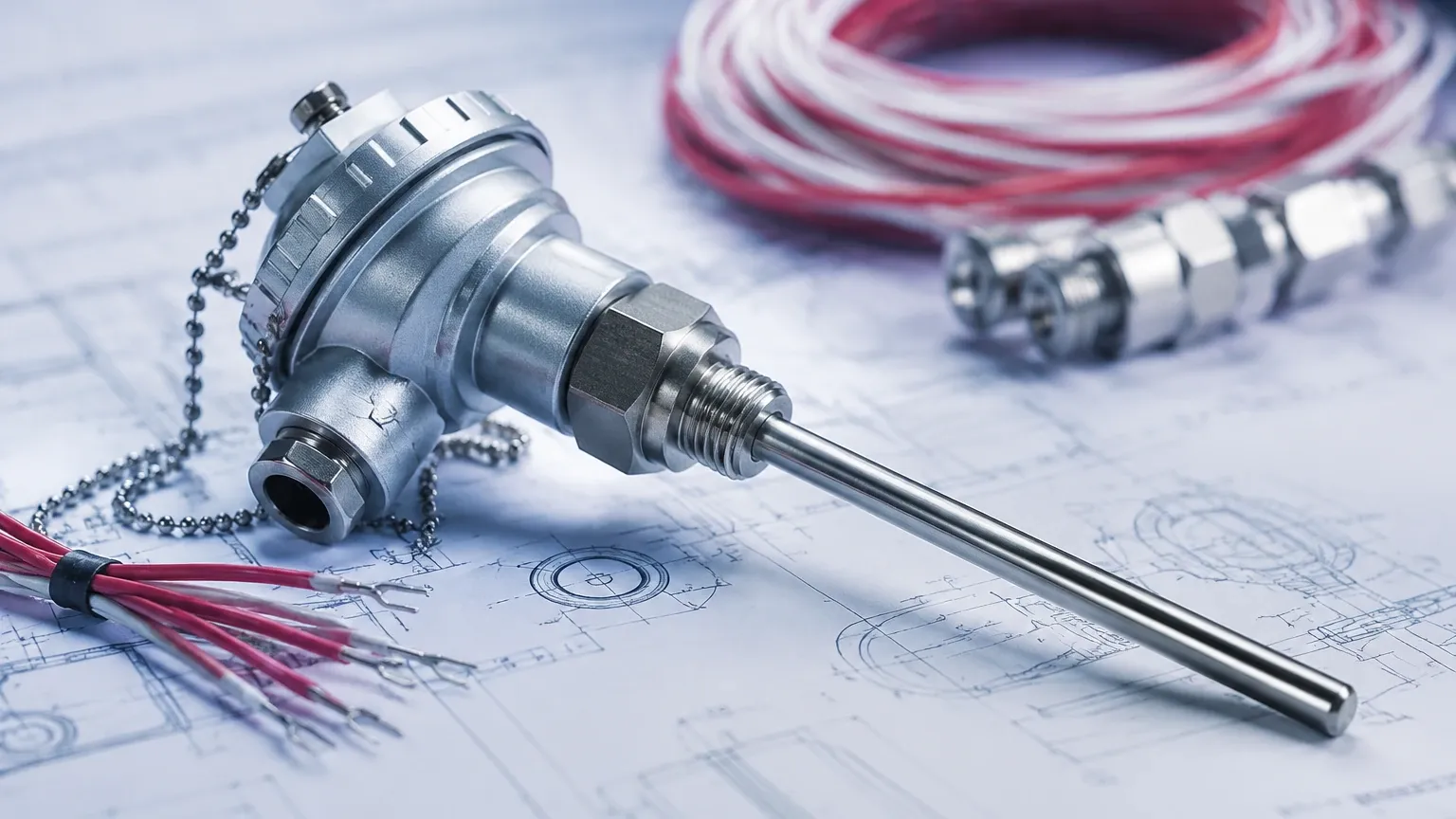
Temperature Rtd
Temperature Rtd
In the landscape of industrial process control, the temperature RTD (Resistance Temperature Detector) stands as a cornerstone technology for precision thermal monitoring. Known for its stability, accuracy, and repeatability, the RTD is essential in applications ranging from chemical processing to water treatment. For engineers and facility managers, understanding the nuances of RTD technology is not merely a matter of measuring heat; it is about ensuring the integrity of complex systems, including level measurement and pressure monitoring, where temperature fluctuations can significantly impact data accuracy.
Understanding the Measurement Principle of Temperature RTDs
The fundamental operation of a temperature RTD is based on the physical property of metals to change their electrical resistance in response to temperature changes. Most metals increase in resistance as they get hotter, a phenomenon known as a positive temperature coefficient (PTC).
For industrial applications, platinum is the most common material used because of its excellent oxidation resistance, wide temperature range, and highly linear relationship between resistance and temperature. The standard industrial RTD is the Pt100, which has a resistance of 100 ohms at 0°C. Another common variant is the Pt1000, offering 1000 ohms at 0°C, which is often preferred in battery-powered or low-power applications to reduce self-heating errors.
The relationship between resistance and temperature is defined by the Callendar-Van Dusen equation. For temperatures above 0°C, the formula is generally simplified to:
\[ R_t = R_0 (1 + At + Bt^2) \]
Where:
- \( R_t \) is the resistance at temperature \( t \).
- \( R_0 \) is the resistance at 0°C.
- \( A \) and \( B \) are constants derived from the properties of the platinum used.
By measuring the resistance across the sensor, the transmitter can calculate the exact temperature with high precision, often within ±0.1°C or better, depending on the accuracy class.
Construction Types: Wire-Wound vs. Thin-Film
When selecting a temperature RTD, engineers must choose between two primary construction methods, each suited for different environmental conditions.
Wire-Wound RTDs
Wire-wound elements consist of a very fine platinum wire wrapped around a ceramic or glass core. This assembly is then sealed within a protective tube.
- Pros: Exceptional accuracy and stability over a very wide temperature range (-200°C to 850°C).
- Cons: They are more fragile and susceptible to damage from high-vibration environments. They also tend to be more expensive due to the manual labor involved in winding the wire.
Thin-Film RTDs
Thin-film elements are manufactured by depositing a thin layer of platinum onto a ceramic substrate using vacuum deposition or sputtering. The platinum layer is then etched into a circuit and coated with glass or epoxy.
- Pros: Highly resistant to vibration and mechanical shock. They are smaller, faster to respond to temperature changes, and more cost-effective for mass production.
- Cons: Generally limited to a narrower temperature range (typically -50°C to 500°C) and may exhibit slightly lower stability at extreme temperatures compared to wire-wound versions.
Wiring Configurations and Lead Wire Compensation
Because an RTD measures resistance, the resistance of the lead wires connecting the sensor to the control system can introduce errors. To mitigate this, three main wiring configurations are used in industrial settings:
1. 2-Wire Configuration: This is the simplest but least accurate method. The resistance of the lead wires is added directly to the sensor's resistance, leading to a higher temperature reading than actual. It is only suitable for applications where the sensor is very close to the transmitter or where high precision is not required.
2. 3-Wire Configuration: This is the industrial standard. A third wire is used to measure the lead wire resistance and subtract it from the total resistance measurement. It assumes that all three wires have the same resistance and are subject to the same ambient conditions.
3. 4-Wire Configuration: Primarily used in laboratories or high-precision industrial processes. It uses two wires to carry the excitation current and two independent wires to measure the voltage drop across the RTD. This completely eliminates the effect of lead wire resistance, providing the highest possible accuracy.
Integration with Level Measurement Systems
In many process industries, temperature RTDs are not standalone instruments but are integrated into broader measurement systems. At Welk, we recognize that accurate level measurement often depends on accurate temperature data.
For instance, hydrostatic level transmitters calculate the height of a liquid based on the pressure exerted by the liquid column. However, liquid density changes with temperature. Without a temperature RTD to provide real-time compensation, the level reading would fluctuate as the process fluid heats or cools, even if the actual volume remains constant.
Similarly, in ultrasonic level sensors, the speed of sound is highly dependent on the temperature of the air or gas through which the pulse travels. An integrated or external RTD ensures that the sensor compensates for these changes, maintaining accuracy across varying seasonal or process temperatures. For more information on how these technologies work together, you can visit our Main Page.
Selection Criteria and Accuracy Classes
Choosing the right temperature RTD requires balancing accuracy requirements with environmental constraints. The International Electrotechnical Commission (IEC) 60751 standard defines several accuracy classes for platinum RTDs.
| Class | Tolerance at 0°C | Tolerance at 100°C | Typical Application |
| :— | :— | :— | :— |
| Class AA (1/3 DIN) | ±0.10°C | ±0.27°C | Precision laboratory work, critical chemical reactions |
| Class A | ±0.15°C | ±0.35°C | General industrial process control, food and beverage |
| Class B | ±0.30°C | ±0.80°C | HVAC, tank monitoring, non-critical utilities |
| Class C | ±0.60°C | ±1.60°C | Basic monitoring where high precision is not required |
Key Evaluation Criteria:
- Temperature Range: Ensure the sensor and its sheath material can withstand the process extremes.
- Response Time: Thin-film sensors are generally faster than wire-wound ones.
- Vibration Levels: High-vibration environments require thin-film elements or specialized ruggedized housings.
- Chemical Compatibility: The outer sheath (usually Stainless Steel 316, Inconel, or PTFE-coated) must be compatible with the process medium.
Installation Best Practices and Maintenance
Correct installation is critical to the longevity and accuracy of a temperature RTD.
* Immersion Depth: To avoid errors caused by heat conduction through the sensor sheath to the ambient air (stem conduction), the sensor should be immersed to a depth of at least 10 times the diameter of the protection tube.
* Use of Thermowells: In high-pressure or corrosive environments, RTDs should be installed inside a thermowell. This allows for the removal and calibration of the sensor without breaking the process seal or draining the tank. Ensure a tight fit or use thermal transfer paste to minimize the time lag caused by the air gap between the sensor and the thermowell wall.
* Lagging: For insulated pipes or tanks, the RTD head should be extended beyond the insulation layer to prevent the electronics from overheating and to allow for easy access.
* Shielding: Use shielded cables to protect the low-voltage resistance signal from electromagnetic interference (EMI) generated by motors or heavy machinery.
Maintenance Checklist:
- Periodically check for moisture ingress in the connection head.
- Inspect the sheath for signs of corrosion or pitting.
- Perform annual calibration checks against a known reference standard to account for sensor drift.
Limitations and Potential Risks
While highly reliable, temperature RTDs have specific limitations that engineers must manage:
* Self-Heating: To measure resistance, a small current is passed through the RTD. This current generates a small amount of heat. If the excitation current is too high, the sensor will report a temperature higher than the actual process temperature. Modern transmitters typically limit this current to less than 1 mA to minimize the effect.
* Response Time: Compared to thermocouples, RTDs generally have a slower response time, especially when housed in heavy-duty thermowells. This may be a factor in high-speed thermal cycling processes.
* Mechanical Stress: Platinum is sensitive to strain. If the sensor is subjected to extreme mechanical stress or bending, the resistance will change, leading to permanent calibration drift.
* Cost: RTDs are generally more expensive than thermocouples, particularly for high-temperature applications where specialized platinum wire is required.
Frequently Asked Questions (FAQs)
Q: Can I use an RTD for temperatures above 600°C?
A: Yes, wire-wound RTDs can reach up to 850°C, but they become increasingly fragile and susceptible to contamination at these levels. For temperatures consistently above 600°C, high-temperature thermocouples are often a more robust choice, though they offer less accuracy.
Q: What is the difference between a Pt100 and a Pt1000?
A: A Pt100 has 100 ohms of resistance at 0°C, while a Pt1000 has 1000 ohms. The Pt1000 is less sensitive to lead wire resistance errors (making 2-wire setups more feasible) and uses less power, but the Pt100 is the more common industrial standard with a wider range of compatible transmitters.
Q: How do I know if my RTD has failed?
A: A failed RTD usually manifests as an "open circuit" (infinite resistance) or a "short circuit" (zero resistance). If the readings are erratic or drifting significantly, it may indicate moisture ingress or mechanical strain on the platinum element.
Q: Is it possible to cut an RTD probe to a shorter length?
A: Generally, no. Most industrial RTDs have the sensing element located in the tip, and the internal wiring is precisely manufactured. Cutting the probe will destroy the sensor. Always specify the required immersion length at the time of order.
By carefully considering these technical factors, engineers can implement temperature RTD solutions that provide the stability and precision required for modern industrial automation. Whether used for thermal monitoring or as part of a sophisticated level measurement system, the RTD remains a vital tool in the pursuit of process efficiency and safety.