Tri State Water Conference
Tri State Water Conference
The Tri State Water Conference represents a vital intersection of policy, engineering, and environmental stewardship, focusing on the shared water resources that span regional boundaries. In the context of industrial and municipal water management, these gatherings highlight the critical need for advanced monitoring technologies to ensure resource sustainability, regulatory compliance, and operational efficiency. For engineers and facility managers participating in such regional dialogues, the selection of level measurement instrumentation is a fundamental technical decision that impacts the accuracy of data used for billing, flood control, and process automation.
Accurate level measurement is the backbone of modern water infrastructure. Whether managing a shared river basin or a complex wastewater treatment plant, the data provided by level sensors informs high-stakes decisions. This article explores the core measurement principles used in the industry, provides selection criteria for various applications, and outlines the technical considerations necessary for successful deployment.
Measurement Principles for Water and Wastewater
Before selecting a specific instrument, it is essential to understand the physics behind the most common level measurement technologies. Each method has distinct advantages depending on the medium, the environment, and the required precision.
Hydrostatic Level Measurement
Hydrostatic sensors operate on the principle that the pressure at a specific point in a liquid is directly proportional to the height of the liquid column above it. The relationship is defined by the formula: $P = \rho \cdot g \cdot h$, where $P$ is pressure, $\rho$ is the density of the liquid, $g$ is the gravitational constant, and $h$ is the height (level).
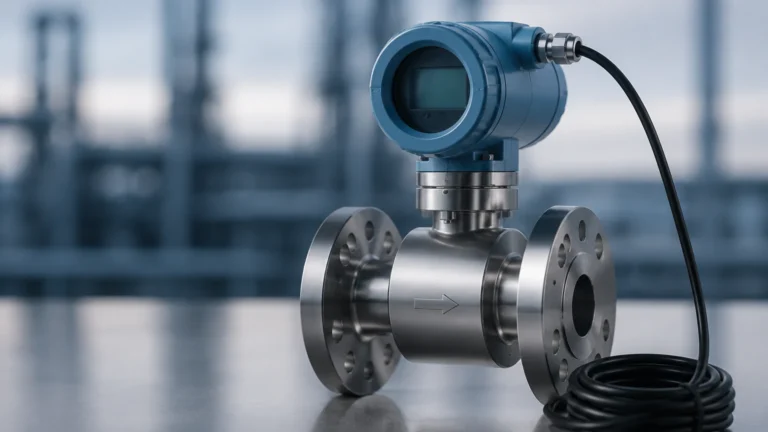
In water applications, submersible hydrostatic transmitters are frequently used. These devices feature a sensing diaphragm that converts mechanical pressure into an electrical signal. To account for changes in atmospheric pressure, a vent tube is typically integrated into the sensor cable, ensuring that the measurement reflects only the liquid's weight. This technology is highly reliable for deep wells, reservoirs, and tanks where the liquid density remains relatively constant.
Ultrasonic Level Measurement
Ultrasonic sensors utilize the Time-of-Flight (ToF) principle. The sensor emits a high-frequency sound pulse that travels through the air, reflects off the surface of the water, and returns to the transducer. The distance is calculated based on the time elapsed and the speed of sound in air.
Because ultrasonic sensors are non-contact, they are ideal for corrosive or dirty liquids, such as raw sewage or chemical dosing tanks. However, the speed of sound is affected by air temperature, requiring integrated temperature compensation. They are also sensitive to surface turbulence and foam, which can scatter or absorb the acoustic signal.
Radar Level Measurement
Radar technology also uses the ToF principle but employs electromagnetic waves instead of sound. Microwave pulses are emitted, reflected, and received. Radar is divided into two main types: Guided Wave Radar (GWR), which uses a probe to direct the signal, and Non-Contact Radar.
Non-contact radar is increasingly the preferred choice for critical water infrastructure. Unlike ultrasonic sensors, radar waves are unaffected by temperature fluctuations, vacuum, pressure, or heavy vapors. Modern 80 GHz high-frequency radar sensors offer narrow beam angles, allowing for precise measurement even in narrow tanks with internal obstructions. This technology provides the highest level of accuracy and reliability for the demanding environments often discussed at the Tri State Water Conference.
Technology Recommendations for Specific Applications
Choosing the right technology requires matching the sensor's strengths to the specific challenges of the application. The following recommendations are based on standard engineering practices in the water sector.
| Application | Recommended Technology | Primary Reason |
| :— | :— | :— |
| Deep Wells/Boreholes | Hydrostatic (Submersible) | High accuracy in narrow, deep vertical spaces. |
| Open Channel Flow | Ultrasonic | Cost-effective and standard for Parshall flumes. |
| Sewage Lift Stations | Non-Contact Radar | Unaffected by grease, foam, or humidity. |
| Chemical Dosing (Acids) | Ultrasonic or Radar | Non-contact prevents sensor corrosion. |
| Sludge Thickening | Hydrostatic or GWR | Handles high density and solids content effectively. |
| Potable Water Tanks | Non-Contact Radar | High precision and maintenance-free operation. |
For professionals seeking a comprehensive range of industrial instruments, Welk offers a variety of solutions tailored to these needs. You can explore their full catalog on the Main Page to find specific models for radar, ultrasonic, and hydrostatic applications.
Practical Selection Criteria
When evaluating level meters for a project, engineers should consider the following five criteria to ensure long-term performance:
1. Measurement Range: Ensure the sensor can cover the full height of the vessel or the maximum expected flood level. For ultrasonic and radar, also consider the "dead zone" or blocking distance—the area immediately below the sensor where measurement is not possible.
2. Process Conditions: Identify the presence of foam, steam, turbulence, or chemical vapors. As noted, radar handles these conditions better than ultrasonic.
3. Accuracy Requirements: Municipal billing applications require high precision (often ±2mm or better), whereas simple high-level alarms in a storm basin may only require ±10mm accuracy.
4. Installation Environment: Consider power availability (loop-powered vs. four-wire), output signals (4-20mA, HART, Modbus), and physical mounting constraints.
5. Maintenance Access: Non-contact sensors generally require less maintenance than contact-based sensors, which is a critical factor for remote sites discussed in regional water management strategies.
Installation Considerations and Best Practices
Proper installation is as important as sensor selection. Even the most advanced radar meter will fail if installed incorrectly.
* Mounting Position: Sensors should be mounted away from the tank wall to avoid false reflections. For ultrasonic and radar, the beam should have a clear path to the liquid surface, free from ladders, pipes, or agitators.
* Stilling Wells: In applications with extreme turbulence or heavy foam, installing a sensor inside a stilling well (a vertical pipe) can provide a calm surface for accurate measurement. This is common in large reservoirs and industrial mixing tanks.
* Submersible Anchoring: Hydrostatic sensors in moving water (like rivers or large channels) should be secured to prevent the sensor from swinging, which can cause measurement errors or cable fatigue.
* Lightning Protection: Since many water level sensors are installed outdoors or at high points, surge protection is essential to prevent damage during electrical storms, a common concern in many tri-state regions.
Limitations and Potential Risks
While modern instrumentation is robust, users must be aware of technical limitations to avoid data inaccuracies:
* Material Build-up: In wastewater applications, fats, oils, and grease (FOG) can build up on contact sensors or the faces of ultrasonic transducers. Regular cleaning or the use of radar with a PTFE-coated antenna can mitigate this.
* Temperature Gradients: Rapid changes in air temperature can create layers of different densities, which can refract ultrasonic waves. High-quality sensors include algorithms to compensate for this, but extreme cases may require radar.
* Signal Absorption: Certain types of thick foam can absorb ultrasonic pulses entirely, leading to a "loss of echo." In these scenarios, hydrostatic or guided wave radar is a more reliable alternative.
* Cable Integrity: For hydrostatic sensors, the vent tube in the cable must remain unobstructed. If moisture enters the vent tube, it can lead to sensor drift or permanent failure.
Frequently Asked Questions (FAQ)
Q: How often should level meters be calibrated?
A: For most municipal water applications, annual calibration is recommended. However, for critical billing or safety-related systems, semi-annual checks may be required by local regulations.
Q: Can one sensor type be used for all water applications?
A: No. While radar is the most versatile, hydrostatic sensors are often more practical for deep groundwater monitoring, and ultrasonic sensors remain a cost-effective choice for simple open-channel flow measurement.
Q: What is the impact of heavy rain on ultrasonic sensors?
A: Heavy rain can interfere with the acoustic signal of an ultrasonic sensor, potentially causing erratic readings. Radar is unaffected by rain and is generally preferred for outdoor environmental monitoring.
Q: How do I choose between a 26 GHz and an 80 GHz radar?
A: 80 GHz radar is preferred for smaller tanks or vessels with many internal obstructions because it has a much narrower beam. 26 GHz radar is often sufficient for large, open reservoirs and is sometimes more cost-effective for simple applications.
In conclusion, the technical discussions at the Tri State Water Conference underscore the importance of reliable data in managing our most precious resource. By understanding the principles of hydrostatic, ultrasonic, and radar measurement, and by following rigorous selection and installation standards, engineers can ensure their systems provide the accuracy needed for the next generation of water management. For those looking to implement these technologies, reviewing the diverse range of instruments available on the Main Page is an excellent starting point for any industrial level measurement project.