Tunable Laser Spectroscopy
Tunable Laser Spectroscopy
In the landscape of industrial process automation and safety, the ability to measure gas concentrations with high precision and rapid response times is critical. Tunable Laser Spectroscopy (TLS), more specifically Tunable Diode Laser Absorption Spectroscopy (TDLAS), has emerged as a premier technology for gas analysis in challenging environments. While traditional level measurement instruments like radar or ultrasonic sensors track liquid and solid volumes, TLS provides the necessary data on the chemical composition of the headspace or process streams, ensuring a holistic approach to process control.
As a professional manufacturer of industrial level measurement instruments, Welk recognizes that level and gas analysis often go hand-in-hand. Whether monitoring the vapor space in a chemical storage tank or ensuring combustion efficiency in a furnace, understanding the principles and application of tunable laser spectroscopy is essential for modern plant engineering.
Understanding the Principles of Tunable Laser Spectroscopy
Tunable Laser Spectroscopy is based on the fundamental principle of absorption spectroscopy. Every gas molecule has a unique set of absorption lines—specific wavelengths of light that the molecule absorbs due to internal energy transitions. By using a laser source that can be precisely tuned to these specific wavelengths, the system can detect and quantify the presence of a target gas.
The Beer-Lambert Law
The core mathematical foundation of TLS is the Beer-Lambert Law. This law describes the relationship between the attenuation of light as it passes through a substance and the properties of that substance. The formula is generally expressed as:
**I = I₀ * e^(-αLC)**
Where:
* I is the intensity of the light after passing through the gas.
* I₀ is the initial intensity of the laser light.
* α is the absorption coefficient (specific to the gas and wavelength).
* L is the optical path length (the distance the light travels through the gas).
* C is the concentration of the target gas.
By measuring the ratio of the transmitted intensity to the initial intensity, and knowing the path length and absorption coefficient, the concentration of the gas can be calculated with high accuracy.
Wavelength Tuning and Scanning
Unlike broad-spectrum light sources used in Non-Dispersive Infrared (NDIR) sensors, a tunable diode laser emits light over a very narrow bandwidth. The "tunable" aspect refers to the ability to shift the laser's center wavelength by adjusting the operating temperature and injection current of the diode.
In a typical measurement cycle, the laser wavelength is scanned rapidly across a single absorption line of the target gas. This scanning technique allows the system to distinguish the gas absorption from other factors like dust, window fouling, or background gas interference, which typically affect the entire spectrum rather than a narrow, specific line.
Key Components and System Architecture
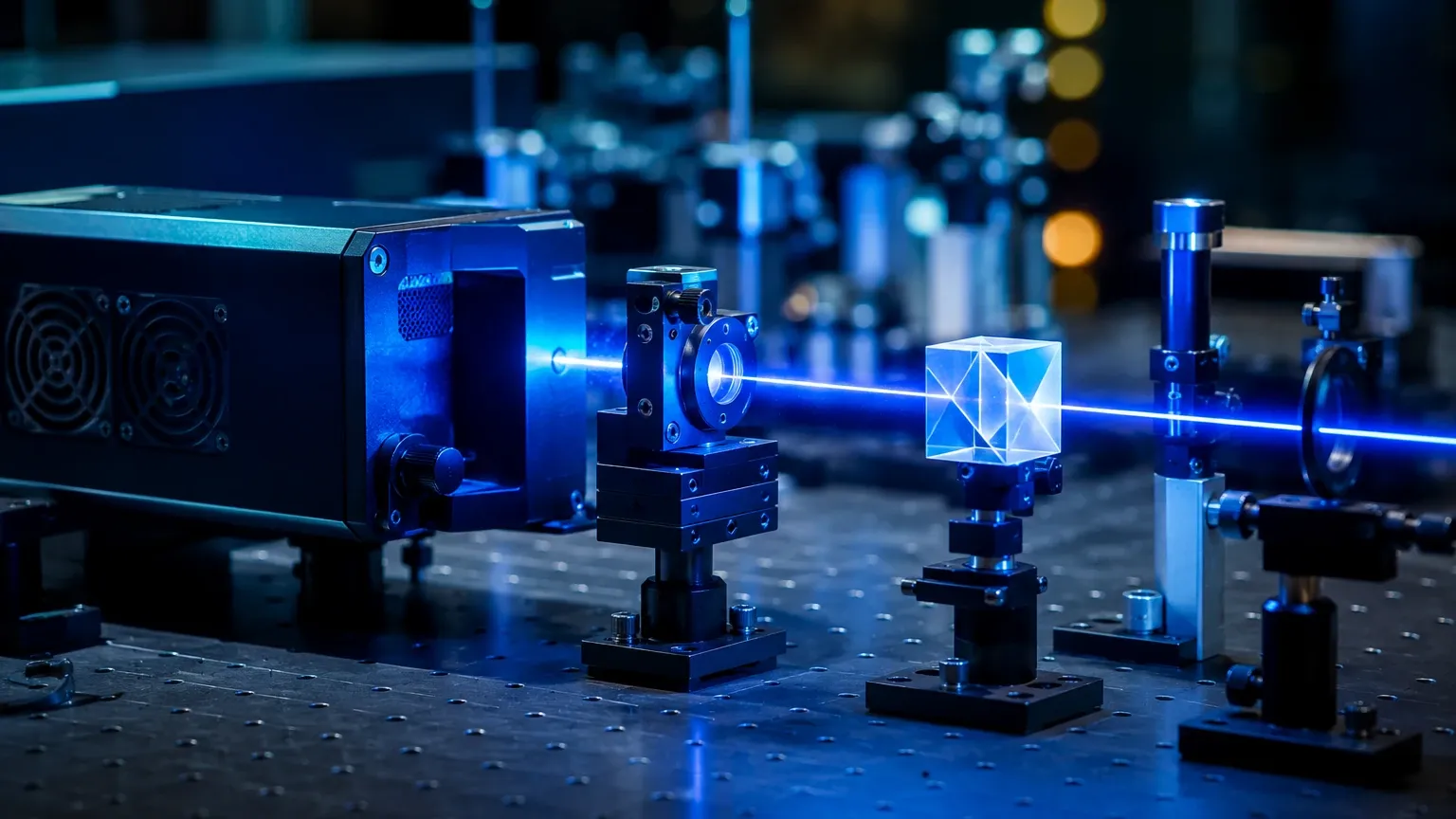
A standard industrial TDLAS system consists of several critical components designed to operate in harsh process conditions:
1. Laser Diode: The light source, often a Vertical Cavity Surface Emitting Laser (VCSEL) or a Distributed Feedback (DFB) laser, chosen for its stability and tuning range.
2. Optical Assembly: Lenses and windows that direct the laser beam through the process medium. In in-situ applications, these are mounted directly on the process flange.
3. Detector: A photodiode that captures the laser light after it has traversed the measurement path. It converts the optical signal back into an electrical signal for processing.
4. Electronics and Signal Processing: The "brains" of the unit that control the laser tuning, perform high-speed data acquisition, and apply algorithms like Wavelength Modulation Spectroscopy (WMS) to improve the signal-to-noise ratio.
Comparison with Alternative Gas Sensing Technologies
To understand why tunable laser spectroscopy is preferred in many B2B industrial applications, it is helpful to compare it against traditional sensing methods.
| Feature | Tunable Laser Spectroscopy (TDLAS) | Electrochemical Sensors | Non-Dispersive Infrared (NDIR) |
| :— | :— | :— | :— |
| Selectivity | Excellent (narrow line absorption) | Moderate (cross-sensitivity issues) | Moderate (broadband filters) |
| Response Time | Very Fast (< 2 seconds) | Slow (minutes) | Moderate (seconds) |
| Maintenance | Low (no moving parts/consumables) | High (sensor replacement required) | Moderate (source/filter aging) |
| Calibration | Stable (factory calibrated) | Frequent field calibration needed | Periodic calibration required |
| Environment | High Temp/Pressure/Dust | Ambient conditions only | Limited temp/pressure range |
| Cost | High initial investment | Low initial investment | Moderate initial investment |
Industrial Applications in Process Control
Tunable laser spectroscopy is utilized across various sectors where accuracy and reliability are non-negotiable. For many of these applications, TLS works in tandem with level measurement solutions found on the Welk Main Page to provide a complete picture of the process state.
Chemical and Petrochemical Refining
In refining, TDLAS is used to monitor moisture (H2O) in catalytic reformers or hydrogen recycle streams. Because the laser is tuned to a specific water absorption line, it is not affected by the high concentrations of hydrocarbons present in the stream. This prevents catalyst poisoning and ensures product quality.
Safety and Headspace Monitoring
In storage tanks containing volatile or reactive chemicals, maintaining an inert atmosphere (nitrogen blanketing) is crucial. While a hydrostatic level transmitter or a radar level meter monitors the liquid volume, a TDLAS analyzer can monitor oxygen (O2) levels in the headspace. If O2 levels rise above a safety threshold, the system triggers an alarm or increases nitrogen flow to prevent combustion.
Emissions Monitoring (CEMS)
Power plants and incinerators use TLS to measure stack gases such as Ammonia (NH3), Hydrogen Chloride (HCl), and Carbon Monoxide (CO). The in-situ nature of TLS allows for measurement directly in the flue gas duct, eliminating the need for complex sampling systems that are prone to clogging and maintenance issues.
Selection Criteria for TDLAS Systems
When selecting a tunable laser spectroscopy system for an industrial project, engineers must evaluate several technical parameters:
* Target Gas and Range: Identify the primary gas (e.g., NH3, H2O, CO, CH4) and the required detection range (ppm or volume %).
* Process Temperature and Pressure: TLS systems can operate at temperatures exceeding 1000°C and pressures up to 20 bar (2.0 MPa), but the absorption line shape changes with these variables. The analyzer must include compensation algorithms for these effects.
* Optical Path Length: The distance between the laser source and the detector. Longer paths increase sensitivity but may reduce signal strength in dusty environments.
* Installation Type:
* In-Situ: The laser and detector are mounted directly on the process pipe or stack. This provides the fastest response.
* Extractive: The gas is pulled from the process into a measurement cell. This is used when the process path is too short, too long, or too opaque for direct measurement.
Installation and Maintenance Best Practices
Successful deployment of tunable laser spectroscopy requires careful attention to the physical installation environment.
Alignment and Stability
For cross-stack or in-situ installations, the laser beam must be precisely aligned with the detector. On large tanks or ducts, thermal expansion can cause structural shifting. Using heavy-duty mounting flanges and, in some cases, auto-alignment systems ensures the signal remains stable over time.
Window Purging
To prevent the optical windows from being coated with process dust or condensation, a purge gas (usually clean, dry instrument air or nitrogen) is injected into the mounting nozzles. The purge flow must be consistent to maintain a clear optical path without significantly diluting the process gas at the measurement point.
Calibration Verification
While TDLAS systems are known for their long-term stability, periodic verification is required by most quality standards. Many modern units feature internal reference cells containing a known concentration of the target gas, allowing the system to perform automated health checks and "line-locking" to ensure the laser hasn't drifted from the absorption peak.
Technical Limitations and Challenges
Despite its advantages, tunable laser spectroscopy is not a universal solution for every gas measurement task.
* Single Gas Focus: Most TDLAS analyzers are designed to measure one or two specific gases. If a facility needs to monitor a dozen different chemical species, a different technology like FTIR (Fourier Transform Infrared) might be more cost-effective, though more complex.
* Line Broadening: At high pressures, gas absorption lines broaden and overlap. This can make it difficult to isolate the target gas signal from background interferences. Advanced spectral deconvolution is required in high-pressure applications.
* Particulate Loading: While TLS is more robust than many optical methods, extremely high dust loads (e.g., > 50 g/m³) can completely block the laser signal. In such cases, extractive systems with filtration are necessary.
Frequently Asked Questions (FAQs)
Q: Can TDLAS measure liquids or solids?
No, tunable laser spectroscopy is strictly a gas-phase measurement technology. For liquids and solids, technologies like radar, ultrasonic, or magnetic level gauges are appropriate. You can find more information on these at https://www.level-meters.com/.
Q: How often does the laser diode need to be replaced?
Modern industrial laser diodes used in TLS systems are highly reliable, with expected lifespans often exceeding 10 years under normal operating conditions. They do not have the "burn-out" characteristics of traditional incandescent or infrared sources.
Q: Is the measurement affected by changes in gas flow velocity?
No, the absorption of light is independent of the speed at which the gas molecules are moving through the optical path. This makes TLS ideal for high-velocity flue gas or process streams.
Q: What is the minimum detectable limit for most gases?
This depends heavily on the gas species and the path length. For many gases like Ammonia or Moisture, sub-ppm (parts per million) detection is easily achievable with a path length of 1 to 2 meters.
By integrating advanced gas analysis like tunable laser spectroscopy with reliable level measurement, industrial operators can achieve a higher standard of safety and efficiency. Understanding the physics of the measurement and the constraints of the application is the first step toward a successful instrumentation strategy.