Ultrasonic vs Electromagnetic Flow Meter
Ultrasonic vs Electromagnetic Flow Meter
In industrial process control, selecting the correct flow measurement technology is as critical as choosing the right level sensor. Two of the most prevalent technologies for liquid flow measurement are ultrasonic and electromagnetic (magmeter) flow meters. While both offer the advantage of having no moving parts—reducing maintenance and pressure drop—they operate on entirely different physical principles. Understanding these principles is the first step toward ensuring long-term accuracy and reliability in applications ranging from municipal water treatment to complex chemical processing.
As a professional manufacturer of industrial instrumentation, Welk provides high-precision measurement solutions tailored to demanding environments. This guide examines the technical nuances of the ultrasonic vs electromagnetic flow meter debate to help engineers and procurement specialists make informed decisions. For a comprehensive overview of industrial measurement technologies, you can Review product options and application support on our main site.
Measurement Principles of Ultrasonic and Electromagnetic Flow Meters
Before comparing performance, it is essential to understand how each device interacts with the process fluid.
Electromagnetic Flow Meters (Magmeters)
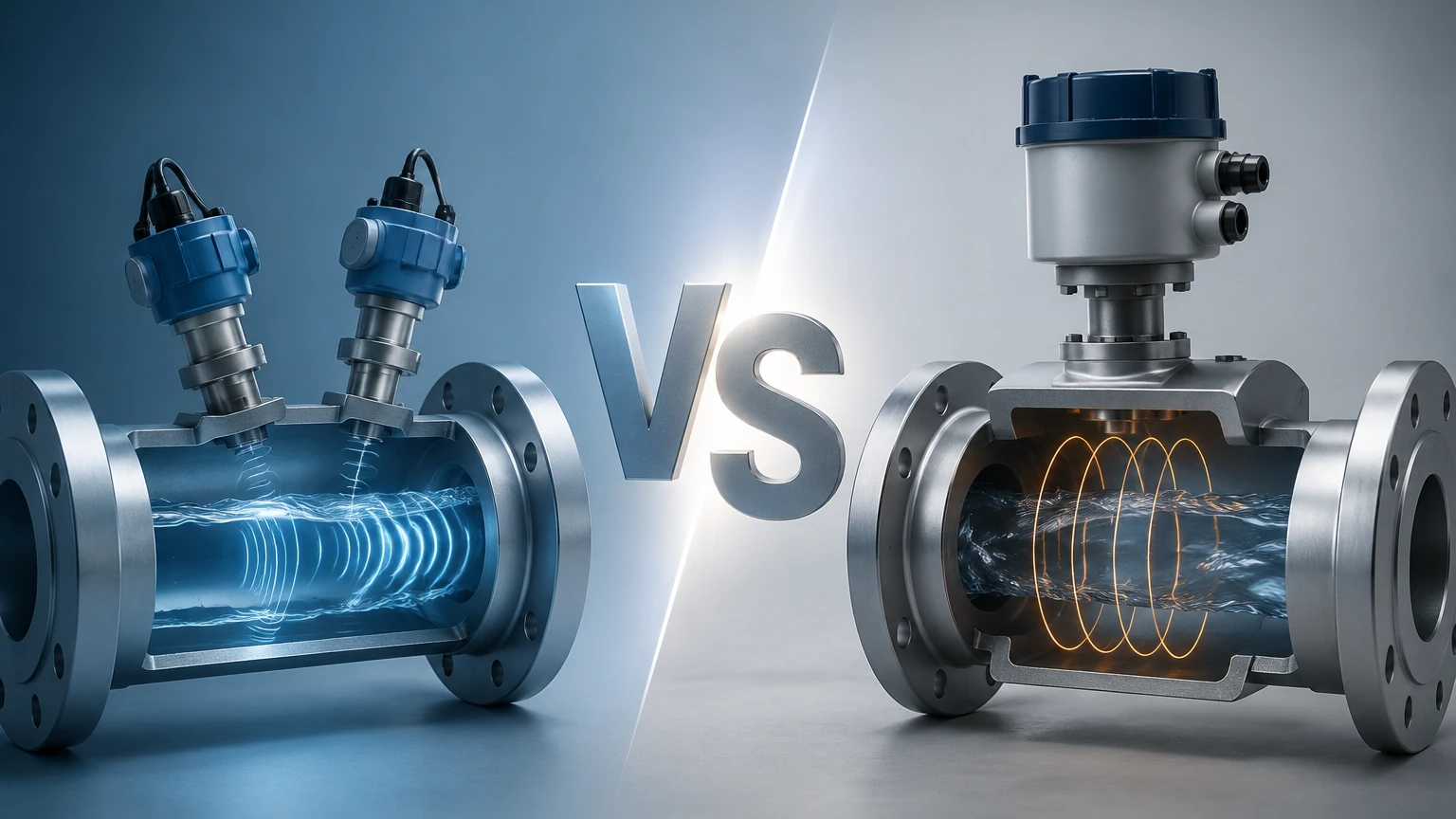
Electromagnetic flow meters operate based on Faraday’s Law of Electromagnetic Induction. This law states that a conductor moving through a magnetic field produces an electrical signal proportional to the velocity of the conductor. In this application, the conductive liquid acts as the conductor.
Inside the meter body, a pair of coils generates a magnetic field. As the liquid flows through this field, a voltage is induced and captured by electrodes located on the pipe walls. The governing equation is $E = k × B × D × v$, where $E$ is the induced voltage, $B$ is the magnetic field strength, $D$ is the distance between electrodes (pipe diameter), and $v$ is the average fluid velocity. Because $k$, $B$, and $D$ are constants, the voltage is directly proportional to the flow velocity.
Ultrasonic Flow Meters
Ultrasonic flow meters typically utilize one of two methods: Transit-Time or Doppler Effect.
1. Transit-Time: This is the most common method for clean liquids. The meter uses two transducers that act as both transmitters and receivers. They send ultrasonic pulses back and forth diagonally across the pipe. The pulse traveling with the flow (downstream) moves faster than the pulse traveling against the flow (upstream). The time difference between these two signals is directly proportional to the fluid velocity.
2. Doppler Effect: This method is used for liquids containing suspended solids or aerated bubbles. The meter transmits an ultrasonic signal into the fluid, which reflects off the particles or bubbles. Because the particles are moving, the frequency of the reflected signal is shifted. The meter measures this frequency shift to calculate the flow rate.
Key Performance Characteristics and Comparison
When evaluating an ultrasonic vs electromagnetic flow meter, the choice often depends on the physical properties of the fluid and the physical constraints of the installation site.
Conductivity Requirements
The most significant limitation of electromagnetic flow meters is that the fluid must be electrically conductive. Most magmeters require a minimum conductivity of 5 μS/cm (microsiemens per centimeter). This makes them ideal for water, wastewater, acids, and bases, but unsuitable for hydrocarbons, distilled water, or non-polar solvents. Ultrasonic meters, conversely, are independent of electrical conductivity and can measure almost any liquid that allows for the transmission of sound waves.
Accuracy and Repeatability
In-line electromagnetic flow meters generally offer superior accuracy, often reaching ±0.2% to ±0.5% of the flow rate. They are highly repeatable and perform exceptionally well at low flow velocities. Ultrasonic meters vary in accuracy depending on the type. In-line ultrasonic meters can match magmeter accuracy, but "clamp-on" ultrasonic versions typically offer ±1% to ±3% accuracy, as they are sensitive to pipe wall thickness and material consistency.
Pipe Size and Installation Cost
For small to medium pipe diameters (DN15 to DN300), electromagnetic flow meters are often the standard choice due to their reliability and integrated design. However, as pipe diameters increase (above DN600 or 24 inches), the cost of an in-line magmeter increases exponentially due to the weight and material of the large flow tube. In these large-scale applications, clamp-on ultrasonic flow meters become highly cost-effective because the hardware cost remains constant regardless of pipe size, and installation does not require cutting the pipe or halting the process.
Selection Table: Ultrasonic vs Electromagnetic Flow Meter
The following table provides a quick reference for comparing the two technologies across standard engineering criteria.
| Feature | Electromagnetic (Magmeter) | Ultrasonic (Transit-Time) |
| :— | :— | :— |
| Fluid Conductivity | Required (>5 μS/cm) | Not Required |
| Typical Accuracy | ±0.2% to ±0.5% | ±0.5% (In-line) to ±2% (Clamp-on) |
| Pressure Drop | Zero (Full bore) | Zero (Non-invasive) |
| Moving Parts | None | None |
| Installation Type | In-line (Flanged/Wafer) | In-line or Clamp-on (External) |
| Suspended Solids | Excellent (Slurries) | Limited (Best for clean liquids) |
| Maintenance | Low | Very Low |
| Large Pipe Cost | High (Increases with size) | Low (Stable for Clamp-on) |
| Common Fluids | Water, Wastewater, Chemicals | Oil, Pure Water, Chemicals, HVAC |
Installation Considerations and Best Practices
Both technologies require specific hydraulic conditions to provide accurate readings. The most critical factor is the flow profile, which must be fully developed and free of turbulence.
Straight Pipe Runs
To minimize turbulence caused by elbows, valves, or pumps, both meters require straight pipe sections upstream and downstream of the sensor. A general rule of thumb for electromagnetic meters is 5D upstream and 3D downstream (where D is the pipe diameter). Ultrasonic meters often require longer runs, typically 10D upstream and 5D downstream, to ensure a stable flow profile for the sound waves to traverse.
Grounding and Electrical Noise
Electromagnetic flow meters are sensitive to electrical noise in the piping system. Proper grounding is essential to ensure that the small voltage signal induced by the flow is not obscured by stray currents. This is particularly important in plastic or lined pipes, where grounding rings must be used. Ultrasonic meters are generally immune to electrical noise but can be affected by acoustic noise from nearby high-pressure valves or pumps.
Pipe Integrity for Clamp-on Sensors
For clamp-on ultrasonic meters, the condition of the pipe is paramount. The ultrasonic signal must pass through the pipe wall, the couplant gel, and into the fluid. Pipes with heavy internal scaling, thick liners, or significant external corrosion can attenuate the signal, leading to measurement failure. In such cases, an in-line meter (either ultrasonic or electromagnetic) is preferred.
Limitations and Application Risks
While both technologies are robust, they are not universal solutions. Engineers must account for the following risks:
* Entrained Air: Both technologies struggle with high volumes of entrained air or gas bubbles. In magmeters, bubbles can cause signal "noise" and erratic readings. In transit-time ultrasonic meters, bubbles scatter the sound waves, potentially causing a complete loss of signal. If the process involves significant aeration, a Doppler-style ultrasonic meter or a Coriolis meter may be required.
* Coating and Scaling: In electromagnetic meters, if the electrodes become coated with non-conductive material (e.g., fats, oils, or minerals), the meter will eventually fail to read. While some modern magmeters include electrode cleaning circuits, heavy buildup remains a risk. Ultrasonic meters are less sensitive to thin coatings but can be affected if the coating significantly changes the internal diameter used for flow calculations.
* Fluid Temperature: Extreme temperatures can affect the electronics of in-line meters. For very high-temperature applications, clamp-on ultrasonic sensors are advantageous because the transducers can be thermally isolated from the pipe surface using specialized mounting tracks.
Industry-Specific Recommendations
Water and Wastewater
For municipal water distribution and wastewater treatment, the Electromagnetic Flow Meter is the industry standard. Its ability to handle slurries, sewage, and chemicals with high accuracy and no pressure drop makes it ideal. However, for leak detection in large trunk mains where cutting the pipe is impossible, Clamp-on Ultrasonic Meters are the preferred diagnostic tool.
Chemical and Petrochemical
In the chemical industry, the choice depends on the fluid. For acids and caustic solutions, a magmeter with a PTFE or PFA liner and tantalum electrodes is highly effective. For hydrocarbons, oils, and non-conductive solvents, the Ultrasonic Flow Meter is the only viable option between the two.
HVAC and Energy Management
For chilled water and hot water systems in large buildings, Ultrasonic Flow Meters are frequently selected. Their ability to be installed without shutting down the HVAC system (via clamp-on sensors) provides a significant logistical advantage for energy auditing and sub-metering.
Frequently Asked Questions (FAQs)
1. Can an electromagnetic flow meter measure deionized (DI) water?
Generally, no. Deionized water has very low conductivity, often below the 5 μS/cm threshold required by most magmeters. An ultrasonic flow meter is a much better choice for DI or ultrapure water.
2. Is a clamp-on ultrasonic meter as accurate as an in-line magmeter?
Typically, no. While high-end clamp-on meters are quite precise, an in-line magmeter is calibrated as a single unit with a known diameter, making it inherently more accurate for custody transfer or high-precision dosing.
3. Do these meters require periodic recalibration?
Since neither meter has moving parts to wear out, they are very stable. However, in regulated industries, annual verification or calibration is often required. Magmeters can often be verified in-situ using electronic simulators, whereas ultrasonic meters may require a reference meter check.
4. What happens if the pipe is not full?
Both electromagnetic and ultrasonic flow meters require a full pipe to provide accurate volumetric flow readings. If the pipe is partially full, the velocity may be measured correctly, but the cross-sectional area used for the calculation will be wrong, leading to significant errors. For partially full pipes, specialized level-based flow calculations or area-velocity meters are needed.
Conclusion
Choosing between an ultrasonic and an electromagnetic flow meter requires a careful audit of the fluid properties, pipe conditions, and budget. If the fluid is conductive and the pipe can be cut, the electromagnetic flow meter offers unmatched precision and reliability. If the fluid is non-conductive, or if a non-invasive installation is required for a large-diameter pipe, the ultrasonic flow meter is the superior technical and economic choice.
At Welk, we understand that flow and level measurement are the cornerstones of process efficiency. Beyond flow, our expertise extends to advanced radar and ultrasonic level sensors designed to integrate seamlessly into your automation architecture. To explore our full range of industrial instrumentation and find the right fit for your specific application, please Main Page.