Usb Pressure Sensor
Usb Pressure Sensor
In the landscape of industrial automation and process monitoring, the method by which data is captured and transmitted has undergone a significant transformation. Traditional pressure measurement relied heavily on analog signals, such as 4-20mA or 0-10V loops, which required specialized programmable logic controllers (PLCs) or dedicated data acquisition (DAQ) hardware to interpret. The emergence of the usb pressure sensor has simplified this architecture, allowing engineers to connect high-precision sensing elements directly to a computer or tablet. This guide explores the engineering principles, selection criteria, and practical applications of USB-integrated pressure measurement technology.
Measurement Principles of Pressure Sensors
Before selecting a usb pressure sensor, it is essential to understand the underlying sensing technologies that convert physical force into a digital signal. Most modern USB sensors utilize one of three primary physical principles.
Piezoresistive Sensing
Piezoresistive sensors are the most common in industrial applications. They consist of a diaphragm—usually made of silicon or stainless steel—with integrated strain gauges. When pressure is applied, the diaphragm deforms, changing the electrical resistance of the gauges. In a USB-enabled device, this resistance change is measured by a Wheatstone bridge circuit, amplified, and then converted into a digital value by an onboard Analog-to-Digital Converter (ADC).
Capacitive Sensing
Capacitive pressure sensors measure the change in electrical capacitance between a flexible diaphragm and a fixed metal plate. As pressure moves the diaphragm, the distance between the plates changes, altering the capacitance. These sensors are known for their high sensitivity and are often used in low-pressure applications, such as cleanroom monitoring or leak detection.
Thin-Film Strain Gauge
Thin-film sensors involve depositing a metal or semiconductor material onto a substrate. These are highly stable and resistant to shock and vibration. While more expensive to manufacture, they offer excellent long-term stability, making them ideal for high-pressure industrial environments where recalibration is difficult.
The Digital Signal Chain
What distinguishes a usb pressure sensor from a standard transducer is the integrated electronics. A standard transducer outputs millivolts; a USB sensor includes:
1. Amplification: Boosting the raw sensor signal.
2. Temperature Compensation: Correcting for thermal expansion/contraction of the sensor materials.
3. ADC (Analog-to-Digital Converter): Converting the voltage to a 16-bit or 24-bit digital signal.
4. Microcontroller: Handling the USB communication protocol (HID or Virtual COM Port).
Applications in Level Measurement
While pressure sensors are often used for gas or steam lines, they play a critical role in hydrostatic level measurement. According to the principles of fluid mechanics, the pressure at the bottom of a liquid column is directly proportional to the height of that column ($P = \rho gh$).
For engineers performing temporary tank testing or calibration, a usb pressure sensor provides a rapid way to verify level readings without wiring into the facility's main control system. By connecting the sensor to the bottom of a tank and viewing the output on a laptop, one can determine the liquid level with high precision. For permanent installations and a broader range of industrial sensing technologies, including radar and ultrasonic options, users can consult the Main Page of specialized manufacturers like Welk.
Key Selection Criteria for USB Pressure Sensors
Selecting the correct sensor requires balancing technical specifications with the environmental realities of the application. The following table outlines the primary factors to consider:
| Feature | Specification Range | Significance |
| :— | :— | :— |
| Pressure Range | 0–100 mbar to 0–700 bar | Must match the maximum expected process pressure. |
| Accuracy (F.S.) | 0.05% to 0.5% | Determines the reliability of the data for critical tests. |
| Sampling Rate | 1 Hz to 1,000 Hz | High rates are needed for dynamic pressure spikes/water hammer. |
| Wetted Materials | 316L Stainless Steel, Hastelloy | Must be chemically compatible with the media being measured. |
| Operating Temp | -20°C to +85°C | The electronics inside the USB housing are sensitive to heat. |
| IP Rating | IP65 to IP67 | Defines protection against dust and moisture ingress. |
Resolution and Bit Depth
When evaluating a usb pressure sensor, the ADC resolution is paramount. A 16-bit ADC provides 65,536 discrete steps across the pressure range, while a 24-bit ADC provides over 16 million steps. For high-precision laboratory work or detecting minute leaks in a system, 24-bit resolution is preferred to ensure that the smallest pressure fluctuations are captured.
Installation and Connection Considerations
Proper installation is vital to ensure the longevity and accuracy of the instrument. Because USB sensors contain sensitive digital electronics, they require different handling than traditional analog gauges.
Mechanical Mounting
1. Thread Compatibility: Ensure the process connection (e.g., G1/4, 1/4" NPT) matches the port. Use appropriate sealants like PTFE tape or bonded seals, but ensure no debris enters the sensor orifice.
2. Orientation: For low-pressure ranges, the orientation of the sensor can affect the zero point due to the weight of the internal diaphragm. It is best practice to calibrate or "tare" the sensor in its final mounting position.
3. Vibration Isolation: Excessive vibration can damage the internal USB connector. If the process involves heavy machinery, use a capillary tube to remote-mount the sensor away from the vibration source.
Electrical and Software Setup
USB cables have a theoretical length limit of approximately 5 meters (16 feet) for USB 2.0. If the sensor must be located further from the computer, active extension cables or USB-to-Ethernet extenders are required. Furthermore, ensure the software provided by the manufacturer supports data logging in the required format (CSV, Excel, or JSON) for post-processing analysis.
Limitations and Risks
Despite their convenience, usb pressure sensors are not suitable for every environment. Engineers should be aware of the following limitations:
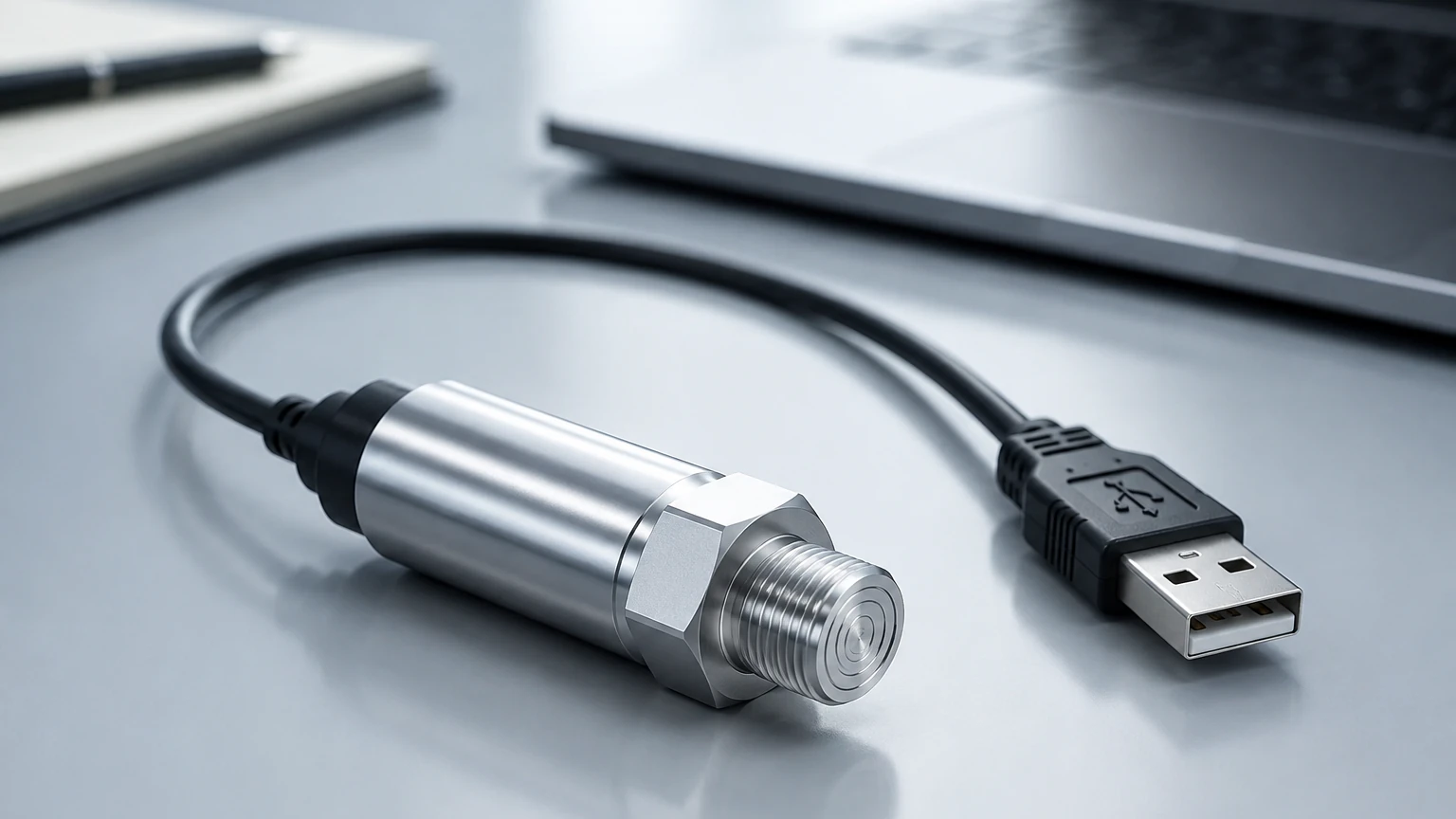
* Connector Fragility: The USB-A or USB-C connector is not an industrial-grade connection. It is prone to disconnecting if pulled and is not naturally waterproof. For permanent outdoor use, a sensor with an M12 connector and a separate USB gateway is often a better choice.
* Power Supply Noise: USB ports on laptops can sometimes have "noisy" power delivery, which may introduce jitter into the pressure readings. Using a high-quality shielded USB cable can mitigate this.
* Software Dependency: Unlike a 4-20mA sensor that works with any PLC, a USB sensor requires a driver or specific software. Ensure the manufacturer provides long-term support for modern operating systems (Windows 10/11, Linux, macOS).
* Temperature Sensitivity: The integrated ADC and USB controller generate a small amount of internal heat. In very tight enclosures or high-ambient environments, this can cause a thermal offset in the pressure reading if the sensor is not properly compensated.
Comparison: USB vs. Traditional Analog Sensors
| Feature | USB Pressure Sensor | Traditional 4-20mA Sensor |
| :— | :— | :— |
| Power Source | Bus-powered (from PC) | External 24V DC Loop |
| Data Logging | Direct to PC software | Requires PLC/SCADA/DAQ |
| Cable Length | Limited (< 5m) | Long distance (> 1000m) |
| Complexity | Low (Plug-and-play) | High (Requires wiring & scaling) |
| Environment | Lab / Temporary Field Work | Permanent Industrial Process |
Frequently Asked Questions (FAQ)
Can a USB pressure sensor be used for hazardous areas (Ex/ATEX)?
Generally, no. Standard USB ports and connectors do not meet the requirements for intrinsic safety or explosion-proof standards. For hazardous environments, it is recommended to use an ATEX-certified pressure transmitter with a barrier and a separate digital interface.
How often should the sensor be calibrated?
For most industrial applications, an annual calibration is recommended. However, if the sensor is used for high-precision laboratory testing or is subjected to frequent pressure shocks (overpressure), semi-annual calibration may be necessary to ensure accuracy remains within the specified tolerance.
What is the difference between Gauge, Absolute, and Sealed Gauge pressure?
* Gauge Pressure: Measured relative to the local atmospheric pressure. The sensor has a vent to the atmosphere.
* Absolute Pressure: Measured relative to a perfect vacuum. Used in barometric or altitude-related applications.
* Sealed Gauge: Measured relative to a fixed reference pressure sealed within the device. This is common for high-pressure sensors where venting is impractical.
Can I connect multiple USB sensors to one computer?
Yes, provided the software supports multi-channel logging. However, be mindful of the total power draw on the USB bus. Using a powered USB hub is recommended when connecting more than two sensors to a single port.
Conclusion
The usb pressure sensor represents a significant step forward in making high-precision pressure and level data more accessible. By eliminating the need for complex intermediate hardware, these devices allow for rapid deployment in R&D, field diagnostics, and quality control. When selecting a unit, engineers must prioritize the sensing principle, accuracy requirements, and the physical constraints of the USB interface to ensure a successful implementation.