Temperature Measurement Instruments
Temperature Measurement Instruments
In the landscape of industrial process control, temperature measurement instruments are as fundamental as pressure or flow sensors. For engineers and plant operators, temperature is rarely a standalone variable; it is a critical factor that influences fluid dynamics, chemical reaction rates, and the accuracy of other measurement technologies, such as level and volume sensing. In many industrial environments, particularly those served by Welk, temperature data is the primary correction factor used to ensure the integrity of level measurement in storage tanks and process vessels.
Selecting the appropriate temperature measurement instruments requires a deep understanding of the underlying physics, the thermal properties of the process media, and the mechanical constraints of the installation site. This guide explores the principles of industrial thermometry, its interplay with level measurement systems, and the criteria for selecting the right instrumentation for demanding B2B applications.
Principles of Industrial Temperature Measurement
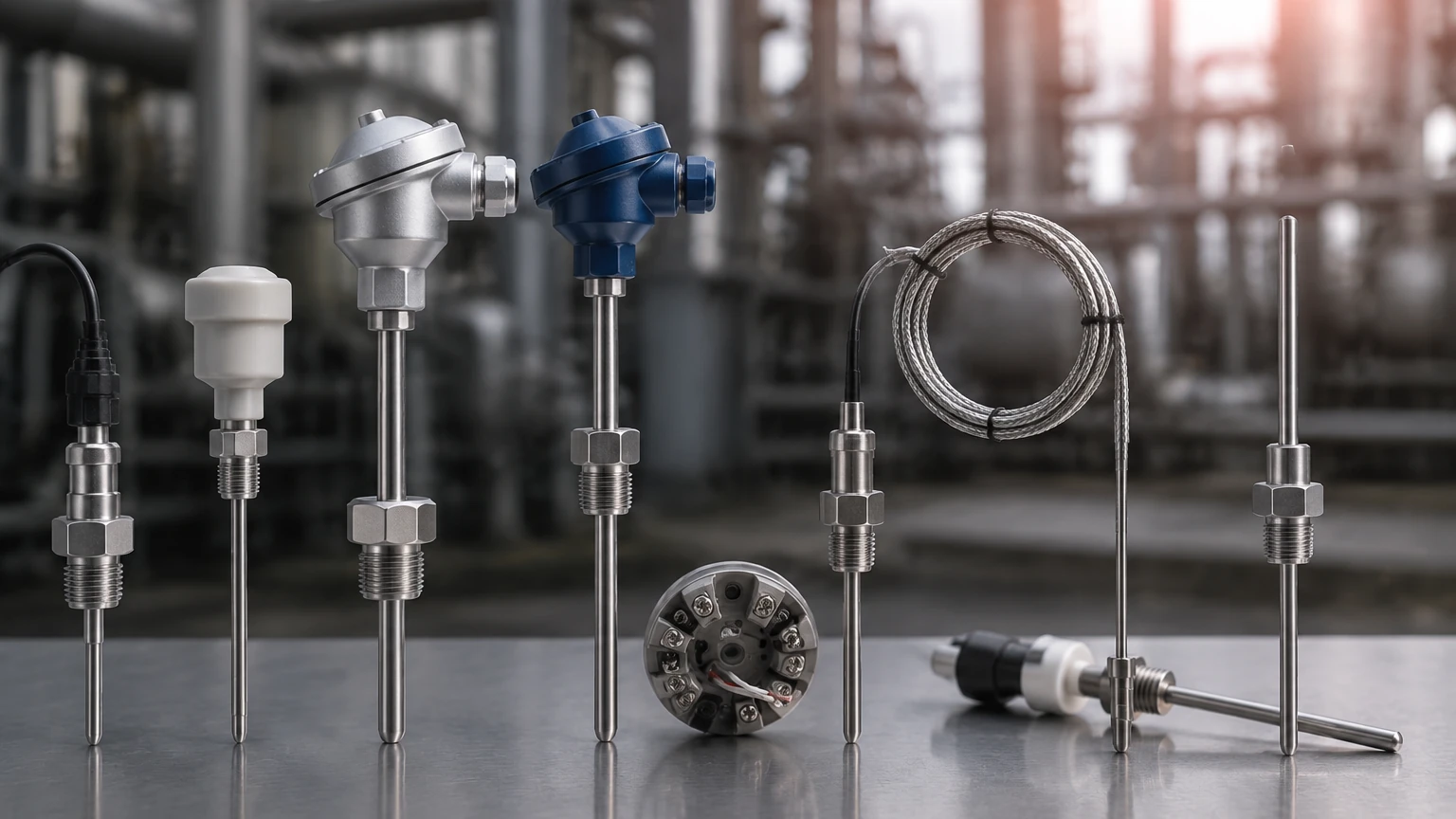
Before selecting a sensor, it is essential to understand the physical principles that govern industrial temperature measurement instruments. Most industrial applications rely on one of three primary technologies: Resistance Temperature Detectors (RTDs), Thermocouples, or Non-contact Infrared (IR) sensors.
Resistance Temperature Detectors (RTDs)
RTDs operate on the principle that the electrical resistance of a metal increases as its temperature rises. The most common material used is platinum, specifically the Pt100 sensor, which has a resistance of 100 ohms at 0°C. RTDs are prized in the process industries for their exceptional accuracy, stability, and linearity over a range typically spanning -200°C to +600°C. They are the preferred choice when precision is paramount, such as in custody transfer or fine chemical processing.
Thermocouples
Thermocouples consist of two dissimilar metal wires joined at one end (the sensing junction). When there is a temperature gradient between the sensing junction and the reference junction, a small voltage (millivolts) is generated—a phenomenon known as the Seebeck effect. Thermocouples are categorized by "types" (e.g., Type K, Type J, Type N) based on the metal alloys used. They are significantly more rugged than RTDs and can measure much higher temperatures, often exceeding 1,700°C, making them ideal for furnaces and high-heat exhaust systems.
Infrared and Non-Contact Sensors
Infrared temperature measurement instruments detect the thermal radiation emitted by an object. These are used when the target is moving, extremely hot, or located in a vacuum where contact probes are impractical. However, they require careful calibration based on the emissivity of the material surface to maintain accuracy.
The Relationship Between Temperature and Level Measurement
For a manufacturer like Welk, temperature measurement is inextricably linked to the performance of level measurement instruments. Temperature fluctuations can introduce significant errors in level readings if not properly compensated. Understanding this relationship is vital for anyone visiting our Main Page to source level sensing solutions.
Impact on Ultrasonic Level Sensors
Ultrasonic sensors measure level by timing the flight of a sound wave. The speed of sound in air (or gas) is highly dependent on temperature. A change of just 1°C can result in a 0.17% error in distance measurement. Therefore, high-quality ultrasonic level sensors must include integrated temperature measurement instruments or external probes to provide real-time compensation for the changing speed of sound in the vapor space.
Impact on Hydrostatic Level Transmitters
Hydrostatic level measurement relies on the formula $P = \rho gh$, where $P$ is pressure, $\rho$ is density, $g$ is gravity, and $h$ is height. As temperature increases, most liquids expand, and their density decreases. Without accurate temperature data to correct the density value ($\rho$), a hydrostatic transmitter will report an incorrect level even if the mass of the liquid remains the same.
Impact on Radar Level Meters
While radar (ToF) is less affected by temperature than ultrasonic waves, extreme temperature shifts can still influence the dielectric constant of the medium and the mechanical dimensions of the tank. In high-precision radar applications, temperature monitoring ensures that structural expansions of the vessel are accounted for in the final volume calculation.
Key Evaluation Criteria for Temperature Instruments
When specifying temperature measurement instruments for a B2B project, engineers must evaluate several technical parameters to ensure long-term reliability and data integrity.
1. Measurement Range: The instrument must not only cover the operating temperature but also survive the maximum design temperature of the process (e.g., during Steam-In-Place or cleaning cycles).
2. Accuracy and Class: RTDs are classified (Class AA, A, B) based on their tolerance. For instance, a Class A Pt100 sensor offers a tolerance of $\pm(0.15 + 0.002|t|)$°C.
3. Response Time ($T_{90}$): This indicates how quickly a sensor reacts to a step change in temperature. In fast-moving thermal processes, a sensor with a high thermal mass (thick thermowell) may lag behind the actual process temperature.
4. Environmental Compatibility: Sensors must be rated for the specific hazardous zone (ATEX/IECEx) and the corrosive nature of the medium. Stainless steel 316L is standard, but exotic alloys like Hastelloy or Tantalum may be required for aggressive acids.
Practical Selection Table: RTD vs. Thermocouple
| Feature | RTD (Pt100/Pt1000) | Thermocouple (Type K/J/N) |
| :— | :— | :— |
| Temperature Range | -200°C to +600°C | -270°C to +1,700°C |
| Accuracy | High (0.1°C to 0.5°C) | Medium (1.0°C to 2.2°C) |
| Stability | Excellent (minimal drift) | Fair (drifts over time) |
| Response Time | Slower (due to mass) | Very Fast (small junction) |
| Durability | Fragile (vibration sensitive) | High (rugged construction) |
| Cost | Higher | Lower |
Installation Considerations and Best Practices
Correct installation is as important as sensor selection. Even the most accurate temperature measurement instruments will provide false data if installed incorrectly.
Thermowell Selection
A thermowell is a cylindrical fitting used to protect temperature sensors from pressure, high flow velocities, and chemical attack. While it protects the sensor, it also introduces a thermal lag. Engineers must calculate the "Wake Frequency" to ensure the thermowell can withstand the fluid forces within the pipe or tank without vibrating to the point of mechanical failure.
Insertion Depth
To avoid stem conduction errors (where heat travels up the sensor body to the outside air), a sensor should typically be immersed to a depth of at least 10 times the diameter of the protection tube. In small-diameter pipes, the sensor should be installed at an elbow or at an angle to ensure sufficient immersion.
Signal Transmission
In industrial settings, electromagnetic interference (EMI) can degrade small millivolt signals from thermocouples. It is standard practice to use a temperature transmitter mounted in the sensor head. This converts the weak signal into a robust 4-20mA or digital signal (HART, Modbus, or Profibus) near the source, significantly improving noise immunity.
Common Risks and Limitations
Despite their maturity, temperature measurement instruments face several operational risks:
* Calibration Drift: Over time, the internal elements of a sensor can degrade due to thermal cycling or contamination. Regular calibration against a traceable standard is required to maintain process safety.
* Vibration Fatigue: In high-vibration environments, the fine wires inside an RTD or thermocouple can break. Using vibration-resistant inserts or mineral-insulated (MI) cables can mitigate this risk.
* Chemical Coating: In level measurement applications involving viscous fluids, the thermowell may become coated. This layer acts as an insulator, significantly slowing the response time and leading to inaccurate process control.
Frequently Asked Questions (FAQ)
Q: Can I use an RTD for high-vibration applications?
A: Standard RTDs are sensitive to vibration. However, thin-film RTD elements or specially designed vibration-resistant probes are available for these conditions. Alternatively, a thermocouple is inherently more resistant to mechanical shock.
Q: How often should temperature measurement instruments be calibrated?
A: This depends on the criticality of the process. For most industrial applications, an annual calibration check is standard. In regulated industries like pharmaceuticals or food production, semi-annual or quarterly calibration may be required.
Q: Why is my temperature reading higher than the actual liquid temperature?
A: This is often caused by "stem conduction." If the external part of the sensor is exposed to a high ambient temperature and the immersion depth is insufficient, heat conducts down the sensor body, artificially inflating the reading.
Conclusion
Temperature measurement instruments are the unsung heroes of industrial automation, providing the necessary data to stabilize processes and ensure the accuracy of level and flow measurements. Whether you are managing a water treatment facility or a complex chemical reactor, choosing the right sensor—be it a precision RTD or a rugged thermocouple—is the first step toward operational excellence. For those integrating these sensors with advanced level measurement systems, understanding the thermal dynamics of the process is essential for achieving reliable results. For more information on integrated measurement solutions, please refer to the technical resources available on our Main Page.