Vega Energy Advisors
Vega Energy Advisors
In the modern industrial landscape, the intersection of energy management and process automation has become a critical focal point for operational excellence. Energy advisors and process engineers are increasingly looking toward high-precision instrumentation to bridge the gap between raw data and actionable efficiency. Level measurement, a fundamental component of fluid and bulk solid management, plays a pivotal role in this optimization. By ensuring accurate inventory tracking and process control, facilities can significantly reduce waste, optimize pump run-times, and lower the carbon footprint of their operations.
Selecting the right level measurement technology requires a deep understanding of both the physical principles of the sensors and the specific requirements of the application. This guide explores the core technologies used in industrial level measurement—radar, ultrasonic, and hydrostatic—and provides a framework for selecting solutions that align with the goals of energy efficiency and reliability.
The Role of Precision Level Measurement in Energy Optimization
Energy advisory often focuses on large-scale utilities and power procurement, but the most significant gains are frequently found within the process loop itself. Level measurement instruments act as the "eyes" of the control system. When these sensors provide inaccurate data, the resulting inefficiencies can be costly:
1. Pump Optimization: In water treatment and chemical processing, pumps are major energy consumers. Accurate level data allows for precise start/stop cycles, preventing "short-cycling" and ensuring pumps operate at their Best Efficiency Point (BEP).
2. Heat Transfer Efficiency: In boiler feed tanks or jacketed reactors, maintaining the correct level is essential for optimal heat transfer. Overfilling or underfilling can lead to excessive energy consumption for heating or cooling.
3. Waste Reduction: Precise level control prevents tank overflows and the subsequent environmental and financial costs of spill remediation. In the context of expensive chemical reagents, even a 1% improvement in level accuracy can translate to thousands of dollars in annual savings.
For those evaluating their instrumentation strategy, reviewing professional options on the Main Page of a specialized manufacturer is the first step toward integrating energy-aware measurement solutions.
Core Measurement Principles
To make an informed selection, it is necessary to understand the physics behind the most common level measurement technologies. Each method has distinct advantages depending on the media and environmental conditions.
Radar Level Measurement (Non-Contact)
Radar level meters utilize high-frequency electromagnetic waves, typically in the 26 GHz or 80 GHz range. The sensor emits a signal toward the product surface, which reflects it back to the antenna. The instrument measures the time of flight or the frequency shift (FMCW) to calculate the distance.
* 80 GHz Radar: Offers a narrow beam angle (as small as 3°), which is ideal for tall, narrow tanks or vessels with internal obstructions like agitators or ladders.
* 26 GHz Radar: A robust choice for general-purpose liquid and solid applications where extreme precision is less critical than cost-effectiveness.
Ultrasonic Level Measurement
Ultrasonic sensors emit acoustic pressure waves. The time taken for the sound wave to travel to the surface and return is used to determine the level. Since sound speed is affected by air temperature, these sensors usually include an integrated temperature probe for compensation.
Hydrostatic Level Measurement
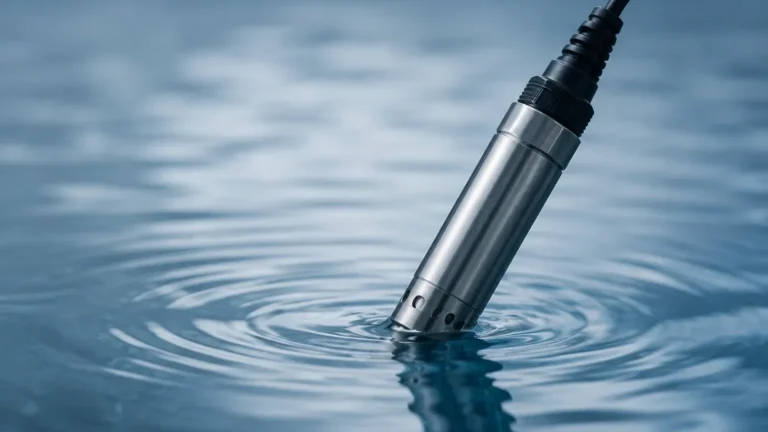
This is a contact-based method where a pressure transmitter is placed at the bottom of a tank. It measures the head pressure exerted by the liquid column. The level is calculated using the formula: $P = \rho \cdot g \cdot h$ (where $P$ is pressure, $\rho$ is liquid density, $g$ is gravity, and $h$ is height).
Technical Selection Criteria
When working with energy advisors to specify instrumentation, several technical factors must be weighed. The following table provides a comparison of technologies based on common industrial variables.
Selection Matrix for Level Technologies
| Feature | Radar (80 GHz) | Ultrasonic | Hydrostatic | Magnetic Gauge |
| :— | :— | :— | :— | :— |
| Accuracy | ±1 mm to ±2 mm | ±0.25% of range | ±0.1% to ±0.5% | ±5 mm |
| Measurement Range | Up to 120 m | Up to 30 m | Up to 200 m (H2O) | Up to 6 m |
| Media Type | Liquids & Solids | Liquids & Slurries | Clean Liquids | Clean Liquids |
| Pressure Limit | Up to 16 MPa | Atmospheric | Up to 40 MPa | Up to 25 MPa |
| Temp. Range | -40°C to +450°C | -40°C to +80°C | -40°C to +120°C | -196°C to +450°C |
| Energy Impact | High (Process Opt.) | Medium (Pump Ctrl) | Medium (Inventory) | Low (Visual) |
Installation Considerations for Maximum Accuracy
Even the most advanced level meter will underperform if installed incorrectly. To ensure the data provided to energy management systems is reliable, follow these engineering guidelines:
1. Avoid the "Dead Zone": Every non-contact sensor has a near-field blanking distance (dead zone) where measurements are impossible. Ensure the maximum expected liquid level does not enter this zone, typically 0.2 m to 0.5 m from the sensor face.
2. Nozzle Geometry: For radar and ultrasonic units, the mounting nozzle should be as short as possible. If a long nozzle is required, its internal diameter must be sufficient to prevent signal interference from the nozzle walls.
3. Agitators and Obstructions: Positioning the sensor away from the path of agitator blades or fill streams is critical. While modern radar software can "mask" fixed obstructions, avoiding them entirely yields a higher signal-to-noise ratio.
4. Stilling Wells: In applications with heavy foam or turbulent surfaces, installing the sensor inside a stilling well (a vertical pipe) can provide a stable surface for measurement, though this requires careful venting to ensure the level inside the pipe matches the tank level.

Limitations and Environmental Challenges
While modern instrumentation is highly versatile, certain environmental factors can limit performance:
* Dielectric Constant (εr): Radar measurement depends on the reflectivity of the media. Low dielectric liquids (like hydrocarbons or oils) reflect less energy than water-based liquids. In these cases, high-sensitivity radar or guided wave radar (GWR) is preferred.
* Vapor and Dust: Heavy steam or dust can attenuate ultrasonic signals. Radar is generally unaffected by vapor but may require specific antenna designs for extremely dusty environments like cement silos.
* Density Changes: Hydrostatic sensors are sensitive to changes in liquid density. If the process involves varying concentrations of chemicals or temperature-induced density shifts, the sensor must be recalibrated or paired with a secondary measurement to compensate.
Frequently Asked Questions (FAQ)
Q: How often should level meters be calibrated to maintain energy efficiency standards?
A: For critical process control, an annual calibration check is recommended. However, many digital radar meters feature self-diagnostic capabilities that can alert operators to signal degradation before a failure occurs.
Q: Can level sensors be used in hazardous (Ex) zones?
A: Yes, most industrial level transmitters are available with ATEX, IECEx, or UL certifications for use in explosive atmospheres common in the oil, gas, and chemical industries.
Q: Is non-contact radar always better than hydrostatic measurement?
A: Not necessarily. Hydrostatic sensors are often more cost-effective for deep wells or pressurized vessels where a top-mounted sensor is impractical. The choice depends on the specific vessel geometry and budget constraints.
Q: How does foam affect measurement?
A: Foam can absorb ultrasonic waves and scatter radar signals. For heavy foam applications, 80 GHz radar or guided wave radar is typically the most reliable solution, as they can penetrate or bypass the foam layer.
Conclusion
For energy advisors and facility managers, the path to a more efficient operation begins with precise data. By selecting level measurement instruments that match the physical demands of the process, industries can achieve a higher degree of automation and resource conservation. Whether utilizing the precision of 80 GHz radar or the robustness of hydrostatic transmitters, the goal remains the same: reliable, accurate, and actionable information. To explore a comprehensive range of industrial measurement technologies and find the right fit for your application, visit the Main Page for detailed product specifications and engineering support.