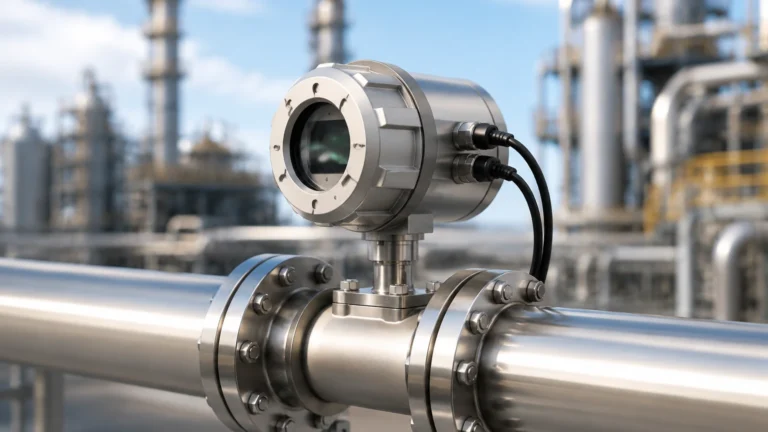
Vega Puls
Vega Puls
Non-contact radar level measurement has revolutionized industrial process control by providing high-precision monitoring without physical contact with the medium. Among the most recognized names in this field is the Vega Puls (VEGAPULS) series, which has set industry benchmarks for reliability across diverse applications. For engineers and procurement specialists, understanding the technical nuances of these sensors—and how they compare to other high-performance radar level meters available on the Main Page of industrial instrument providers—is critical for ensuring operational efficiency and safety.
Understanding the Measurement Principle of Radar Sensors
To evaluate the Vega Puls series effectively, one must first understand the underlying physics of radar level measurement. Most modern radar sensors, including the latest generations of the Vega Puls, utilize the Frequency Modulated Continuous Wave (FMCW) principle or the Pulse Radar principle.
Time of Flight (ToF)
Both methods rely on the "Time of Flight" principle. The sensor emits a high-frequency signal (microwave) toward the medium. This signal is reflected by the surface of the product and received back by the antenna. Since the speed of light is constant, the time it takes for the signal to travel to the surface and back is directly proportional to the distance.
FMCW vs. Pulse Radar
* Pulse Radar: The sensor sends out short microwave pulses and measures the time delay between the transmitted and received pulse. While effective, it often requires more complex signal processing to filter out noise.
* FMCW Radar: This technology emits a continuous signal with a changing frequency (a frequency sweep). The distance is calculated by comparing the frequency difference between the emitted and received signals at any given moment. FMCW is generally preferred for its superior signal-to-noise ratio and higher accuracy, particularly in the 80 GHz frequency range common in newer Vega Puls models.
Evolution of the Vega Puls Series
The Vega Puls line has evolved through several technological generations, primarily defined by the frequency of the microwave signals used. Frequency is a critical factor because it determines the beam angle and the ability of the sensor to focus on the target.
1. Low Frequency (approx. 6 GHz): Early radar sensors used lower frequencies. These were robust against foam and heavy vapors but required very large antennas to achieve a narrow beam, making them difficult to install in small nozzles.
2. Medium Frequency (approx. 26 GHz): This became the industry standard for many years (e.g., the Vega Puls 60 series). It offered a balance between antenna size and signal focus, suitable for a wide range of liquids and solids.
3. High Frequency (80 GHz): The current state-of-the-art technology, found in the Vega Puls 6X and the compact 10/20/30 series. The 80 GHz frequency allows for extremely narrow beam angles (as small as 3°) even with small antenna diameters. This makes it possible to measure accurately in tall, narrow tanks or vessels with internal obstructions.
Technical Selection Criteria
When selecting a radar level meter, whether from the Vega Puls range or equivalent industrial manufacturers like Welk, several technical parameters must be evaluated. The following table provides a general comparison of common specifications found in high-frequency radar sensors.
| Parameter | Compact Series (e.g., Puls 10/20) | High-End Series (e.g., Puls 6X) |
| :— | :— | :— |
| Frequency | 80 GHz | 80 GHz |
| Measuring Range | Up to 15 meters (approx. 49 ft) | Up to 120 meters (approx. 393 ft) |
| Accuracy | ±5 mm | ±1 mm |
| Beam Angle | 8° to 4° | 3° to 6° |
| Process Temperature | -40 to +80 °C | -196 to +450 °C |
| Process Pressure | -1 to 3 bar | -1 to 160 bar |
| Output Signal | 4…20 mA/HART, Modbus, SDI-12 | 4…20 mA/HART, Profibus PA, Foundation Fieldbus |
Installation Considerations for Radar Level Meters
Proper installation is paramount to the performance of a Vega Puls sensor. Even the most advanced 80 GHz radar can provide inaccurate data if the installation environment is not properly assessed.
Beam Angle and Obstructions
The narrow beam of 80 GHz sensors is a significant advantage. However, the "keep-out zone" must still be respected. Any internal structures such as ladders, heating coils, or agitators that intersect the radar beam will create "false echoes." While modern software can perform a "false signal suppression" to ignore these reflections, it is best practice to install the sensor in a location with a clear line of sight to the medium.
Nozzle Geometry
The height and diameter of the mounting nozzle can affect the signal. If a nozzle is too long or too narrow, the radar signal may reflect off the nozzle walls before even entering the tank. For 80 GHz sensors, the antenna should ideally be flush with or slightly below the nozzle bottom to minimize interference.
Orientation and Polarization
Radar signals are polarized. Rotating the sensor in its mounting flange can sometimes help minimize reflections from tank walls or internal structures. Most Vega Puls units include markings to help align the polarization plane correctly during installation.

Industrial Applications and Media Compatibility
Radar level measurement is versatile, but different media require different configurations.
Water and Wastewater
In this sector, sensors like the Vega Puls 11 or 21 are frequently used for open channel flow measurement or level monitoring in pump stations. These sensors must have high IP ratings (IP66/IP68) to withstand flooding and humidity. The non-contact nature is a major benefit here, as it prevents sensor fouling from sewage or debris.
Chemical and Petrochemical
Applications involving aggressive acids or volatile hydrocarbons require sensors with specific wetted materials, such as PTFE or PVDF. Furthermore, in pressurized vessels, the dielectric constant (εr) of the medium becomes a critical factor. Media with a low dielectric constant (like liquefied gases) reflect radar signals weakly, necessitating high-sensitivity sensors and sometimes the use of a bypass pipe or stilling well to concentrate the signal.
Bulk Solids
Measuring the level of grain, plastic pellets, or cement presents unique challenges, such as dust and uneven surface profiles (cones of repose). The high frequency of the Vega Puls 69, for example, is specifically designed to penetrate dust and provide a reliable average level across the uneven surface of solids.
Limitations and Troubleshooting
Despite the robustness of the Vega Puls technology, certain conditions can limit performance:
* Heavy Foam: While radar can penetrate some foam, extremely dense or thick foam (like shaving cream) can absorb the radar signal or reflect it prematurely, leading to false readings. In these cases, a guided wave radar or a hydrostatic pressure sensor may be more appropriate.
* Extreme Turbulence: Rapidly moving liquid surfaces can scatter the radar signal. This is often mitigated through software damping or by installing the sensor inside a stilling well.
* Dielectric Constant (εr) Limits: If the εr of the medium is lower than 1.4, the reflection may be too weak for standard non-contact radar. Specialized high-sensitivity versions or contact-based measurement methods might be required.
Comparing Market Solutions
While the Vega Puls series is a prominent choice, the industrial market offers various alternatives that provide similar or enhanced capabilities. Manufacturers like Welk provide a comprehensive range of radar level meters, ultrasonic sensors, and hydrostatic transmitters that cater to the same demanding environments. When evaluating options, engineers should look for:
* Ease of Integration: Compatibility with existing PLC/SCADA systems via HART, Profibus, or wireless protocols.
* Customization: The ability to provide OEM/ODM services for specific vessel geometries or hazardous area certifications (ATEX, IECEx).
* Cost-Effectiveness: Balancing the initial capital expenditure with the long-term maintenance savings provided by non-contact technology.
For those seeking a broader overview of available technologies and specific product models, visiting a dedicated industrial resource like the Main Page can provide the necessary technical data to make an informed decision.
Frequently Asked Questions (FAQ)
Q: Can a Vega Puls sensor measure through a plastic tank lid?
A: Yes, because plastic is non-conductive and has a low dielectric constant, radar signals can pass through the top of a plastic tank (e.g., HDPE or PP) to measure the liquid inside without a hole being cut in the tank.
Q: How does temperature affect radar measurement?
A: Unlike ultrasonic sensors, which are affected by the speed of sound changing with air temperature, radar signals are electromagnetic and are virtually unaffected by temperature or pressure changes in the vapor space.
Q: What is the lifespan of a non-contact radar sensor?
A: Because there are no moving parts and no contact with the medium, these sensors often last 10 to 15 years or more, provided the electronics are protected from extreme environmental conditions.
Q: Is 80 GHz always better than 26 GHz?
A: Not necessarily. While 80 GHz offers a narrower beam and better accuracy, 26 GHz can be more effective in applications with heavy steam or certain types of foam where the longer wavelength can better penetrate the interference.
In conclusion, the Vega Puls series remains a leader in the level measurement industry, but the choice of any radar sensor must be grounded in a thorough analysis of the process conditions, the physical properties of the medium, and the specific requirements of the installation site.