Single Use Inline Ph
Single Use Inline Ph
In the rapidly evolving landscape of biopharmaceutical manufacturing and specialized chemical processing, the shift toward single-use technology (SUT) has redefined how process parameters are monitored. Among these parameters, pH is perhaps the most critical for maintaining product quality, yield, and batch consistency. Single use inline pH sensors offer a streamlined alternative to traditional reusable glass electrodes, eliminating the need for cleaning, sterilization, and complex maintenance cycles.
For engineers and facility managers, understanding the nuances of single use inline pH measurement—from the underlying sensing principles to the integration within a broader process control framework—is essential for optimizing modern production lines. This guide explores the technical foundations, selection criteria, and operational considerations for these specialized instruments.
Understanding the Principles of Single-Use pH Measurement
Unlike traditional pH probes that are designed for hundreds of cycles and require Steam-in-Place (SIP) or Autoclave sterilization, single use inline pH sensors are designed for a single batch or a specific production run. There are two primary technologies used in these sensors: electrochemical and optical.
1. Electrochemical (Potentiometric) Sensors
These are essentially a variation of the classic glass electrode. They consist of a pH-sensitive glass membrane and a reference electrode. In a single-use format, these sensors are often pre-installed into a plastic housing or a bioreactor bag.
* Measurement Principle: The sensor measures the potential difference (voltage) across the glass membrane, which is proportional to the hydrogen ion concentration in the fluid, following the Nernst equation.
* Storage Challenges: Because the glass membrane must remain hydrated to function, these sensors are typically stored in a specialized buffer solution within the single-use assembly. This requires robust sealing to prevent the buffer from leaking or drying out during the shelf life of the product.
2. Optical (Fluorescence-Based) Sensors
Optical pH sensing is increasingly popular in single-use applications due to its small footprint and lack of liquid-filled components.
* Measurement Principle: These sensors utilize a pH-sensitive fluorescent dye (an analyte-sensitive indicator) embedded in a polymer matrix, often referred to as a "sensor patch." A fiber optic cable outside the process container shines a light at a specific wavelength onto the patch. The intensity or the decay time (lifetime) of the resulting fluorescence changes in response to the pH of the process fluid.
* Advantages: These sensors are entirely solid-state, making them highly resistant to mechanical shock and easier to integrate into flexible tubing or bags without the risk of glass breakage.
The Strategic Importance of Inline Single-Use pH Monitoring
The transition to single use inline pH monitoring is driven by the need for increased facility throughput and reduced risk of cross-contamination. In traditional stainless-steel environments, the time required for Clean-in-Place (CIP) and SIP procedures can account for up to 30% of total equipment downtime.
By utilizing single-use sensors, manufacturers can:
* Eliminate Sterilization Cycles: Sensors come pre-sterilized (usually via gamma irradiation), allowing for immediate use.
* Reduce Validation Burden: Since the sensor is disposed of after the batch, there is no need to validate cleaning efficacy for that specific component.
* Enhance Safety: The risk of glass shards entering the process stream—a major concern with traditional electrodes—is significantly mitigated, especially when using optical or plastic-bodied electrochemical sensors.
Key Evaluation Criteria for Selecting Single-Use pH Sensors
When evaluating single use inline pH solutions, technical teams must look beyond the initial cost. The performance of the sensor directly impacts the accuracy of the control loop. Key criteria include:
Accuracy and Precision
In bioprocessing, a deviation of even 0.1 pH units can significantly alter protein folding or cell metabolism. Ensure the sensor provides an accuracy of at least ±0.05 to ±0.1 pH units within the target range (typically pH 6.0 to 8.0 for cell culture).
Drift and Stability
Single-use sensors are often required to operate continuously for 14 to 21 days in a bioreactor. Drift—the gradual deviation of the sensor reading over time—must be minimal. Optical sensors, in particular, can be susceptible to "photo-bleaching" if the excitation light is applied too frequently, leading to drift.
Gamma Compatibility
Most single-use assemblies are sterilized using gamma radiation (typically 25–45 kGy). It is vital to confirm that the pH-sensitive materials and the internal buffer (for electrochemical types) do not degrade or shift significantly in their calibration constants after exposure to radiation.
Material Compliance
All wetted materials must meet stringent regulatory standards, such as USP Class VI and ISO 10993, to ensure that no harmful extractables or leachables (E&L) migrate from the sensor body into the product.
Comparison: Single-Use vs. Multi-Use pH Measurement Systems
| Feature | Single-Use (Inline) | Traditional Multi-Use (Glass) |
| :— | :— | :— |
| Sterilization | Pre-sterilized (Gamma) | SIP / Autoclave |
| Cleaning | None (Disposable) | CIP (Chemical/Thermal) |
| Calibration | Factory pre-calibrated / 1-point offset | Full 2-point calibration required |
| Risk of Breakage | Low (Polymer/Optical) | High (Glass) |
| Installation Time | Minutes | Hours (including sterilization) |
| Cost per Run | Higher (Consumable cost) | Lower (Amortized over time) |
| Maintenance | Zero | High (Refilling electrolytes, cleaning) |
Installation and Operational Best Practices
Successful implementation of single use inline pH sensors requires careful attention to the physical and electronic integration.
Physical Integration
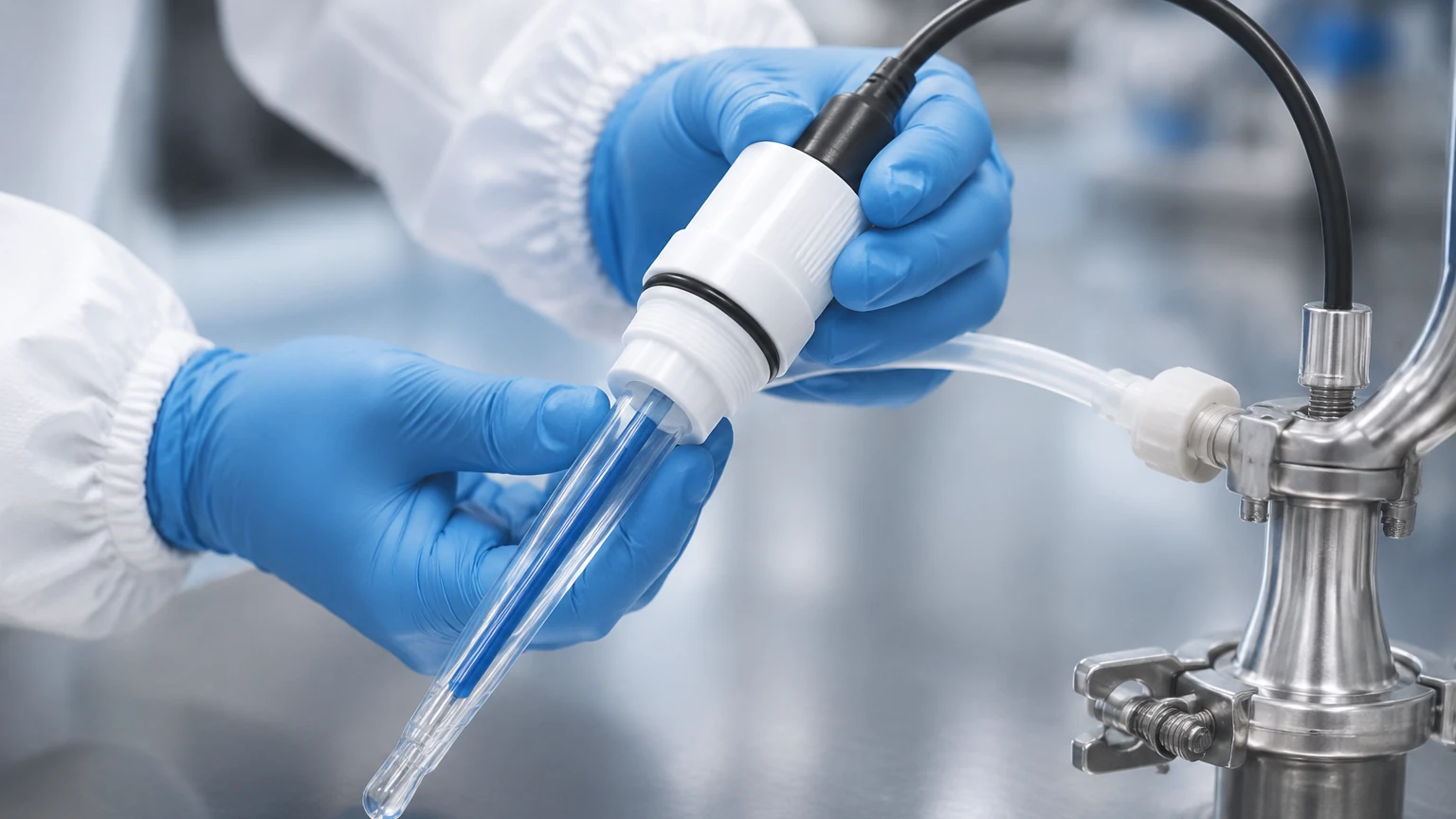
Inline sensors are usually integrated via a flow-through cell or a specific port in a single-use bag.
* Flow-Through Cells: For downstream processing (like chromatography or filtration), the sensor is housed in a plastic manifold with barbed or tri-clamp connectors. Ensure the flow path (e.g., 6 mm to 25 mm ID) matches the process tubing to prevent pressure drops.
* Orientation: For electrochemical types, the sensor should be installed at an angle (usually >15° from horizontal) to prevent air bubbles from being trapped against the sensing membrane, which would cause erratic readings.
Calibration and Standardization
While most single-use sensors are "factory calibrated," the shipping and sterilization process can cause slight shifts.
1. Factory Calibration: The manufacturer provides calibration constants (slope and offset) specific to the lot.
2. One-Point Standardization: Once the sensor is installed and the process fluid is introduced, a sample is taken for measurement with a high-precision lab pH meter. The inline sensor's reading is then adjusted to match the lab value. This accounts for any shifts caused by gamma irradiation or local temperature variations.
Risks, Limitations, and Mitigation Strategies
Despite their advantages, single use inline pH sensors have specific limitations that must be managed:
* Shelf Life: Unlike dry-stored level sensors or pressure transmitters, electrochemical pH sensors have a limited shelf life (often 6 to 12 months) because the reference electrode can dry out or the buffer chemistry can change. Inventory must be managed on a First-In-First-Out (FIFO) basis.
* Temperature Sensitivity: pH measurement is highly temperature-dependent. Ensure the system includes integrated temperature compensation (PT100 or PT1000 sensors) to adjust the pH calculation in real-time.
* Pressure Limits: Most single-use plastic housings are rated for lower pressures than stainless steel (typically up to 3–4 bar). Exceeding these limits can lead to leaks or sensor failure.
Integrating pH Data with Industrial Process Control
pH is rarely monitored in isolation. In a complex industrial environment, it is part of a holistic fluid management system that includes flow, temperature, and level measurement. For instance, in a neutralization tank, the pH sensor controls the dosing pumps, while level meters ensure the tank does not overflow or run dry.
Welk provides a wide range of industrial instrumentation designed to work alongside analytical sensors to provide a complete picture of process health. While pH ensures the chemical integrity of the batch, maintaining precise volume control via high-accuracy Main Page level measurement instruments is equally vital for process safety and efficiency. Integrating these data points into a centralized PLC or SCADA system allows for automated dosing, alarming, and data logging, which are critical for regulatory compliance (such as 21 CFR Part 11).
Frequently Asked Questions (FAQs)
Q: Can single-use pH sensors be recalibrated during a long run?
A: Yes, through one-point standardization. If the process allows for sterile sampling, you can compare the inline reading to a benchtop meter and adjust the offset in your transmitter to compensate for any drift observed over several days.
Q: Are optical pH sensors better than electrochemical ones?
A: It depends on the application. Optical sensors are excellent for small-scale bioreactors and applications where glass is prohibited. However, electrochemical sensors generally offer a wider measurement range and better performance in highly turbid or colored liquids where light transmission might be hindered.
Q: How do I handle the signal from a single-use sensor?
A: Most single-use sensors require a specific transmitter or a pre-amplifier that converts the high-impedance mV signal (electrochemical) or the optical signal into a standard industrial output like 4-20mA, Modbus, or Foundation Fieldbus.
Summary of Selection Steps
To ensure the successful deployment of single use inline pH technology, follow these steps:
1. Define the pH Range: Ensure the sensor is optimized for your specific range (e.g., pH 4–10 vs. pH 6–8).
2. Check Sterilization Compatibility: Verify the sensor can withstand the required gamma radiation dose.
3. Evaluate Physical Connection: Match the sensor housing (barb, TC, or luer lock) to your existing single-use tubing.
4. Confirm Regulatory Compliance: Request USP Class VI and E&L data from the manufacturer.
5. Plan for Signal Integration: Ensure your control system can accept the sensor's specific output or that you have the correct intermediate transmitter.
By carefully considering these factors, engineering teams can leverage single-use pH measurement to increase operational flexibility and maintain the highest standards of process control.