Vertical Level Switches
Vertical Level Switches
In industrial process control, ensuring the accurate detection of liquid levels is critical for operational safety, inventory management, and equipment protection. Vertical level switches represent one of the most reliable and widely implemented technologies for point-level detection. These devices are specifically designed to be mounted from the top or bottom of a vessel, providing high-precision switching signals when a liquid reaches a predetermined threshold.
Whether used for overfill prevention, pump control, or low-level alarms, vertical level switches offer a robust solution across various sectors, including water treatment, chemical processing, and oil and gas. This guide explores the fundamental measurement principles, selection criteria, and installation best practices for these essential instruments.
Measurement Principles of Vertical Level Switches
Before selecting a specific model, it is essential to understand the physical principles that govern how different vertical level switches operate. The choice of technology often depends on the physical properties of the liquid and the environmental conditions of the tank.
Magnetic Float Technology
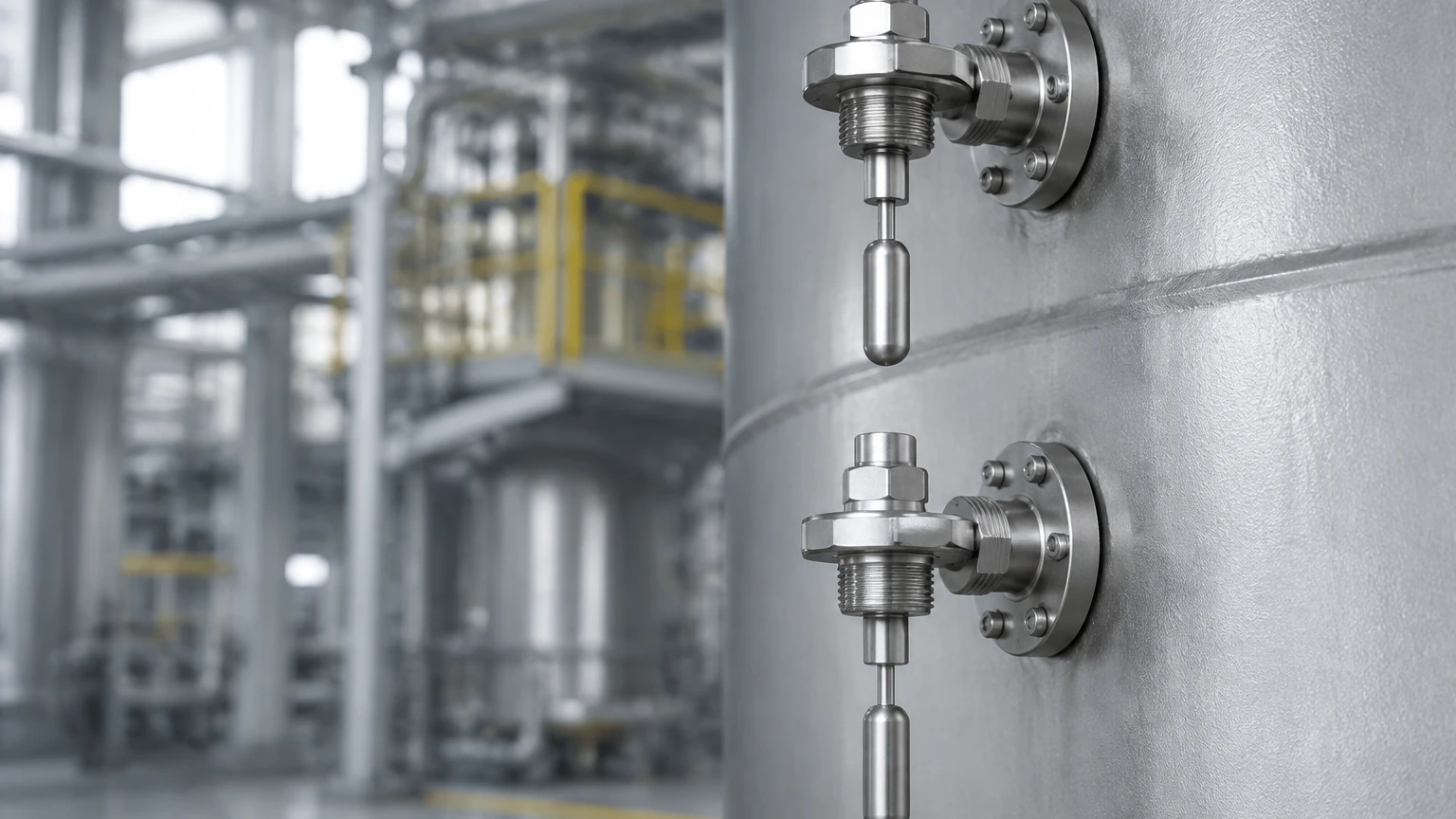
The most common principle for vertical level switches is the magnetic float mechanism. This design consists of a hollow float containing a permanent magnet and a stationary stem containing one or more hermetically sealed reed switches. As the liquid level rises or falls, the float moves vertically along the stem. When the magnet inside the float reaches the position of the reed switch, the magnetic field causes the switch contacts to open or close.
This technology is favored for its simplicity and the fact that it does not require a continuous power supply to operate the switch itself. It is highly effective for clean liquids with consistent density.
Vibrating Tuning Fork Technology
Vibrating or "tuning fork" level switches utilize piezoelectric crystals to vibrate the fork tines at their natural resonance frequency in the air. When the tines are submerged in a liquid, the frequency of vibration changes significantly. The internal electronics detect this frequency shift and convert it into a switching signal.
Vertical level switches using this principle are ideal for applications where the liquid density might vary or where there is a risk of turbulence and bubbles, as the vibration helps shed small amounts of build-up.
Ultrasonic Point Level Detection
Ultrasonic vertical switches operate by emitting high-frequency sound waves across a small gap in the sensor head. When the gap is filled with air, the signal is attenuated. When liquid fills the gap, the ultrasonic signal is transmitted efficiently to a receiver, triggering the switch. This non-contact-sensing element approach is useful for liquids that might coat or stick to mechanical floats.
Key Evaluation Criteria for Selection
Selecting the correct vertical level switch requires a detailed analysis of the application environment. Engineers must confirm several technical parameters to ensure long-term reliability.
Material Compatibility
The wetted parts of the switch must be chemically compatible with the process media. Common materials include:
* Stainless Steel (304 or 316L): Suitable for high-temperature, high-pressure, and food-grade applications.
* PP (Polypropylene): Often used for water treatment and mildly corrosive chemicals at lower temperatures.
* PVDF/PTFE: Reserved for highly aggressive acids and bases.
Temperature and Pressure Ratings
Vertical level switches are subject to the internal environment of the vessel. Standard plastic switches may only handle up to 80°C (176°F) and 2 Bar (29 PSI), whereas specialized stainless steel variants can withstand temperatures exceeding 200°C (392°F) and pressures up to 40 Bar (580 PSI).
Liquid Specific Gravity
For float-based vertical level switches, the buoyancy of the float is critical. The float must have a lower density than the liquid it is intended to measure. Most standard floats are designed for liquids with a specific gravity (SG) of 0.8 or higher. For light oils or liquefied gases, specialized low-density floats are required.
Practical Selection Table
The following table provides a comparison of common vertical level switch types to assist in the initial engineering phase.
| Feature | Magnetic Float Switch | Tuning Fork Switch | Ultrasonic Switch |
| :— | :— | :— | :— |
| Best For | Clean liquids, low cost | Viscous liquids, powders | Coating liquids, aerated liquids |
| Max Temperature | Up to 200°C | Up to 150°C | Up to 135°C |
| Max Pressure | Up to 40 Bar | Up to 40 Bar | Up to 20 Bar |
| Maintenance | Low (Moving parts) | Very Low (No moving parts) | Low (No moving parts) |
| Viscosity Limit | Low to Medium | High | Medium |
| Density Sensitivity | High (Requires buoyancy) | Low | None |
Installation Considerations and Best Practices
Proper installation is as important as selecting the right technology. Because vertical level switches are typically mounted through the top of a tank, several mechanical factors must be addressed.
Mounting Orientation and Alignment
As the name implies, vertical level switches must be installed as close to true vertical as possible. A deviation of more than 15 degrees can increase friction between the float and the stem in magnetic models, potentially leading to mechanical sticking. For tall tanks, ensure the stem is long enough to reach the desired switching point, but consider the structural integrity of a long, unsupported rod.
Turbulence and Agitation
In tanks with mixers or high-velocity inflow, the moving liquid can cause the float to bounce or the stem to vibrate. In these scenarios, the use of a "still pipe" or "stilling well" is recommended. This is a perforated pipe installed around the switch to dampen liquid movement while allowing the level to equalize with the rest of the tank.
Electrical Wiring and Safety
Most industrial vertical level switches provide either a Dry Contact (SPST/SPDT) or a Transistor output. When switching inductive loads like pump motors or large solenoids, it is vital to use an intermediate relay to prevent the high inrush current from welding the small reed switch contacts together. For hazardous areas, ensure the device carries the appropriate ATEX or IECEx certification for intrinsic safety.
Common Risks and Limitations
While vertical level switches are highly reliable, certain conditions can lead to premature failure or false readings:
1. Build-up and Scaling: In wastewater or chemical crystallization processes, material can accumulate on the stem or inside the float. This increases the weight of the float or creates friction, preventing it from moving. Regular inspection is required in "dirty" applications.
2. Magnetic Particles: Since many vertical switches use magnets, any metallic fines or magnetic particles in the liquid will be attracted to the float. This can eventually jam the mechanism.
3. Vapor and Condensation: In high-temperature tanks, condensation can form inside the switch housing if not properly sealed. Using a moisture-resistant potting compound or a high-IP-rated enclosure (IP67/68) is necessary for outdoor or high-humidity environments.
Frequently Asked Questions (FAQs)
Q: Can a single vertical level switch monitor multiple points?
A: Yes. Magnetic float switches can be customized with multiple reed switches at different heights along a single stem. This allows a single process entry point to provide signals for Low, High, and High-High levels.
Q: How do I test a vertical level switch without filling the tank?
A: For float switches, you can manually slide the float up and down the stem while checking continuity with a multimeter. For tuning forks, most modern units include a test button or a magnetic test point that simulates a liquid-covered state.
Q: What is the difference between N.O. and N.C. configurations?
A: N.O. (Normally Open) means the circuit is open when the float is at the bottom (dry). N.C. (Normally Closed) means the circuit is closed when the float is at the bottom. Most vertical level switches allow the user to reverse the logic by simply flipping the float 180 degrees on the stem.
Conclusion
Vertical level switches remain a cornerstone of industrial automation due to their reliability and ease of integration. By understanding the measurement principles—from magnetic floats to ultrasonic gaps—and carefully considering the chemical and physical demands of the application, engineers can significantly reduce downtime and prevent costly overflows. For those looking to integrate these solutions into a broader automation system, it is advisable to Review product options and application support on our Main Page to find the specific configuration that matches your operational requirements. Always confirm the specific gravity, chemical concentration, and maximum operating pressure with your equipment provider before finalizing a purchase to ensure the longevity of your level measurement system.