Water Level Application
Water Level Application
In the industrial and municipal sectors, the term "water level application" encompasses a vast array of monitoring requirements, ranging from simple storage tank management to complex wastewater treatment processes and environmental flood monitoring. Precise level measurement is critical for operational efficiency, safety, and regulatory compliance. Selecting the appropriate technology requires a deep understanding of the physical principles governing different sensors and how they interact with the specific environment of the application.
As a professional manufacturer, Welk provides a comprehensive suite of industrial level measurement instruments designed to meet these diverse needs. This guide explores the fundamental principles of water level measurement, provides selection criteria for various scenarios, and outlines best practices for installation and maintenance.
Core Principles of Water Level Measurement
Before selecting a sensor for a water level application, it is essential to understand the underlying measurement technologies. Most industrial solutions fall into one of four categories: radar, ultrasonic, hydrostatic, and mechanical/magnetic.
Radar Level Measurement
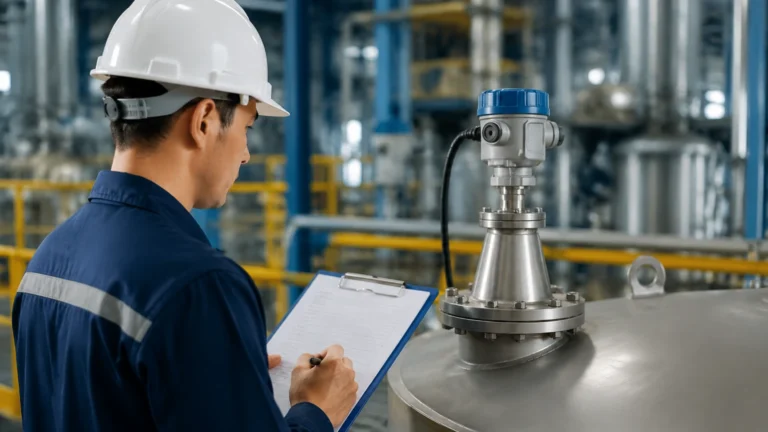
Radar level meters operate on the Time-of-Flight (ToF) principle. The sensor emits high-frequency microwave pulses (typically in the 26 GHz or 80 GHz range) that travel at the speed of light. When these pulses hit the water surface, they are reflected back to the sensor. The device calculates the distance based on the time elapsed between emission and reception.
Because microwaves do not require a medium for propagation, radar is largely unaffected by temperature fluctuations, vacuum, or high pressure. Modern 80 GHz radar sensors offer narrow beam angles, allowing for precise measurement even in narrow tanks with internal obstructions.
Ultrasonic Level Measurement
Similar to radar, ultrasonic sensors use the ToF principle but utilize sound waves instead of microwaves. The sensor emits an ultrasonic pulse that reflects off the water surface. The time taken for the echo to return is proportional to the distance.
Ultrasonic sensors are highly cost-effective for many water level applications. However, because sound speed is affected by air temperature, these sensors must include integrated temperature compensation. They are also sensitive to heavy foam, steam, and significant air turbulence, which can dissipate or distort the sound waves.
Hydrostatic Pressure Measurement
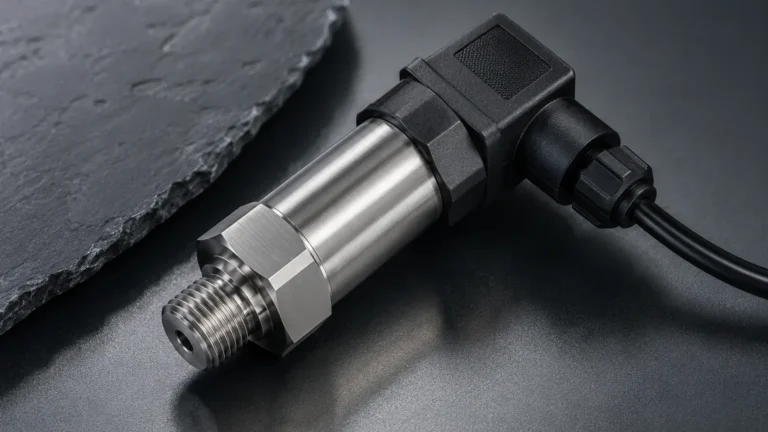
Hydrostatic level transmitters measure the pressure exerted by the liquid column above the sensor. Based on the formula $P = \rho gh$ (where $P$ is pressure, $\rho$ is liquid density, $g$ is gravity, and $h$ is height), the sensor converts the measured pressure into a level reading.
In a water level application involving vented tanks or open reservoirs, a submersible pressure transducer is often used. These sensors include a vent tube in the cable to compensate for changes in atmospheric pressure, ensuring the reading reflects only the weight of the water.
Magnetic Level Gauges and Switches
Magnetic level gauges utilize a float containing a permanent magnet that moves with the water level inside a bypass chamber. This magnet flips visual flags on an external scale and can actuate reed switches or transmitters for remote monitoring. This technology provides a highly reliable mechanical backup and clear local indication without requiring a power source for the visual display.
Technology Selection Matrix
Choosing the right instrument for a water level application depends on the environment, accuracy requirements, and budget. The following table provides a general comparison of the primary technologies used in the industry.
| Technology | Typical Accuracy | Max Range | Contact Type | Key Advantages | Common Limitations |
| :— | :— | :— | :— | :— | :— |
| Radar (80 GHz) | ±1 mm to ±2 mm | Up to 120m | Non-contact | Unaffected by steam/dust; high precision | Higher initial cost |
| Ultrasonic | ±0.25% of range | Up to 30m | Non-contact | Cost-effective; easy to install | Affected by foam and heavy steam |
| Hydrostatic | ±0.1% to ±0.5% | Up to 200m+ | Contact | Simple; ideal for deep wells/boreholes | Sensitive to density changes |
| Magnetic Gauge | ±5 mm to ±10 mm | Up to 6m+ | Contact | Visual local indication; no power needed | Mechanical parts; bypass piping required |
For detailed specifications and to Review product options and application support, engineers should consult the technical data sheets provided on the Welk Main Page.
Specific Scenarios in Water Level Application
Municipal Wastewater Treatment
Wastewater applications often involve turbulent surfaces, floating debris, and corrosive gases like hydrogen sulfide (H2S). Non-contact radar is frequently preferred here because it remains accurate despite surface agitation and does not suffer from the fouling that affects contact-based sensors. For open channel flow measurement in flumes or weirs, ultrasonic sensors are a standard, cost-effective choice.
Deep Well and Borehole Monitoring
When monitoring groundwater levels in deep wells, hydrostatic transmitters are the industry standard. These sensors are designed with slim diameters (often 20mm to 30mm) to fit into narrow stilling wells. The cable must be reinforced with Kevlar or steel to prevent stretching over long distances, which could introduce measurement errors.
Chemical Water Treatment Tanks
In applications involving deionized water or chemical additives, the material compatibility of the sensor is paramount. Radar sensors with PTFE (Teflon) encapsulated antennas or ultrasonic sensors with PVDF housings are typically used to prevent corrosion and ensure long-term reliability.
Installation Considerations and Best Practices
Proper installation is as critical as selecting the right technology. Even the most advanced sensor will fail to provide accurate data if positioned incorrectly.
1. Avoid the "Dead Zone": Every non-contact sensor (radar and ultrasonic) has a minimum distance near the face of the transducer where it cannot measure accurately, known as the dead zone or blocking distance. Ensure the sensor is mounted high enough so the maximum water level never enters this zone.
2. Mounting Position: Sensors should be mounted away from the tank wall to avoid false reflections (echoes). As a rule of thumb, the sensor should be placed at least 1/6th of the tank diameter away from the wall.
3. Inflow Interference: Never mount a level sensor directly above the water inlet. The falling water will create turbulence and false echoes, leading to erratic readings.
4. Stilling Wells: In applications with extreme turbulence or heavy foam, installing the sensor inside a stilling well (a vertical pipe) can provide a calm surface for measurement. This is particularly effective for both radar and hydrostatic sensors.
5. Submersible Cable Protection: For hydrostatic sensors, the vent tube must be kept clear of moisture. Using a desiccant bellows or a specialized junction box at the top of the well is necessary to prevent condensation from blocking the tube and causing pressure measurement errors.

Limitations and Common Risks
While modern instrumentation is highly robust, certain factors can compromise a water level application:
* Foam: Thick, dense foam can absorb ultrasonic signals and scatter radar pulses. In these cases, 80 GHz radar or hydrostatic sensors are generally more reliable.
* Vapor and Condensation: While radar can penetrate vapor, heavy condensation on an ultrasonic transducer face can "blind" the sensor. Some ultrasonic sensors feature a self-cleaning function through the vibration of the transducer face, but radar remains superior in high-humidity environments.
* Build-up: In wastewater applications, grease or biological growth can build up on contact sensors. Non-contact methods mitigate this risk, though periodic inspection of the sensor face is still recommended.
* Atmospheric Pressure Changes: For hydrostatic sensors, failing to properly vent the sensor to the atmosphere will result in errors equivalent to the change in weather-related barometric pressure (approximately 10.2 cm of water per 10 mbar of pressure change).
Frequently Asked Questions (FAQs)
Q: Can I use an ultrasonic sensor for outdoor water level monitoring?
A: Yes, but you must ensure the sensor has an integrated temperature sensor to compensate for the change in the speed of sound as the air temperature shifts throughout the day. It should also be protected from direct sunlight to prevent the housing from overheating, which can skew the temperature reading.
Q: When should I choose 80 GHz radar over 26 GHz radar?
A: 80 GHz radar is preferred when you have a small mounting nozzle, a narrow tank, or internal obstructions like agitators or ladders. The narrower beam angle (as small as 3 degrees) allows the signal to bypass these obstacles more easily than the wider beam of a 26 GHz unit.
Q: How often do hydrostatic level transmitters need calibration?
A: In clean water applications, these sensors are very stable and may only need a calibration check every 12 to 24 months. In wastewater, more frequent checks are required to ensure the diaphragm is not fouled or damaged by debris.
Q: Is radar affected by the salinity of the water?
A: No. Radar reflects off the dielectric constant of the surface. While the dielectric constant of water changes slightly with salinity, the change is not significant enough to affect the time-of-flight measurement.
Conclusion and Next Steps
Successful water level application management relies on matching the specific environmental challenges with the correct measurement physics. Whether the priority is high-precision non-contact measurement via radar or the simple, rugged reliability of hydrostatic pressure, understanding these technologies ensures long-term operational success.
For engineers and procurement professionals looking to implement these solutions, the next step is to evaluate the specific geometry and chemical profile of the water source. Welk offers customized OEM/ODM services to tailor these instruments to specific industrial requirements. To explore our full range of radar, ultrasonic, and hydrostatic instruments, please visit our Main Page at https://www.level-meters.com/ for technical support and product selection guidance.