What Is Coriolis Mass Flow Meter
What Is Coriolis Mass Flow Meter
In the landscape of industrial process control, the ability to measure fluid movement with high precision is fundamental to efficiency, safety, and profitability. While many technologies measure the volume of a moving fluid, the Coriolis mass flow meter stands out for its ability to measure mass directly. This distinction is critical because mass remains constant regardless of changes in temperature, pressure, or viscosity, whereas volume fluctuates significantly under these variables.
Understanding what is coriolis mass flow meter involves looking at a multivariable instrument capable of providing simultaneous measurements of mass flow, density, and temperature. This article provides a comprehensive engineering reference for the technology, its operating principles, and its application in modern industrial environments.
Measurement Principles: The Coriolis Effect
The fundamental operating principle of a Coriolis mass flow meter is based on the Coriolis effect, a phenomenon of classical mechanics. When a fluid moves through a vibrating tube, it is subjected to Coriolis acceleration, which results in a measurable force on the tube walls.
The Vibrating Tube Mechanism
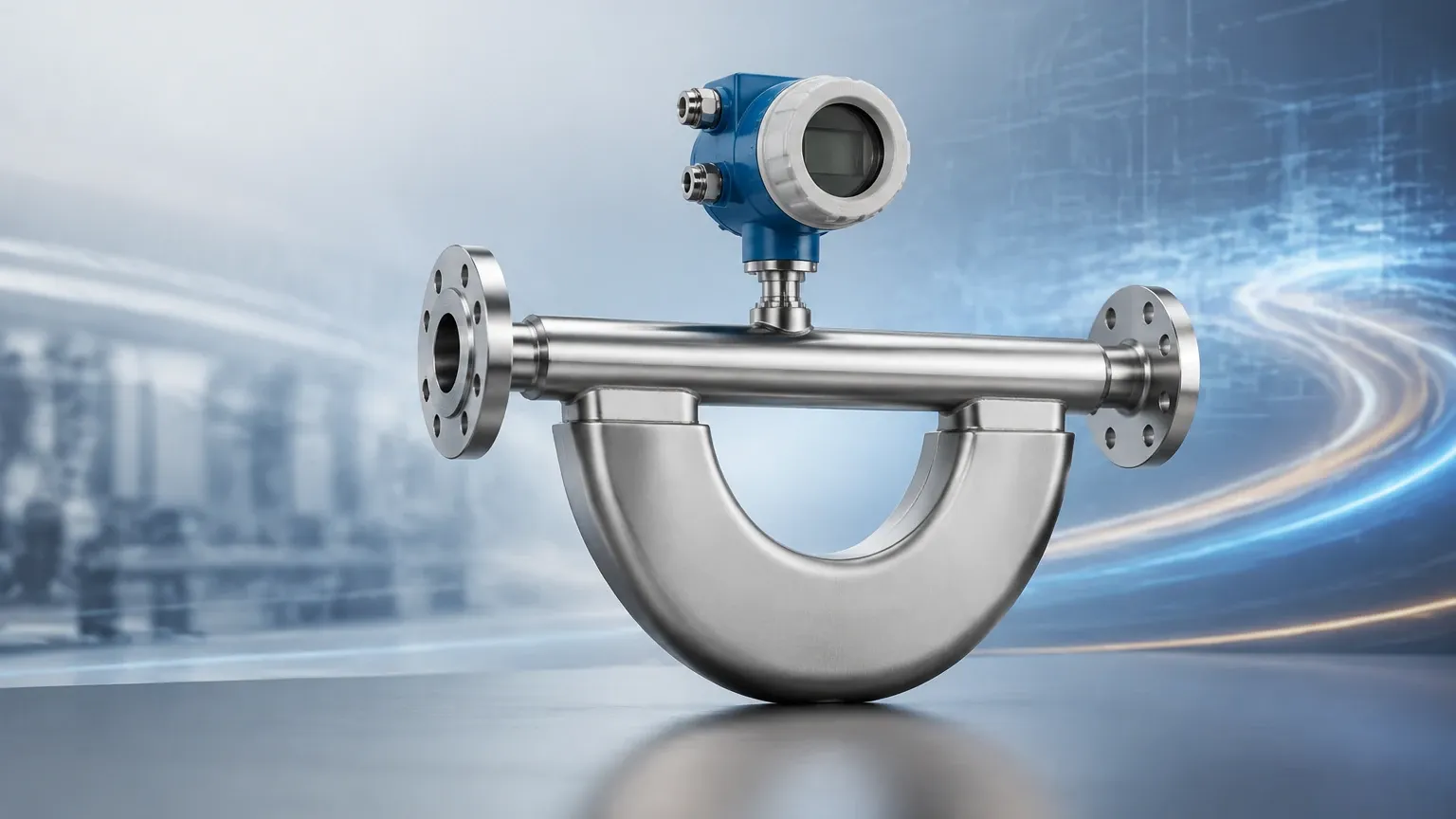
Inside a Coriolis meter, one or two measuring tubes are driven to vibrate at their resonant frequency by an electromagnetic drive coil. When there is no flow, the tubes vibrate uniformly. However, when fluid begins to flow through the tubes, the mass of the moving fluid interacts with the vibration.
As the fluid moves toward the point of maximum vibration (the center of the tube loop), it resists being pushed upward and pushes back down on the tube. Conversely, as the fluid leaves the center and moves toward the exit, it resists having its vertical motion decreased and pushes up against the tube. This creates a twisting effect or a "phase shift" between the inlet and outlet sides of the tube.
Measuring Mass Flow
Sensors (pick-off coils) located at the inlet and outlet sections of the tube detect this phase shift. The time difference ($Δt$) between the two sine waves generated by these sensors is directly proportional to the mass flow rate. Because this measurement relies on the inertia of the fluid mass, it is inherently independent of the fluid's physical properties such as density, viscosity, or flow profile.
Density and Temperature Measurement
Beyond mass flow, these meters are exceptional at measuring density. The resonant frequency at which the tubes vibrate depends on the total mass of the system (the mass of the tubes plus the mass of the fluid inside them). Since the mass of the tubes is constant, any change in the resonant frequency is caused by a change in fluid density.
Additionally, an integrated Resistance Temperature Detector (RTD) monitors the tube temperature. This is necessary because the elasticity of the tube material changes with temperature, which would otherwise affect the accuracy of the flow and density readings. This temperature data is also provided as an output, making the Coriolis meter a true multivariable device.
Relationship to Level Measurement Systems
While Coriolis meters measure flow, they are frequently integrated into systems alongside level measurement instruments. In complex process plants, such as those served by Main Page solutions, mass flow data is often reconciled with tank level data to ensure mass balance. For example, in a chemical blending tank, radar level meters provide the inventory volume, while Coriolis meters ensure that the precise mass of each reactant is added to the mixture. This dual-verification approach is essential for high-value custody transfer and chemical stoichiometry.
Key Evaluation Criteria for Selection
When determining if a Coriolis mass flow meter is appropriate for a specific application, engineers must evaluate several technical parameters. Unlike simpler volumetric meters, the selection of a Coriolis meter requires a deep understanding of the process conditions.
Accuracy and Repeatability
Coriolis meters are among the most accurate flow measurement devices available. Typical liquid mass flow accuracy ranges from ±0.1% to ±0.05% of the flow rate. For gas applications, accuracy is generally around ±0.5%. Repeatability is equally high, often within ±0.02%.
Pressure Drop
Because the fluid must pass through narrowed measuring tubes (often U-shaped), there is an inherent pressure drop. Engineers must ensure that the available system pressure can overcome this drop without causing cavitation or flashing, especially when dealing with volatile liquids.
Material Compatibility
The measuring tubes are the only wetted parts of the instrument besides the process connections. Common materials include 316L Stainless Steel, Hastelloy C-22, and Tantalum. Selection must be based on the chemical aggressiveness of the fluid to prevent stress corrosion cracking or erosion.
Practical Selection Table
| Feature | Specification / Requirement |
| :— | :— |
| Primary Measurement | Mass Flow Rate (kg/h, t/h) |
| Secondary Measurements | Density (kg/m³), Temperature (°C), Volumetric Flow |
| Typical Accuracy (Liquid) | ±0.1% of rate |
| Typical Accuracy (Gas) | ±0.5% of rate |
| Turndown Ratio | 20:1 to 100:1 |
| Maximum Pressure | Up to 350 bar (5000 psi) depending on model |
| Temperature Range | -200°C to +350°C |
| Line Sizes | 1 mm to 300 mm (1/12" to 12") |
Installation Considerations
To maintain the high accuracy associated with Coriolis technology, proper installation is paramount. While Coriolis meters do not require the long straight pipe runs associated with orifice plates or turbine meters, they are sensitive to mechanical stress and vibration.
1. Orientation:
* Liquids: The meter should ideally be installed in a "U" down position (flag-down) to ensure the tubes remain full and to prevent air bubbles from being trapped.
* Gases: The meter should be installed in an "inverted U" position (flag-up) to allow any condensed liquids to drain out of the tubes.
* Slurries: Vertical installation with upward flow is preferred to prevent solids from settling in the tubes.
2. Support and Vibration: The meter must be securely supported on both the inlet and outlet flanges. Because the meter operates on vibration, external mechanical vibrations from pumps or motors at the same frequency as the meter's resonance can cause measurement errors. High-quality meters use dual-tube designs to cancel out external noise, but rigid mounting is still recommended.
3. Stress-Free Mounting: The piping must be aligned correctly so that the meter is not subjected to axial or torsional stress when the flange bolts are tightened. Excessive stress can shift the zero point and degrade accuracy.
4. Zero Calibration: After installation and under full-pipe, no-flow conditions, a "zero trim" must be performed to account for the specific mechanical environment of the installation.
Limitations and Common Risks
Despite their versatility, Coriolis mass flow meters are not a universal solution for every application. Engineers should be aware of the following limitations:
* Initial Cost: The complexity of the sensor and the precision electronics make Coriolis meters significantly more expensive than magnetic or ultrasonic flow meters.
* Size and Weight: For large pipe diameters (above 200 mm or 8 inches), the meters become extremely heavy and bulky, often requiring dedicated structural supports.
* Entrained Gas: While modern digital signal processing (DSP) has improved performance, significant amounts of entrained gas in a liquid stream (slug flow) can dampen the tube vibration, leading to measurement errors or "stalling" of the meter.
* Pressure Drop: In high-viscosity applications, the pressure drop across the meter can be substantial, requiring larger pumps or oversized meters to compensate.
Frequently Asked Questions (FAQs)
Q: Does a Coriolis meter require periodic recalibration?
A: Unlike mechanical meters with moving parts that wear out, Coriolis meters have no internal friction. If the fluid is non-erosive and non-corrosive, the calibration remains stable for years. However, in regulated industries like oil and gas custody transfer, annual verification is often required.
Q: Can it measure the flow of non-conductive liquids?
A: Yes. Unlike electromagnetic flow meters, Coriolis meters do not rely on electrical conductivity. They work equally well on deionized water, hydrocarbons, and liquid gases.
Q: How does viscosity affect the measurement?
A: Mass flow measurement is independent of viscosity. However, high viscosity increases the pressure drop across the meter. It is important to size the meter correctly to ensure the pump can handle the resistance.
Q: Can a Coriolis meter measure steam?
A: While theoretically possible, it is rarely practical. The low density of steam requires very high velocities to generate enough Coriolis force for an accurate reading, often leading to unacceptable pressure drops. Vortex or differential pressure meters are usually preferred for steam.
Conclusion
Defining what is coriolis mass flow meter reveals a sophisticated instrument that has revolutionized process control by providing direct mass measurement. Its ability to ignore changes in fluid properties while simultaneously providing density and temperature data makes it an invaluable tool for high-precision applications in the chemical, pharmaceutical, and food industries.
While the initial investment is higher than other technologies, the reduction in measurement uncertainty and the elimination of maintenance associated with moving parts often result in a lower total cost of ownership. For engineers managing complex fluid systems, integrating Coriolis technology with reliable level measurement solutions from providers like Welk ensures a robust and accurate process monitoring strategy. When selecting a meter, always prioritize fluid compatibility, pressure drop constraints, and proper mechanical installation to realize the full potential of this advanced technology.