Who Invented the Wireless Communication
Who Invented the Wireless Communication
In the modern industrial landscape, wireless communication is the backbone of the Industrial Internet of Things (IIoT). From remote oil fields to complex chemical processing plants, the ability to transmit data without physical cabling has revolutionized how engineers monitor tank levels and process variables. However, to understand the sophisticated radar and ultrasonic level meters used today, one must look back at the scientific milestones of the late 19th and early 20th centuries. The question of who invented the wireless communication does not have a single-name answer; rather, it is a history of cumulative breakthroughs in physics and electrical engineering.
For process engineers and procurement specialists, understanding these foundations is more than a historical exercise. The same principles of electromagnetic wave propagation discovered by the pioneers of wireless communication are the exact principles that govern the accuracy and reliability of modern industrial level measurement instruments.
The Scientific Pioneers of Wireless Communication
The journey toward wireless technology began with theoretical physics and moved toward practical experimentation. Several key figures are central to the development of the technology we now use for wireless level sensing and data transmission.
James Clerk Maxwell: The Theoretical Architect
In the 1860s, Scottish physicist James Clerk Maxwell published a set of equations that unified electricity, magnetism, and light into the single field of electromagnetism. He theoretically predicted that electromagnetic waves could travel through empty space at the speed of light. Without Maxwell’s mathematical framework, the development of radio, radar, and wireless telemetry would have been impossible.
Heinrich Hertz: Proving the Theory
It was not until the late 1880s that German physicist Heinrich Hertz experimentally proved Maxwell’s theories. Using a spark-gap transmitter and a simple loop receiver, Hertz demonstrated the transmission and reception of radio waves across his laboratory. While Hertz famously thought his discovery had "no use whatsoever," his work provided the experimental proof that electromagnetic energy could be transmitted without wires.
Guglielmo Marconi: The Practical Inventor
When discussing who invented the wireless communication in a commercial and practical sense, Guglielmo Marconi is the name most frequently cited. In the mid-1890s, Marconi began experimenting with Hertzian waves, eventually developing a system that could transmit signals over long distances. In 1901, he successfully sent the first transatlantic wireless signal. Marconi’s focus on the engineering and commercialization of radio set the stage for the global wireless networks used in industry today.
Nikola Tesla: The Visionary of Radio
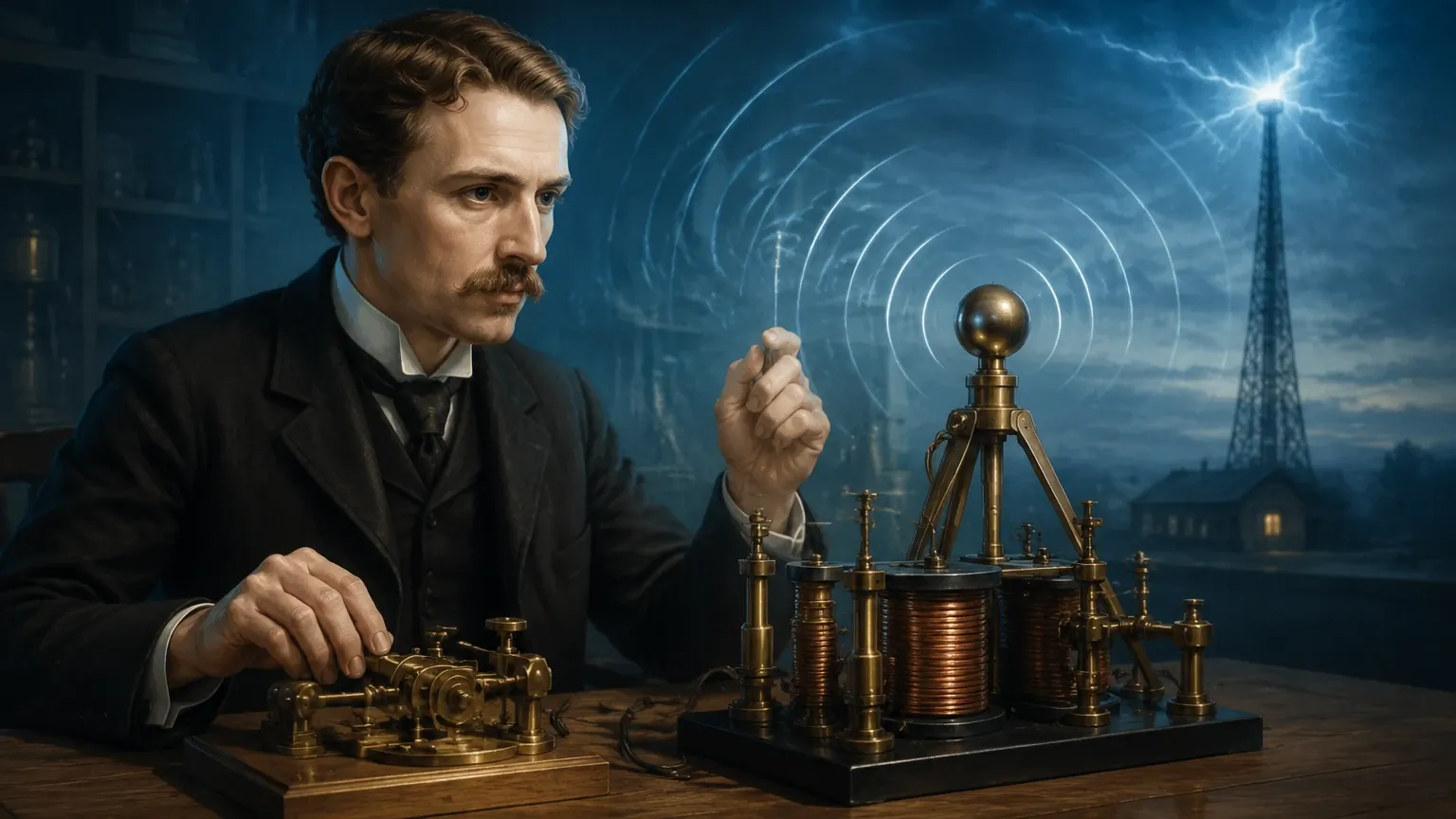
Nikola Tesla also played a critical role, particularly in the development of the high-frequency alternators and the Tesla coil. Tesla’s work on resonance and tuning was essential for selecting specific frequencies, a concept that is vital today for preventing interference between multiple wireless level sensors in a single facility. In 1943, the U.S. Supreme Court recognized Tesla’s contributions by overturning some of Marconi’s patents in favor of Tesla’s earlier work.
From Radio Waves to Industrial Level Measurement
The technological evolution from simple wireless telegraphy to modern industrial sensing followed two distinct paths: the transmission of data (Wireless Communication) and the use of waves for distance measurement (Radar and Ultrasonic).
Radar Level Measurement Principles
Radar (Radio Detection and Ranging) is a direct application of the electromagnetic wave theories established by Maxwell and Hertz. In level measurement, a radar transmitter emits a high-frequency electromagnetic wave (typically in the GHz range). This wave travels through the air or vapor space, hits the surface of the medium (liquid or solid), and reflects back to the sensor.
There are two primary methods used in modern radar level meters:
1. Time of Flight (ToF): The instrument measures the exact time it takes for a pulse to travel to the surface and back. Since the speed of light is constant, the distance can be calculated with extreme precision.
2. Frequency Modulated Continuous Wave (FMCW): The transmitter sends a continuous signal with a constantly changing frequency. The difference in frequency between the transmitted signal and the reflected signal is proportional to the distance.
Ultrasonic Level Measurement Principles
While radar uses electromagnetic waves, ultrasonic sensors use mechanical sound waves. This technology relies on the piezoelectric effect to generate high-frequency sound pulses (typically 20 kHz to 200 kHz). Like radar, it uses the Time of Flight principle, but it is dependent on the speed of sound, which varies with air temperature. Therefore, high-quality ultrasonic sensors, such as those provided by Welk, include integrated temperature compensation to maintain accuracy.
Wireless Communication Protocols in Modern Industry
Identifying who invented the wireless communication also leads us to the modern protocols that allow level meters to communicate with centralized control systems (PLC/SCADA) without signal wires. Today, industrial level measurement often utilizes several key wireless standards:
* WirelessHART: An industry-standard protocol designed specifically for process automation. It uses a mesh network topology to ensure high reliability in metal-heavy industrial environments.
* LoRaWAN (Long Range Wide Area Network): Ideal for remote monitoring, such as water reservoir levels or agricultural tanks, where low power consumption and long-range transmission (up to 15 km) are required.
* NB-IoT (Narrowband IoT): A cellular-based protocol that allows level meters to connect directly to the internet via existing mobile infrastructure, perfect for widely distributed assets.
Selection Criteria for Wireless Level Measurement
Choosing the right technology requires an understanding of both the measurement principle and the communication method. The following table provides a comparison for engineering selection:
| Feature | Radar Level Meters | Ultrasonic Level Sensors | Hydrostatic Transmitters (Wireless) |
| :— | :— | :— | :— |
| Medium | Liquids, Solids, Corrosives | Liquids, Slurries | Liquids only |
| Accuracy | ±1 mm to ±5 mm | ±0.25% of range | ±0.1% to ±0.5% of span |
| Range | Up to 100 meters | Up to 30 meters | Depth-dependent (up to 200m) |
| Pressure/Temp | High tolerance | Limited tolerance | High tolerance |
| Best Use Case | Chemical tanks, high-temp silos | Water treatment, open channels | Deep wells, vented tanks |
Installation Considerations and Best Practices
To ensure the reliability of wireless level measurement systems, engineers must follow strict installation guidelines that account for the physics of wave propagation.
1. Obstruction Clearance: For both radar and ultrasonic sensors, the "beam angle" must be considered. Any internal tank structures (ladders, agitators, pipes) within the signal cone will cause false reflections.
2. Nozzle Geometry: The mounting nozzle should be short and wide enough to prevent the signal from reflecting off the nozzle walls before entering the tank. This is particularly important for ultrasonic sensors which have a larger "dead zone" (blocking distance) near the sensor face.
3. Antenna Alignment: In wireless data transmission, the orientation of the antenna is crucial. Antennas should be mounted vertically and away from large metal surfaces that could cause signal attenuation or multi-path interference.
4. Power Management: Most wireless level meters are battery-powered. Engineers must balance the frequency of measurement (update rate) with the desired battery life. Many Welk systems offer configurable sleep modes to extend battery life to several years.
Limitations and Challenges
Despite the advancements since the days of Marconi and Tesla, wireless communication and sensing have inherent limitations:
* Dielectric Constant (εr): Radar measurement depends on the reflectivity of the medium. Materials with very low dielectric constants (like certain oils or dry powders) may not reflect enough energy for a reliable signal. In these cases, Guided Wave Radar (GWR) is often recommended.
* Signal Interference: In dense industrial environments, electromagnetic interference (EMI) from large motors or high-voltage equipment can disrupt wireless data transmission. Utilizing frequency-hopping spread spectrum (FHSS) technology helps mitigate this risk.
* Environmental Factors: For ultrasonic sensors, heavy foam, dust, or steam can absorb the sound waves, leading to signal loss. Radar is generally unaffected by these factors, making it the preferred choice for volatile environments.
Frequently Asked Questions (FAQ)
Q: Did Marconi really invent wireless communication alone?
A: No. Marconi was a brilliant integrator and entrepreneur who utilized the theoretical work of Maxwell and the experimental work of Hertz. He was the first to create a commercially viable system, but the "invention" is a collective achievement of many scientists.
Q: Why choose wireless level meters over wired ones?
A: The primary driver is cost. Installing signal cable and conduit in a hazardous area or across a large facility can cost ten times more than the instrument itself. Wireless systems provide rapid deployment and flexibility.
Q: How far can a wireless level meter transmit data?
A: This depends on the protocol. WirelessHART typically covers 100-200 meters between nodes in a mesh, while LoRaWAN can reach several kilometers in open terrain.
Q: Can wireless signals pass through metal tanks?
A: No. Radio and ultrasonic waves cannot pass through metal. The sensor must be mounted on a nozzle or a non-metallic window (for certain radar applications) to see the liquid inside. The wireless communication antenna must be located outside the tank.
Conclusion
The history of who invented the wireless communication is a testament to human ingenuity, moving from the abstract equations of James Clerk Maxwell to the global connectivity we enjoy today. In the industrial sector, this legacy lives on through high-precision level measurement technologies. Whether you are managing a municipal water system or a complex chemical refinery, selecting the right measurement principle—be it radar, ultrasonic, or hydrostatic—is essential for operational safety and efficiency.
For those seeking to implement these advanced technologies in their own facilities, it is vital to partner with manufacturers who understand both the physics of sensing and the rigors of industrial environments. To explore a comprehensive range of solutions for your specific application, Main Page to review product options and application support from Welk, a leader in industrial level measurement.