Wireless Fuel Level Sensor
Wireless Fuel Level Sensor
In the modern industrial landscape, the ability to monitor fuel inventory and consumption remotely is no longer a luxury but a necessity for operational efficiency. A wireless fuel level sensor provides a critical link between physical storage tanks and digital management systems, eliminating the need for manual dipping or complex wiring. These devices are widely utilized across logistics, construction, power generation, and remote facility management to prevent fuel theft, optimize refueling schedules, and ensure the continuous operation of critical infrastructure.
As a professional manufacturer of industrial level measurement instruments, Welk provides a range of technologies designed to meet the rigorous demands of fuel monitoring. This guide explores the technical principles, selection criteria, and practical installation considerations for implementing wireless fuel level sensing solutions.
Measurement Principles and Wireless Transmission
Before selecting a wireless fuel level sensor, it is essential to understand the underlying measurement technologies and how they transmit data. Fuel, being a non-conductive and often volatile hydrocarbon, requires specific sensing approaches to ensure safety and accuracy.
Capacitive Level Sensing
Capacitive sensors are among the most common choices for fuel monitoring, particularly in vehicle tanks and stationary storage. The sensor consists of a probe—usually a rod or tube—that acts as one electrode of a capacitor, while the tank wall or a reference tube acts as the second electrode. Fuel serves as the dielectric material. As the fuel level rises or falls, the total capacitance changes proportionally. This change is converted into a level signal. Capacitive sensors are highly accurate and can be cut to length to fit specific tank depths.
Ultrasonic Level Sensing
Ultrasonic sensors operate on the "time-of-flight" principle. The sensor, mounted at the top of the tank, emits a high-frequency sound pulse. This pulse travels through the air, reflects off the fuel surface, and returns to the sensor. By measuring the time taken for the echo to return, the device calculates the distance to the liquid surface. This non-contact method is advantageous for avoiding contamination and is relatively easy to install, though it requires a clear path free of internal tank obstructions.
Hydrostatic Pressure Sensing
Hydrostatic sensors measure the pressure exerted by the liquid column above the sensor. Since pressure is directly proportional to the height of the liquid and its density ($P = \rho gh$), the sensor can determine the fuel level. These are typically submersible sensors placed at the bottom of the tank. While highly reliable for large stationary tanks, they require accurate fuel density data to maintain precision.
Wireless Communication Protocols
The "wireless" component of these sensors refers to how the measurement data is transmitted to a gateway or cloud platform. Common protocols include:
* LoRaWAN: Ideal for long-range communication (up to 10-15 km in open areas) with very low power consumption, making it suitable for remote sites.
* NB-IoT / LTE-M: Utilizes cellular networks to transmit data directly to the cloud. This is effective for mobile assets or locations with existing cellular coverage.
* Bluetooth (BLE): Typically used for short-range configuration or local monitoring via a smartphone app.
* Zigbee/WirelessHART: Often found in localized industrial mesh networks within a single facility.
Key Evaluation Criteria for Industrial Applications
Selecting the right wireless fuel level sensor requires a balance between technical specifications and environmental constraints. Engineers should evaluate the following factors:
1. Accuracy and Resolution
For fuel management, high precision is required to detect small changes that might indicate a leak or unauthorized fuel removal. Look for sensors with an accuracy of at least ±0.5% to ±1% of the full scale (FS).
2. Battery Life and Power Management
Since wireless sensors are often installed in locations without power access, battery longevity is paramount. Most industrial wireless sensors are designed to last between 3 to 5 years, depending on the reporting frequency (e.g., sending data once every hour versus once every minute).
3. Media Compatibility and ATEX Certification
Fuel is flammable. It is mandatory that any sensor used in fuel tanks carries the appropriate explosion-proof certifications, such as ATEX or IECEx, to ensure the electronics do not pose an ignition risk.
4. Environmental Ruggedness
Sensors must withstand extreme temperatures (often -40°C to +85°C) and be rated to at least IP67 or IP68 to prevent moisture ingress. For marine or coastal environments, corrosion resistance is also a critical factor.
Selection Table: Comparing Wireless Fuel Level Technologies
| Feature | Capacitive Probe | Ultrasonic (Non-contact) | Hydrostatic (Submersible) |
| :— | :— | :— | :— |
| Best Use Case | Vehicle tanks, small/medium stationary tanks | Corrosive fuels, non-invasive needs | Deep storage tanks, underground tanks |
| Accuracy | High (±0.5% FS) | Moderate (±1% FS) | High (±0.5% FS) |
| Installation | Requires drilling/mounting probe | Top-mounted, non-contact | Bottom-placed or suspended |
| Maintenance | Low (occasional cleaning) | Very Low | Moderate (check for clogging) |
| Limitations | Sensitive to fuel type changes | Affected by foam and heavy vapor | Density-dependent |
| Typical Range | Up to 3000 mm | 0.2 m to 10 m | 1 m to 20 m+ |
Installation Considerations and Best Practices
Successful deployment of a wireless fuel level sensor depends heavily on correct installation. Failure to follow engineering guidelines can lead to signal loss or inaccurate readings.
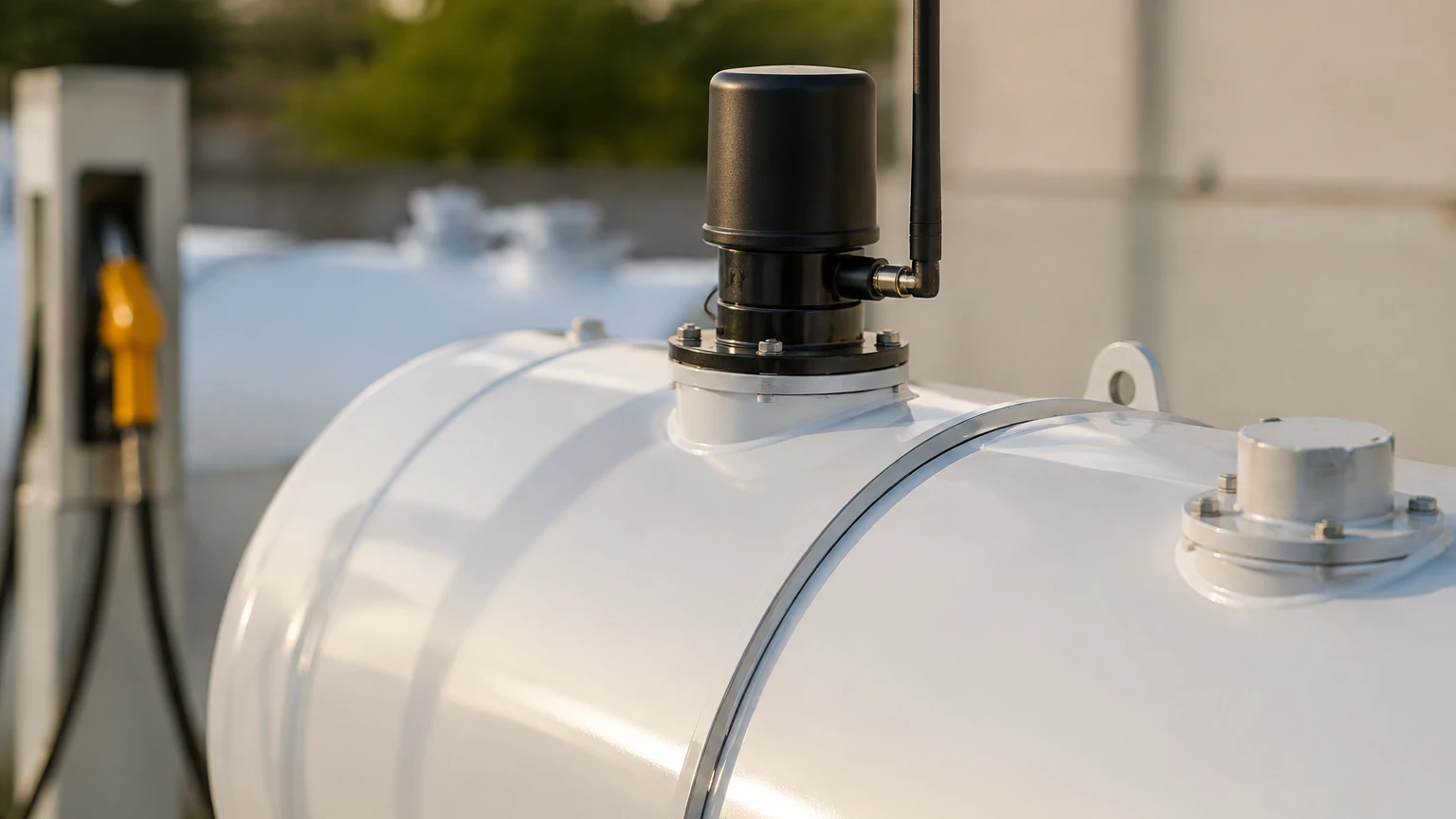
1. Antenna Positioning: If the tank is made of metal, it acts as a Faraday cage, blocking wireless signals. In such cases, an external antenna must be mounted outside the tank and connected to the sensor via a coaxial cable.
2. Dead Zones: Ultrasonic sensors have a "dead zone" (typically 100 mm to 300 mm) immediately below the transducer where measurements cannot be taken. The sensor must be mounted high enough to account for the maximum fill level.
3. Calibration: Capacitive sensors often require calibration at "empty" and "full" states to account for the specific dielectric constant of the fuel being measured (e.g., diesel vs. gasoline).
4. Tank Geometry: For non-linear tanks (e.g., horizontal cylindrical tanks), the software or gateway must be programmed with a strapping table to convert the measured height into an accurate volume (liters).
5. Signal Interference: In industrial environments, large metal structures or high-voltage equipment can interfere with wireless transmissions. Conduct a site survey to ensure the chosen protocol (LoRaWAN or NB-IoT) has sufficient signal strength.
Common Risks and Limitations
While wireless technology simplifies data collection, users should be aware of specific limitations:
* Signal Latency: Wireless sensors are typically not used for real-time control (like high-level alarms that shut off a pump) because there is a delay between the measurement and the data appearing in the system.
* Temperature Sensitivity: Fuel expands and contracts with temperature. A drop in level might be due to cooling rather than a leak. Advanced systems integrate temperature compensation to provide "net volume" at a standard temperature (e.g., 15°C).
* Battery Failure: Without a robust monitoring system, a dead battery can lead to significant data gaps. Systems should include low-battery alerts.
Frequently Asked Questions (FAQs)
Q: Can a wireless fuel level sensor detect fuel theft?
A: Yes. By monitoring the level in real-time or at frequent intervals, the system can trigger an alert if the fuel level drops rapidly at a time when the engine is not running or no authorized dispensing is occurring.
Q: How does the sensor handle moving vehicles?
A: Sensors designed for mobile assets use damping algorithms (either in the hardware or software) to average out the fluctuations caused by fuel sloshing during movement.
Q: Is it difficult to integrate these sensors into existing ERP systems?
A: Most modern wireless gateways support standard protocols like MQTT or Modbus TCP, allowing for seamless integration into existing management software or the Welk Main Page for comprehensive monitoring solutions.
Q: What is the typical transmission distance for LoRaWAN sensors?
A: In an industrial environment with moderate obstructions, you can expect 1 km to 3 km. In open terrain, this can extend beyond 10 km.
Conclusion
Implementing a wireless fuel level sensor is a strategic move for any organization looking to digitize its fuel management. By understanding the measurement principles—whether capacitive, ultrasonic, or hydrostatic—and selecting the appropriate wireless protocol, engineers can ensure reliable data flow. Proper attention to installation, particularly regarding signal penetration and ATEX safety requirements, is the key to a long-term, maintenance-free solution. For more detailed technical specifications and to explore the full range of industrial level measurement instruments, please visit the Welk Main Page.