Wireless Ultrasonic Fuel Level Monitor
Wireless Ultrasonic Fuel Level Monitor
In modern industrial operations, fuel represents a significant operational expense and a critical resource for power generation, transport, and logistics. Managing this resource effectively requires precision, real-time data, and the ability to monitor assets across distributed locations. The wireless ultrasonic fuel level monitor has emerged as a preferred solution for organizations seeking to eliminate the complexities of manual dipping and the high costs of wired sensor installations.
By combining non-contact ultrasonic sensing technology with low-power wireless communication, these devices provide a scalable way to track fuel inventory, detect leaks, and prevent unauthorized fuel removal. This guide explores the engineering principles, selection criteria, and installation requirements for implementing wireless ultrasonic level measurement in B2B environments.
Understanding Ultrasonic Measurement Principles
Before selecting a wireless ultrasonic fuel level monitor, it is essential to understand the underlying physics of ultrasonic technology. These sensors operate on the "Time of Flight" (ToF) principle.
The Time of Flight (ToF) Mechanism
An ultrasonic sensor contains a piezoelectric transducer that emits high-frequency sound pulses (typically between 40 kHz and 200 kHz). These sound waves travel through the air gap in the tank, strike the surface of the fuel, and reflect back to the sensor head. The electronics within the monitor measure the exact time interval between the emission of the pulse and the reception of the echo.
Using the known speed of sound in air (approximately 343 m/s at 20°C), the device calculates the distance to the fuel surface using the formula:
Distance = (Speed of Sound × Time) / 2
Once the distance is determined, the sensor subtracts this value from the total tank height to calculate the fuel level. If the tank geometry is programmed into the device, it can further convert this level into volume (liters or cubic meters).
Compensation for Temperature
The speed of sound is not constant; it varies with the temperature of the medium through which it travels. In fuel tanks, temperature fluctuations can occur due to ambient weather or process heat. A professional-grade wireless ultrasonic fuel level monitor includes an integrated temperature sensor to automatically adjust the speed-of-sound calculation, ensuring accuracy remains within ±0.25% to ±1% of the measured range.
Advantages of Wireless Fuel Monitoring Systems
Transitioning from wired or manual monitoring to a wireless ultrasonic system offers several strategic advantages for industrial facilities.
1. Reduced Installation Costs: Traditional wired sensors require trenching, conduit runs, and extensive labor, especially in large tank farms. Wireless monitors eliminate these costs, often paying for themselves through installation savings alone.
2. Flexibility and Scalability: Wireless units can be deployed on mobile fuel bowsers, temporary storage tanks, or remote generator sets where wired infrastructure is non-existent.
3. Non-Contact Measurement: Because the sensor does not touch the fuel, it is not subject to corrosion, clogging, or mechanical wear. This is particularly beneficial for fuels with additives or contaminants that might foul a submersible pressure transmitter.
4. Real-Time Alerts: Integrated wireless modules allow the sensor to transmit data to a central dashboard at set intervals. Users can receive SMS or email alerts when fuel levels drop below a critical threshold or when a sudden drop indicates a potential theft or leak.
Key Components of a Wireless System
A complete wireless ultrasonic fuel level monitor system consists of three primary layers:
1. The Sensing Node
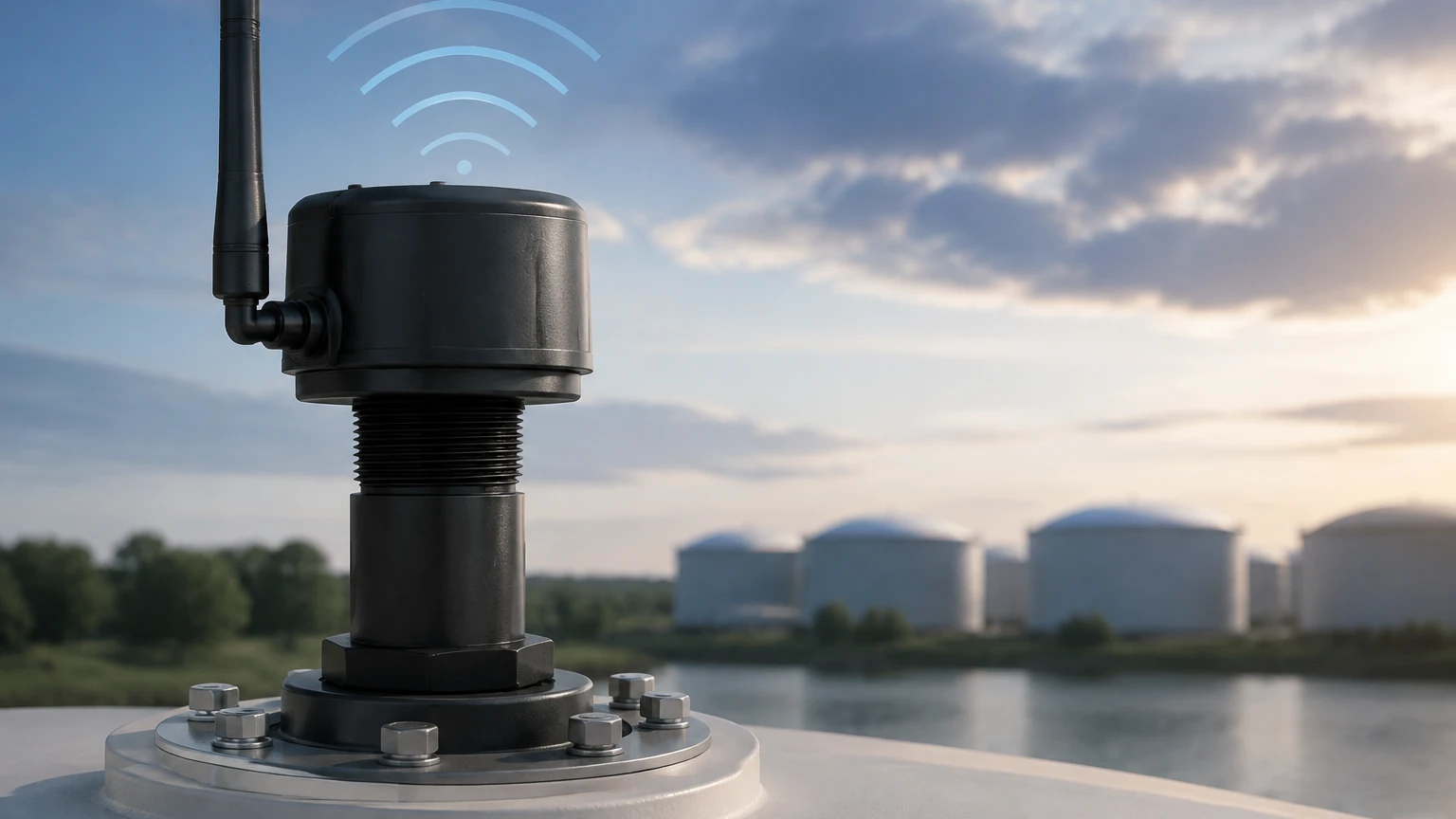
This is the hardware mounted on the tank. It houses the ultrasonic transducer, the processing electronics, the wireless radio (e.g., LoRaWAN, NB-IoT, or Cellular), and a long-life battery. For industrial use, these nodes are typically rated IP67 or IP68 for weather resistance.
2. The Gateway or Base Station
In systems using local wireless protocols like LoRaWAN or Zigbee, a gateway collects signals from multiple sensors within a range of 1 km to 15 km and forwards the data to the cloud via Ethernet or 4G. For NB-IoT or LTE-M sensors, the device connects directly to the existing cellular infrastructure, eliminating the need for a local gateway.
3. Data Management Software
The end-user interacts with a cloud-based platform or on-premise software. This interface provides visualization of fuel levels across all sites, historical trend analysis, and integration with ERP systems for automated fuel reordering.
Selection Criteria for Industrial Applications
Choosing the right wireless ultrasonic fuel level monitor requires an evaluation of the specific application environment. Engineers should consult the Main Page of their equipment provider to verify compatibility with these factors:
Tank Geometry and Material
Ultrasonic waves spread in a cone shape (typically 5° to 12°). If a tank is narrow or contains internal obstructions like ladders, heating coils, or baffles, the waves may reflect off these objects instead of the fuel. In such cases, a sensor with a narrower beam angle or sophisticated "false echo suppression" software is required.
Fuel Type and Volatility
While diesel and heating oil are standard applications, gasoline and aviation fuels are highly volatile. For these environments, the wireless monitor must be intrinsically safe and carry ATEX, IECEx, or UL certifications. Furthermore, some fuels may produce heavy vapors that slightly change the speed of sound, requiring specific calibration.
Communication Range and Environment
* NB-IoT/LTE-M: Best for urban or suburban areas with good cellular coverage. High reliability and no gateway management.
* LoRaWAN: Ideal for private networks in remote industrial sites or large-scale facilities where cellular signals are weak or data costs must be minimized.
* Satellite: Used for extremely remote assets (e.g., oil rigs or desert pipelines) where no other wireless infrastructure exists.
Practical Selection Table
| Feature | Entry-Level Monitor | Industrial-Grade Monitor | High-Precision System |
| :— | :— | :— | :— |
| Measurement Range | Up to 3 meters | Up to 6-10 meters | Up to 15+ meters |
| Accuracy | ±2% of range | ±0.5% to ±1% | ±0.25% |
| Battery Life | 1-2 years | 5-7 years | 10 years (with high-cap Li-SOCI2) |
| Connectivity | Wi-Fi / Bluetooth | LoRaWAN / NB-IoT | Satellite / Dual-Mode Cellular |
| Housing | Plastic (ABS) | Reinforced Polycarbonate / SS | Aluminum / Stainless Steel |
| Certifications | CE / RoHS | IP67 / ATEX Zone 2 | IP68 / ATEX Zone 0/1 |
Installation Best Practices and Considerations
Proper installation is the most critical factor in ensuring the reliability of a wireless ultrasonic fuel level monitor. Failure to follow these guidelines often results in "lost echoes" or erratic readings.
Positioning the Sensor
The sensor must be mounted at the top of the tank, perfectly perpendicular to the fuel surface. If the sensor is tilted, the reflected pulse may not return to the transducer. For tanks with rounded tops, the sensor should be placed at the highest point, away from the sidewalls to prevent interference from wall echoes.
The Dead Zone (Blocking Distance)
Every ultrasonic sensor has a "dead zone"—a small area directly in front of the transducer where it cannot measure. This is usually between 100 mm and 500 mm, depending on the frequency. If the fuel level rises into this zone, the sensor will provide an error or an incorrect reading. Installers must ensure the sensor is mounted high enough (perhaps using a stand-off pipe) so that the maximum fuel level never enters the dead zone.
Avoiding Obstructions
The ultrasonic beam expands as it travels. For a sensor with a 10° beam angle, the beam diameter at 5 meters is approximately 0.87 meters. Ensure that no internal structures fall within this cone. If the tank has an internal fill pipe, the sensor should be mounted on the opposite side to avoid turbulence and physical interference.
Technical Limitations and Environmental Factors
While highly versatile, wireless ultrasonic fuel level monitors are not suitable for every scenario. Engineers must be aware of the following limitations:
* Heavy Foam: If the fuel surface is covered in thick foam (sometimes caused by rapid filling), the foam can absorb the ultrasonic pulse rather than reflecting it. This results in a "loss of signal" error.
* High Pressure/Vacuum: Ultrasonic sensors rely on the air medium to transmit sound. Significant changes in air density due to high pressure or vacuum will drastically alter the speed of sound and can eventually prevent the transducer from functioning.
* Extreme Turbulence: During high-speed filling, the surface of the fuel can become extremely turbulent. This scatters the ultrasonic waves. Most industrial monitors use software averaging to smooth out these fluctuations, but extreme cases may require a stilling well.
* Vapor Interference: In very hot climates, heavy fuel vapors can accumulate in the headspace. While temperature compensation helps, extreme vapor density can attenuate the signal.
Frequently Asked Questions (FAQ)
Q: How long does the battery last in a wireless fuel monitor?
A: Battery life depends on the frequency of data transmission (the "uplink interval"). In most B2B applications, a transmission every 4 to 12 hours is sufficient, allowing the battery to last between 5 and 10 years. Increasing the frequency to every 15 minutes will significantly shorten the lifespan.
Q: Can I use an ultrasonic monitor on a mobile fuel truck?
A: Yes, but the system must be designed for it. Mobile monitors often include GPS and accelerometers to ensure that measurements are only taken when the vehicle is stationary and level, preventing errors caused by fuel sloshing.
Q: Is the wireless signal secure?
A: Industrial wireless protocols like LoRaWAN and NB-IoT include AES-128 encryption as standard. This ensures that fuel level data cannot be intercepted or spoofed by unauthorized parties.
Q: What happens if the wireless network goes down?
A: Most professional monitors have internal logging capabilities. They can store thousands of data points locally and "backfill" the data to the cloud once the connection is restored, ensuring no inventory data is lost.
Conclusion
The implementation of a wireless ultrasonic fuel level monitor provides a balance of accuracy, ease of installation, and long-term reliability. By understanding the acoustic principles and environmental constraints of the site, industrial operators can move away from manual processes toward a data-driven fuel management strategy. For specific technical datasheets and to explore various sensor models tailored to different tank sizes and fuel types, users should visit the Main Page to review product options and application support.