Wireless Water Tank Level Indicator
Wireless Water Tank Level Indicator
In modern industrial and municipal water management, the transition from manual inspection to automated monitoring has become a standard for operational efficiency. A wireless water tank level indicator serves as a critical bridge between physical liquid storage and digital oversight, allowing facilities to monitor water levels in real-time without the prohibitive costs of extensive cabling. These systems are particularly valuable in large-scale water treatment plants, remote agricultural reservoirs, and complex industrial cooling systems where physical access is limited or terrain makes wiring impractical.
Selecting the appropriate wireless system requires an understanding of both the sensing technology used to detect the water level and the wireless protocol used to transmit that data to a central gateway or control room. This guide explores the engineering principles, selection criteria, and installation best practices for industrial-grade wireless level monitoring.
Core Measurement Principles
Before evaluating wireless transmission options, it is essential to determine which sensing technology is best suited for the specific tank environment. Most wireless water tank level indicators utilize one of three primary measurement principles: ultrasonic, radar, or hydrostatic pressure.
1. Ultrasonic Level Measurement
Ultrasonic sensors are non-contact devices that emit high-frequency sound pulses toward the water surface. The sensor measures the time it takes for the echo to return after hitting the liquid. Since the speed of sound in air is known (approximately 340 m/s at 20°C), the distance to the water can be calculated accurately.
* Advantages: No contact with the medium, low maintenance, and relatively low cost.
* Limitations: Performance can be affected by heavy foam, extreme steam, or significant temperature fluctuations that alter the speed of sound.
2. Radar Level Measurement
Radar sensors, specifically Pulse Radar or Frequency Modulated Continuous Wave (FMCW) radar, use electromagnetic waves instead of sound. These waves travel at the speed of light and are reflected by the dielectric constant of the water surface.
* Advantages: Highly accurate (often within ±2mm), unaffected by vacuum, pressure, temperature, or vapor. Ideal for professional industrial applications.
* Limitations: Higher initial investment compared to ultrasonic sensors.
3. Hydrostatic Level Measurement
Hydrostatic transmitters are contact-based sensors placed at the bottom of the tank or suspended near the floor. They measure the pressure exerted by the liquid column above them. In water applications, every 10.2 centimeters of water column exerts approximately 1 kPa of pressure.
* Advantages: Excellent for deep tanks or reservoirs where top-mounting is difficult; unaffected by surface foam or turbulence.
* Limitations: Requires immersion in the fluid, which may lead to scaling or sediment buildup over time.
Wireless Transmission Technologies
The "wireless" component of a wireless water tank level indicator refers to the communication protocol between the sensor node and the receiver. The choice of protocol depends on the distance, power availability, and data frequency required.
| Technology | Typical Range | Best Use Case |
| :— | :— | :— |
| LoRaWAN | 2 km to 15 km | Remote sites with no cellular coverage; battery-powered nodes. |
| NB-IoT / Cellular | Global (via towers) | Urban or industrial areas with existing cellular infrastructure. |
| RF (433/915 MHz) | 100 m to 1 km | Simple point-to-point monitoring within a single facility. |
| Wi-Fi / Bluetooth | 10 m to 50 m | Small indoor tanks or localized maintenance checks. |
For most B2B and industrial projects, LoRaWAN and NB-IoT are preferred due to their low power consumption, which allows battery-operated sensors to function for several years without maintenance. To explore specific hardware configurations for these protocols, engineers can Review product options and application support to match the sensor to the site's network architecture.
Selection Criteria for Industrial Applications
When specifying a wireless water tank level indicator, engineers must look beyond the basic measurement range. The following factors are critical for long-term reliability:
1. Tank Geometry and Internal Obstructions: For non-contact sensors (ultrasonic and radar), the "beam angle" is vital. If a tank has internal ladders, agitators, or bracing, a narrow beam angle is required to avoid false echoes.
2. Dead Zones (Blocking Distance): Ultrasonic sensors have a minimum distance (usually 0.2m to 0.5m) from the sensor face where they cannot measure. If the tank is frequently filled to the brim, a sensor with a small dead zone or a mounting stand-off is necessary.
3. Ingress Protection (IP Rating): Outdoor water tanks are exposed to rain, humidity, and UV radiation. A minimum of IP67 or IP68 rating is recommended for the sensor housing to prevent water ingress.
4. Power Management: If the site lacks a power grid, the sensor must be battery-powered or solar-assisted. The transmission interval (e.g., sending data every 15 minutes vs. every 1 second) significantly impacts battery life.
Comparison Table: Technology Suitability
| Feature | Ultrasonic | Radar | Hydrostatic |
| :— | :— | :— | :— |
| Contact Type | Non-contact | Non-contact | Contact (Submerged) |
| Accuracy | Moderate (±0.25% FS) | High (±2mm to ±5mm) | Moderate to High |
| Foam Tolerance | Poor | Good | Excellent |
| Vapor/Steam | Poor | Excellent | Excellent |
| Max Range | Up to 15m | Up to 70m+ | Up to 200m+ |
| Typical Cost | Low – Medium | Medium – High | Medium |
Installation Considerations and Best Practices
Successful deployment of a wireless water tank level indicator depends heavily on the physical installation and signal path optimization.
Mounting Position
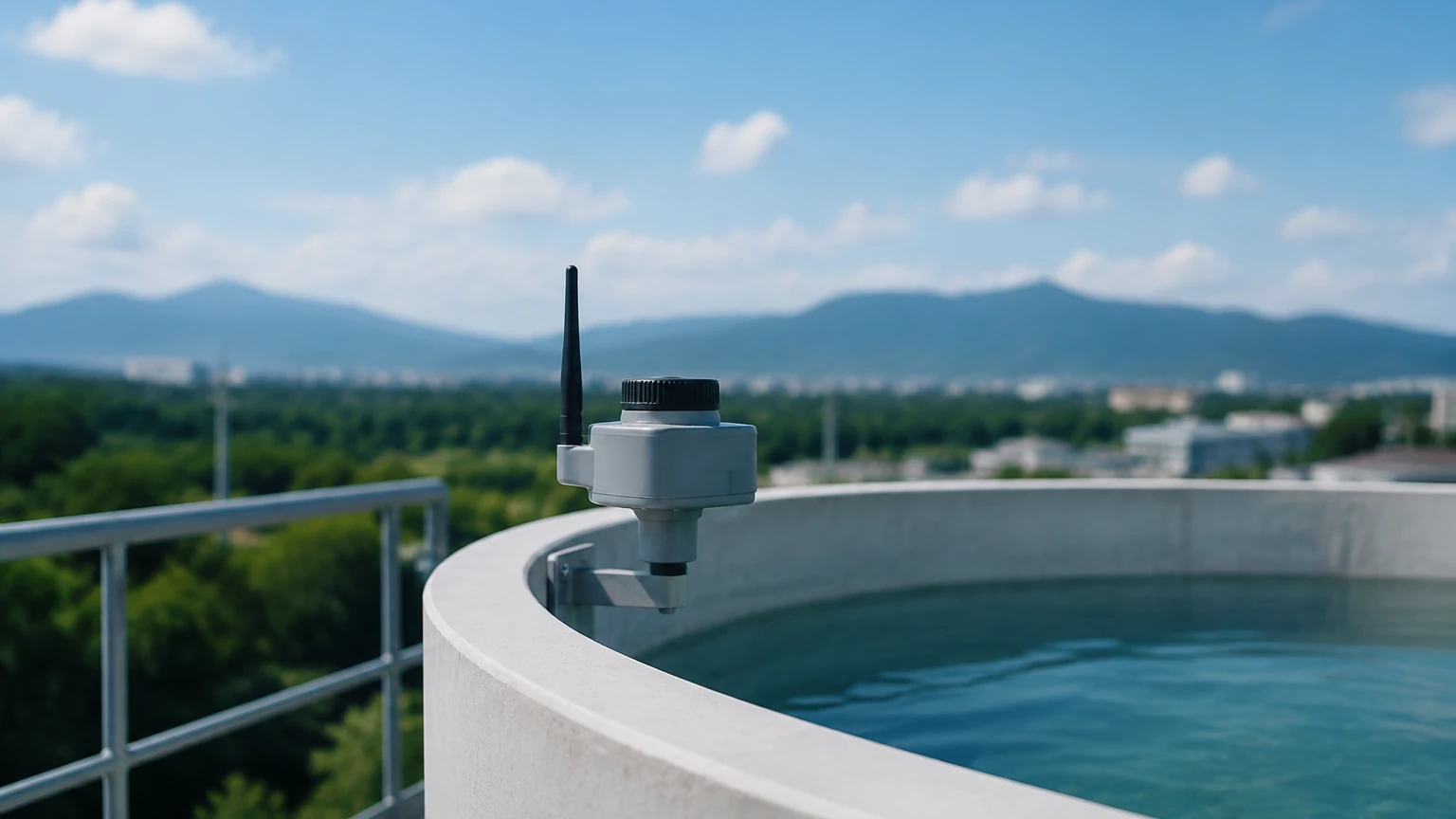
For top-mounted sensors (Radar and Ultrasonic), the device should be installed away from the inlet pipe to avoid interference from turbulent water during filling. It should also be mounted perfectly vertical; a tilt of even a few degrees can cause the signal to bounce off the tank walls rather than the water surface, leading to signal loss.
Signal Strength and Antenna Placement
Wireless signals, especially higher frequency ones, are easily blocked by metal structures or thick concrete walls. If the sensor is installed inside a metal tank, the antenna must be routed to the exterior of the tank using a coaxial extension to ensure the signal reaches the gateway.
Calibration and Zero-Point Setting
Once installed, the system must be calibrated. This involves inputting the "Empty Distance" (distance from the sensor face to the tank bottom) and the "Full Distance" (the maximum desired water level). For hydrostatic sensors, the specific gravity of the liquid must be confirmed, although for standard water, a value of 1.0 is used.
Common Risks and Limitations
While wireless systems offer flexibility, they are not without risks that must be mitigated during the design phase:
* Signal Latency: Unlike wired 4-20mA loops which provide instantaneous feedback, wireless indicators often operate on a "sleep-wake" cycle to save battery. This means there may be a delay of several minutes between a level change and the update in the control system. They are generally not recommended for high-level safety shutdowns where millisecond response times are required.
* Interference: In dense industrial environments, electromagnetic interference (EMI) can disrupt wireless transmissions. Selecting a frequency-hopping protocol or a robust industrial band (like 915 MHz in the US or 868 MHz in Europe) helps mitigate this risk.
* Battery Failure: In cold climates, battery capacity can drop significantly. Industrial-grade lithium-thionyl chloride (Li-SOCl2) batteries are typically used for their wide temperature range (-55°C to +85°C).
Frequently Asked Questions (FAQ)
Q: Can a wireless water tank level indicator work through a concrete tank lid?
A: Standard RF signals can struggle with thick reinforced concrete. It is best practice to mount the transmitter or antenna on the exterior of the lid or use a specialized through-wall antenna mount.
Q: How often do the sensors need to be calibrated?
A: Radar and ultrasonic sensors are generally stable and may only require a check once a year. Hydrostatic sensors may require more frequent checks if the water contains high levels of silt or minerals that could coat the diaphragm.
Q: Is it possible to integrate these indicators with an existing SCADA system?
A: Yes. Most wireless gateways provide outputs via Modbus RTU, Modbus TCP/IP, or MQTT, allowing seamless integration into existing industrial control networks.
Conclusion
A wireless water tank level indicator is an essential tool for modernizing water management infrastructure. By eliminating the need for trenching and cabling, these systems provide a cost-effective way to gain visibility into remote or distributed assets. For engineers and facility managers, the key to success lies in selecting the right sensing principle—whether it be the precision of radar or the simplicity of hydrostatic pressure—and ensuring the wireless protocol matches the site's geographical and structural constraints. For detailed technical specifications and to find the right hardware for your application, visit the Main Page for a comprehensive overview of industrial level measurement solutions.