Wtc32nd
Wtc32nd
In the landscape of industrial automation and process control, the accurate detection of material levels is fundamental to operational safety and efficiency. The Wtc32nd represents a specific class of RF (Radio Frequency) admittance level switches designed to overcome the limitations of traditional capacitance-based sensors. Primarily utilized in sectors such as chemical processing, water treatment, and bulk solids handling, this instrument provides a robust solution for point-level detection in challenging environments where material buildup or coating is a frequent issue.
Selecting the appropriate instrumentation requires a deep understanding of the underlying physics, the specific process conditions, and the mechanical requirements of the installation site. This guide examines the technical foundations of the Wtc32nd, offering engineering insights into its application, selection, and maintenance.
Measurement Principles: RF Admittance vs. Capacitance
To understand the functionality of the Wtc32nd, one must first distinguish between standard capacitance and RF admittance. While both technologies utilize the electrical properties of the medium, the Wtc32nd employs a more sophisticated approach to signal processing.
The Capacitance Foundation
In a basic capacitance sensor, the probe and the vessel wall act as two plates of a capacitor. The material between them serves as the dielectric. As the level rises, the dielectric constant changes, increasing the measured capacitance. However, a significant drawback occurs when conductive material coats the probe; the sensor may continue to indicate a "full" state even after the level has dropped, as the coating maintains an electrical path.
The RF Admittance Advantage
Admittance is the reciprocal of impedance in an AC circuit. It consists of two components: conductance (resistive) and susceptance (capacitive). The Wtc32nd operates at a high radio frequency, allowing the electronics to measure both components simultaneously.
By analyzing the phase shift between voltage and current, the device can mathematically distinguish between the bridge formed by a thick coating on the probe and the actual presence of the bulk material. This "driven shield" or "guard" technology ensures that the sensing element ignores the electrical interference caused by material buildup, providing a reliable switch signal only when the material actually reaches the probe tip.
Technical Architecture of the Wtc32nd
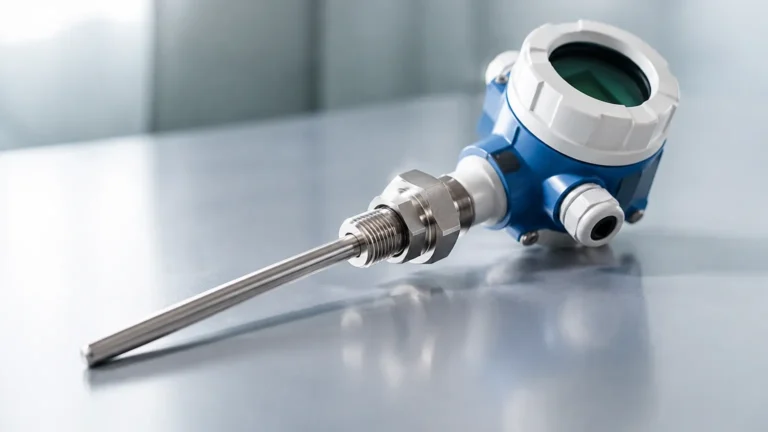
The Wtc32nd is typically constructed with a three-electrode design. This configuration is essential for its high-performance anti-coating capabilities:
1. Sensing Element: The primary probe that detects the presence of the material.
2. Shield/Guard Element: An intermediate section energized at the same potential and frequency as the sensing element. Because there is no potential difference between the shield and the probe, no current flows between them. This effectively "pushes" the sensing field further into the tank, bypassing any material stuck to the insulation near the mounting nozzle.
3. Ground: The vessel wall or a dedicated ground rod that completes the circuit.
This architecture allows the Wtc32nd to operate effectively in high-viscosity liquids, slurries, and powders that tend to stick to surfaces, such as fly ash, cement, or wastewater sludge.
Selection Criteria for Process Environments
Choosing the right configuration for a Wtc32nd installation involves evaluating several physical and chemical factors. Engineers must consider the following parameters to ensure long-term reliability.
Material Dielectric Constant
The dielectric constant (ε) of the medium determines the sensitivity required. Materials with high dielectric constants (e.g., water, ε ≈ 80) are easier to detect than those with low constants (e.g., plastic pellets or dry hydrocarbons, ε < 2). The Wtc32nd usually features adjustable sensitivity to accommodate these variations.
Pressure and Temperature
Process connections must be rated for the specific environment. Standard models often handle temperatures up to 80°C, but high-temperature variants utilizing ceramic or specialized PFA/PTFE insulation can withstand environments exceeding 250°C. Similarly, pressure ratings must be verified, especially in pressurized chemical reactors where ratings of 2.0 MPa to 4.0 MPa (20 to 40 bar) may be required.
Probe Geometry
* Rod Probes: Ideal for top-mounting in tanks with relatively low agitation. Standard lengths range from 0.5 meters to 3 meters.
* Cable Probes: Used for deep silos or where side-mounting is not feasible. These can extend up to 20 meters or more and often include a heavy weight to maintain tension.
* Flat/Plate Probes: Employed in chutes or conveyors where a protruding rod would be damaged by heavy falling material.
Practical Selection Table
The following table provides a general reference for selecting Wtc32nd configurations based on common industrial applications.
| Application | Material State | Recommended Probe Type | Typical Insulation | Notes |
| :— | :— | :— | :— | :— |
| Wastewater Sump | Liquid/Slurry | Rod Probe | PTFE / PFA | High anti-coating required |
| Cement Silo | Dry Powder | Cable Probe | Reinforced Nylon/PTFE | Must withstand tensile loads |
| Oil Storage | Hydrocarbon | Rod Probe | PEEK | Low dielectric sensitivity |
| Chemical Reactor | Corrosive Liquid | Rod Probe | Full PFA Jacket | Check chemical compatibility |
| Grain Elevator | Granular Solid | Flexible Cable | Polyurethane | Dust-tight seal required |

Installation Considerations
Proper installation is critical to the performance of the Wtc32nd. Even the most advanced RF admittance sensor will fail if mechanical and electrical guidelines are ignored.
Mounting Position
The sensor should be mounted away from the material inlet to avoid false triggers caused by falling product. For horizontal mounting, the probe should be angled slightly downward (approx. 20 degrees) to allow liquid or moisture to drain off the probe surface naturally.
The "Dead Zone"
There is a non-sensing region near the process connection (the mounting nut or flange). This is where the shield element is located. Ensure that the active sensing part of the probe extends far enough into the vessel to clear the mounting nozzle and any internal structural reinforcements.
Grounding
Since the measurement is made between the probe and the ground, a reliable electrical path is mandatory. In metal tanks, the process connection usually provides sufficient grounding. In plastic or fiberglass (FRP) tanks, a dedicated ground rod or a grounding strip must be installed inside the tank to provide a reference point for the RF signal.
Wiring and Power
Most Wtc32nd units are available in universal power configurations (e.g., 24V DC or 220V AC). It is recommended to use shielded cables for signal transmission to prevent electromagnetic interference (EMI) from high-power motors or VFDs (Variable Frequency Drives) located near the sensor.
Limitations and Operational Constraints
While the Wtc32nd is highly versatile, it is not a universal solution for every level measurement challenge. Engineers should be aware of the following limitations:
* Significant Dielectric Shifts: If the tank is used for different materials with vastly different dielectric constants, the switch may require recalibration. For example, a setting calibrated for oil may not trigger correctly for a dry powder.
* Extreme Mechanical Stress: In silos with heavy solids like large rocks or ore, the lateral force on a rod probe can cause bending or breakage. In these cases, heavy-duty cable probes or non-contact radar may be more appropriate.
* Vacuum Conditions: Some insulation materials may outgas or deform under high vacuum. It is essential to confirm the vacuum rating of the specific Wtc32nd model before installation in such environments.
For more complex applications involving continuous measurement or non-contact requirements, it is often beneficial to Review product options and application support to compare RF admittance with radar or ultrasonic technologies.
Frequently Asked Questions (FAQs)
Q: How often does the Wtc32nd require calibration?
A: Under stable process conditions, the Wtc32nd is virtually maintenance-free. Calibration is typically only required during initial commissioning or if the process material changes significantly.
Q: Can the Wtc32nd detect the interface between two liquids?
A: Yes. If there is a significant difference in the dielectric constants of the two liquids (e.g., oil and water), the Wtc32nd can be calibrated to detect the interface level specifically.
Q: What is the maximum length for a cable-type Wtc32nd?
A: While standard lengths are up to 20 meters, custom solutions can extend further depending on the tensile strength of the cable and the density of the material being measured.
Q: Does the device work in explosive atmospheres?
A: Many versions of the Wtc32nd are designed with intrinsically safe or explosion-proof housings (Ex d or Ex i) for use in hazardous zones. Always check the local ATEX, IECEx, or UL certifications on the product label.
Conclusion
The Wtc32nd is a high-reliability instrument that addresses the common industrial problem of material buildup on level sensors. By utilizing RF admittance technology and a driven shield design, it provides accurate point-level detection where other technologies fail. Whether managing wastewater, chemical reagents, or bulk solids, the Wtc32nd offers a cost-effective and durable solution for modern process control. For detailed technical data and to explore the full range of industrial level measurement instruments, visit the Main Page of the manufacturer's reference site.