Best Radar Level Transmitter
Best Radar Level Transmitter: An Engineering Guide to High-Precision Selection
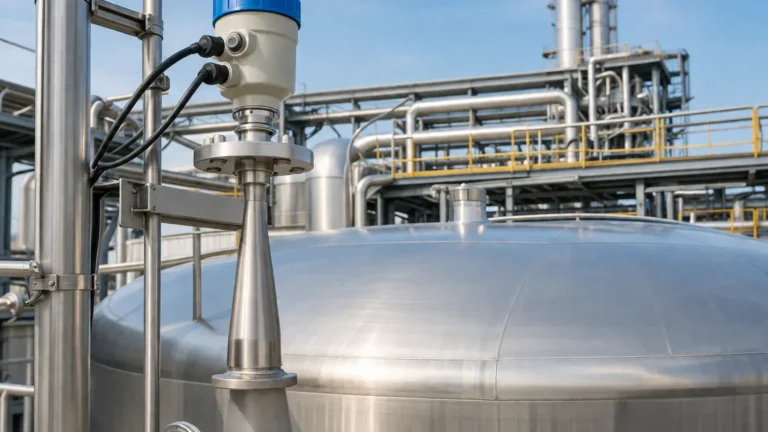
In the landscape of industrial process control, selecting the best radar level transmitter is not a matter of finding a universal "one-size-fits-all" device, but rather matching specific microwave technology to the unique constraints of the application. Radar technology has evolved from expensive, niche aerospace applications to the primary standard for non-contact level measurement in the water treatment, chemical, and oil and gas sectors.
This guide examines the fundamental physics of radar measurement, compares various frequency bands, and provides a framework for selecting the most reliable Radar Level Meters for industrial environments.
1. Understanding Radar Measurement Principles
Before evaluating equipment, engineers must understand how radar instruments interpret distance. All radar level transmitters function by emitting electromagnetic waves (microwaves) and measuring the properties of the reflected signal. There are two primary methods used in modern industrial instrumentation: Pulse Radar and Frequency Modulated Continuous Wave (FMCW).
Pulse Radar (Time of Flight)
Pulse radar transmitters emit a short microwave signal toward the product surface. The signal travels at the speed of light ($c$), reflects off the media, and returns to the sensor antenna. The transmitter measures the "Time of Flight" ($t$) and calculates the distance ($d$) using the formula:
$$d = \frac{c \times t}{2}$$
While effective for many applications, pulse radar requires high-speed timing electronics and can sometimes struggle with low-dielectric materials where the reflection is weak.
FMCW (Frequency Modulated Continuous Wave)
FMCW radar is often considered the technology behind the best radar level transmitter for high-precision requirements. Instead of pulses, the transmitter emits a continuous signal with a constantly changing frequency (a linear frequency sweep). The reflected signal is compared to the signal currently being emitted. The difference in frequency ($Δf$) is directly proportional to the travel time and, consequently, the distance. FMCW provides a much higher signal-to-noise ratio and better resolution, making it ideal for narrow vessels or materials with low reflectivity.
2. Frequency Bands: 26GHz vs. 80GHz
The frequency of the microwave signal determines the beam angle and the instrument's ability to handle obstacles. Selecting the correct frequency is the most critical step in specifying a radar level meter.
* 26GHz Radar: Often referred to as "High Frequency" in legacy terms, 26GHz is the workhorse of the industry. It offers a balance between signal strength and beam focus. It is suitable for most liquid storage tanks and large silos.
* 80GHz Radar: This represents the current state-of-the-art. At 80GHz, the wavelength is significantly shorter, allowing for a much narrower beam angle (as low as 3°). A narrow beam is essential for avoiding internal obstructions like agitators, heating coils, or ladders. It also allows for measurement through smaller nozzles and provides superior performance in heavy dust or turbulent conditions.
| Feature | 26GHz Radar | 80GHz Radar |
| :— | :— | :— |
| Beam Angle | Typically 8° – 20° | Typically 3° – 6° |
| Measurement Range | Up to 30m – 70m | Up to 120m |
| Accuracy | ±3mm to ±5mm | ±1mm to ±2mm |
| Nozzle Size | Requires larger nozzles | Can measure through 1-inch nozzles |
| Best For | Standard liquid storage | Narrow tanks, agitators, solids |
3. Non-Contact vs. Guided Wave Radar (GWR)
When determining the best radar level transmitter for a project, engineers must choose between non-contact (airborne) radar and Guided Wave Radar (GWR).
Non-Contact Radar
These instruments are mounted at the top of the vessel and do not touch the process media. This is advantageous for corrosive, viscous, or hygienic applications where contact could damage the sensor or contaminate the product. They are highly resistant to changes in density, pressure, and temperature.
Guided Wave Radar (GWR)
In GWR, the microwave pulse is guided along a physical probe (rod or cable). This technology is immune to surface turbulence, foam, and heavy steam. It is particularly effective for low-dielectric fluids (like liquefied gases or oils) because the probe concentrates the energy, ensuring a stronger reflection. GWR is also the preferred choice for interface measurement (e.g., measuring the oil-water interface).
4. Key Selection Criteria for Industrial Applications
To ensure the reliability of Radar Level Meters, several process-specific variables must be evaluated during the procurement phase:
Dielectric Constant (εr)
The dielectric constant of the media determines how much microwave energy is reflected. Metals and water-based liquids have high dielectrics (εr > 20) and are easy to measure. Hydrocarbons, solvents, and powders often have low dielectrics (εr < 2). If the dielectric is extremely low, a GWR or a high-sensitivity 80GHz FMCW transmitter is required.
Vessel Geometry and Internal Obstructions
In narrow vessels or those containing agitators, a wide radar beam will hit the walls or the blades, creating "false echoes." The best radar level transmitter for these scenarios is an 80GHz unit with a small beam angle and advanced software for "False Echo Suppression," which allows the transmitter to "learn" and ignore static reflections from internal structures.
Process Conditions
* Temperature: Standard units handle up to 80°C (176°F), but specialized high-temperature versions with ceramic seals can operate up to 450°C (842°F).
* Pressure: Standard process flanges usually support up to 40 bar (580 psi), but high-pressure variants can exceed 160 bar (2320 psi).
* Vapor and Condensation: While radar is generally unaffected by vapor, heavy condensation on the antenna can attenuate the signal. In these cases, a PTFE-encapsulated antenna or a lens antenna with a self-cleaning shape is recommended.
5. Installation Best Practices
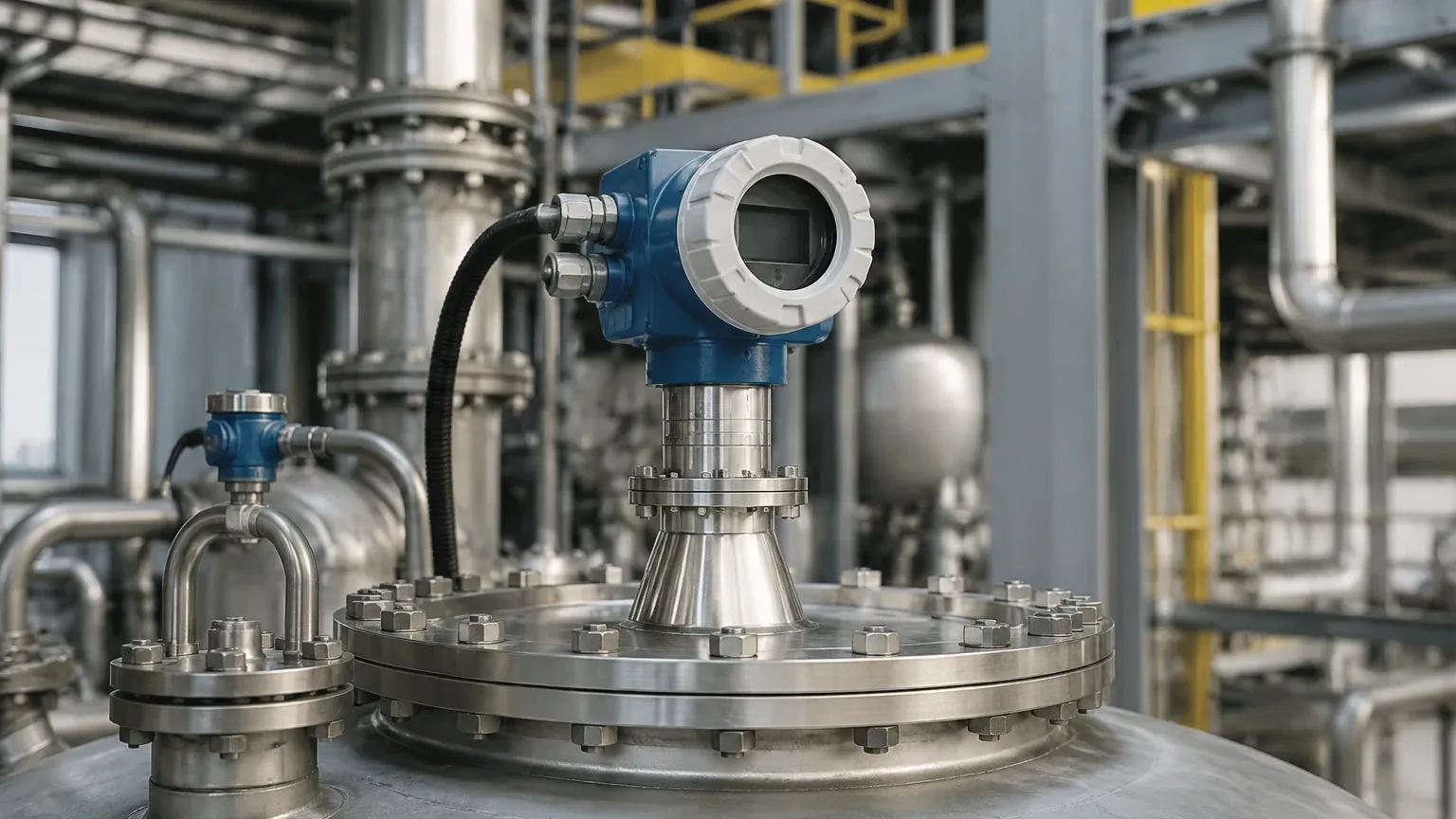
Even the most advanced radar level transmitter will fail if installed incorrectly. Follow these engineering guidelines to ensure measurement integrity:
1. Nozzle Height and Diameter: The antenna should ideally extend slightly below the nozzle into the vessel to prevent signal interference from the nozzle edge. If using a long nozzle, ensure the beam angle is narrow enough to avoid hitting the nozzle walls.
2. Mounting Position: Never mount the transmitter in the center of a tank with a domed roof, as this can create multiple reflections that confuse the sensor. Ideally, mount the unit at 1/6th to 1/4th of the tank diameter from the wall.
3. Avoid the Inflow: Do not install the transmitter directly above the fill stream. The turbulence and the falling material will cause significant signal noise.
4. Dead Zone (Blocking Distance): Every radar has a minimum measurable distance (the dead zone) near the antenna. Ensure the maximum expected level does not enter this zone, or the reading will become erratic.
6. Limitations and Application Risks
While radar is highly versatile, it is not a universal solution. Engineers should be aware of the following limitations:
* Heavy Foam: Thick, dense foam (like shaving cream) can absorb the radar signal entirely, resulting in a "Loss of Echo." While GWR or low-frequency radar can sometimes penetrate light foam, ultrasonic or hydrostatic sensors might be better alternatives for extremely foamy processes.
* Extremely Low Dielectric Solids: Very dry, low-density powders may not reflect enough energy for non-contact radar. In these cases, GWR with a large surface area cable probe is often the better choice.
* Vacuum Conditions: While microwaves travel through a vacuum, the sealing of the transmitter must be rated for vacuum service to prevent air ingress or damage to the electronics.
7. Maintenance and Troubleshooting
Modern digital radar transmitters are largely maintenance-free due to the lack of moving parts. However, periodic checks are recommended:
* Signal Strength Monitoring: Most smart transmitters provide a "Signal-to-Noise Ratio" (SNR) or "Amplitude" value. A significant drop in this value over time may indicate buildup on the antenna or a change in the process media properties.
* Antenna Cleaning: In sticky or crystallizing applications, the antenna may require periodic cleaning. Choosing a flush-mounted lens antenna can minimize the frequency of this maintenance.
* Echo Curve Analysis: Using manufacturer-provided software, engineers can view the "Echo Curve." This visual representation of the reflected signals is the most powerful tool for troubleshooting, allowing the user to distinguish between the actual product level and interference from internal tank structures.
8. Frequently Asked Questions (FAQ)
Q: Can radar level transmitters measure through plastic tank walls?
A: Yes. High-frequency radar (especially 80GHz) can often measure through plastic or fiberglass tank tops, allowing for non-invasive measurement where the sensor never contacts the process or even the internal atmosphere of the tank.
Q: How does dust affect radar measurement?
A: Unlike ultrasonic sensors, radar is largely unaffected by dust because the microwave wavelength is much larger than the dust particles. However, extremely heavy dust in tall silos may require a high-power 80GHz transmitter with a dust-purging connection.
Q: Is radar better than ultrasonic for level measurement?
A: In most industrial B2B applications, radar is superior because it is unaffected by air temperature, pressure, vacuum, or vapor layers—all of which significantly impact the speed of sound and, therefore, the accuracy of ultrasonic sensors.
Q: What is the lifespan of a typical radar level transmitter?
A: With no moving parts and robust solid-state electronics, a high-quality radar transmitter often has an operational lifespan exceeding 10 to 15 years, provided the process seals remain intact.
Conclusion
Identifying the best radar level transmitter requires a deep dive into the chemical and physical properties of the process. For most modern applications, 80GHz FMCW technology provides the highest precision and easiest installation. However, for specialized needs like interface measurement or extremely low-dielectric fluids, Guided Wave Radar remains the engineering standard. By carefully considering the dielectric constant, vessel geometry, and potential obstructions, procurement teams can select Radar Level Meters that provide reliable, maintenance-free data for years of operation.