Hsn Code for Radar Level Transmitter
HSN Code for Radar Level Transmitter: A Technical and Regulatory Guide
In the landscape of industrial automation and process control, the accurate measurement of liquid and solid levels is fundamental to operational safety and efficiency. Among the various technologies available, radar level transmitters have emerged as a gold standard due to their non-contact nature and high precision. However, for procurement managers and engineers operating in a globalized market, selecting the right instrument involves more than just understanding the physics of microwaves; it also requires navigating the complexities of international trade and taxation. Central to this process is the hsn code for radar level transmitter, a standardized numerical method of classifying traded products.
This article provides a comprehensive technical overview of Radar Level Meters, explaining their operating principles, selection criteria, and installation constraints, while clarifying the regulatory classification necessary for seamless international procurement.
Understanding Radar Level Measurement Principles
Before addressing the logistical aspects of the hsn code for radar level transmitter, it is essential to understand how these devices function. Radar level measurement is based on the principle of Time of Flight (ToF). The instrument emits electromagnetic pulses or continuous waves toward the material surface, which reflects them back to the sensor. By measuring the time taken for the signal to travel to the surface and back, the device calculates the distance and, consequently, the level of the medium.
There are two primary technologies used in modern industrial radar transmitters:
1. Pulse Radar (Non-Contact)
Pulse radar transmitters emit short microwave pulses at a fixed frequency. The device measures the time interval between the emission of the pulse and the reception of the echo. This technology is robust and energy-efficient, making it suitable for a wide range of standard tank applications. However, it may struggle in environments with high levels of turbulence or heavy foam.
2. Frequency Modulated Continuous Wave (FMCW)
FMCW radar transmits a continuous signal with a constantly changing frequency. The distance to the product surface is determined by the frequency difference between the transmitted and received signals at any given moment. FMCW technology generally offers higher accuracy and better signal-to-noise ratios than pulse radar, making it the preferred choice for complex applications involving low dielectric constants or long measurement ranges (up to 100 meters / 328 feet).
The HSN Code for Radar Level Transmitter
For international shipping, customs clearance, and tax assessment (such as GST in India or VAT in Europe), products are classified under the Harmonized System of Nomenclature (HSN).
Classification Breakdown
The hsn code for radar level transmitter typically falls under Chapter 90: *Optical, photographic, cinematographic, measuring, checking, precision, medical or surgical instruments and apparatus*.
Specifically, the primary classification is 9026: *Instruments and apparatus for measuring or checking the flow, level, pressure or other variables of liquids or gases*.
* HSN 9026.10: Specifically covers instruments for measuring or checking the level of liquids.
* HSN 9026.10.10: Often used for electronic level gauges/transmitters in various regional tariff schedules.
* HSN 9026.90: Covers parts and accessories for these instruments.
While 9026 is the globally recognized base, buyers should verify the specific 8-digit code with their local customs authority, as sub-classifications can vary slightly depending on the country of import and the specific features of the transmitter (e.g., whether it includes a local display or specialized explosion-proof housing).
Technical Selection Criteria
Choosing the correct radar level meter requires a deep dive into the process conditions. The following factors are critical for ensuring long-term reliability:
Frequency Selection
* 6 GHz to 10 GHz (C-Band): Best for applications with heavy steam, condensation, or foam. The longer wavelength can penetrate these obstacles more effectively than higher frequencies.
* 26 GHz (K-Band): The industry standard for most liquid applications. It offers a balance between a relatively narrow beam angle and good resistance to process disturbances.
* 80 GHz (W-Band): The latest advancement in radar technology. It provides an extremely narrow beam angle (often less than 3 degrees), allowing for measurement in tall, narrow tanks or tanks with internal obstructions like agitators and heating coils.
Dielectric Constant (εr)
The reflectivity of the radar signal depends heavily on the dielectric constant of the medium. Materials with high dielectric constants, such as water (εr ≈ 80), reflect signals strongly. Hydrocarbons and oils often have low dielectric constants (εr < 2), requiring more sensitive radar electronics or FMCW technology to ensure a reliable echo.
Antenna Types
* Horn Antenna: The most common type, suitable for most liquid and solid applications. Available in various sizes to adjust beam width.
* Rod/Lens Antenna: Often used in corrosive environments or where a hygienic (tri-clamp) connection is required. The antenna is typically encapsulated in PTFE or PFA.
* Parabolic Antenna: Used primarily for solid materials (silos) where a very high gain is needed to capture reflections from uneven surfaces.
Comparison Table: Radar Technology Selection
| Feature | Pulse Radar (26 GHz) | FMCW Radar (80 GHz) | Guided Wave Radar (GWR) |
| :— | :— | :— | :— |
| Measurement Type | Non-contact | Non-contact | Contact (Probe) |
| Accuracy | ±3 mm to ±5 mm | ±1 mm | ±2 mm |
| Beam Angle | 8° to 20° | 3° to 4° | N/A (signal follows probe) |
| Foam Resistance | Moderate | Low to Moderate | High |
| Max Range | 30m (98 ft) | 100m (328 ft) | 75m (246 ft) |
| Internal Obstructions | Sensitive | Less Sensitive | Not Affected (if clear of probe) |
| HSN Code Base | 9026 | 9026 | 9026 |
Installation Considerations and Constraints
Proper installation is as important as selecting the right frequency. Even the most advanced radar level transmitter will fail if positioned incorrectly.
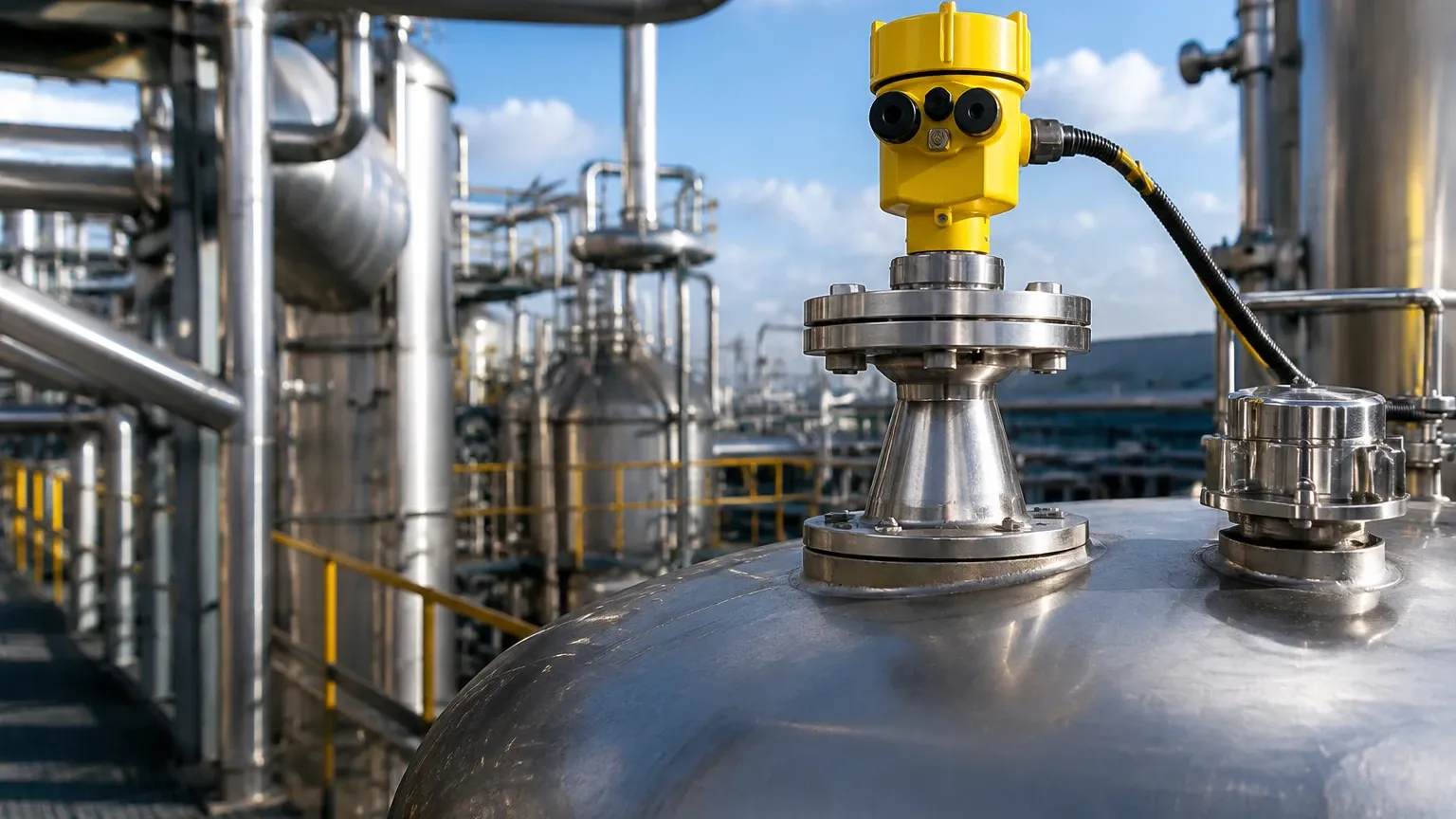
1. Nozzle Dimensions: The antenna should ideally extend slightly beyond the mounting nozzle to prevent "ringing" or false echoes from the nozzle edge. If the nozzle is very long, a higher frequency (80 GHz) or a nozzle-specific extension is required.
2. Beam Path Clearance: The "keep-out zone" defined by the beam angle must be free of ladders, pipes, and agitator blades. If an obstruction is unavoidable, most modern transmitters offer "False Echo Suppression" software to map out and ignore these static reflections.
3. Mounting Position: The transmitter should not be mounted in the center of a tank (to avoid multiple reflections from the tank walls) nor too close to the wall (to avoid interference). A position at 1/4 to 1/6 of the tank diameter is generally recommended.
4. Orientation: For solid materials, an aiming flange (swivel holder) is often necessary to point the radar beam at the angle of repose of the material, ensuring a return signal reaches the sensor.
Limitations and Application Risks
While versatile, radar level meters are not universal solutions. Engineers must be aware of the following risks:
* Heavy Foam: Certain types of dense, thick foam can absorb the radar signal entirely, leading to a "Loss of Echo" (LOE) error. In such cases, Guided Wave Radar (GWR) or hydrostatic pressure sensors may be more appropriate.
* Vacuum Conditions: While radar works perfectly in a vacuum (as electromagnetic waves do not require a medium), the mechanical seals and process connections must be rated for vacuum service to prevent air ingress or sensor damage.
* Extreme Turbulence: Rapidly moving liquid surfaces can scatter the radar signal. This can often be mitigated by using a stilling well or bypass chamber, which provides a calm surface for measurement.
International Procurement Checklist
When requesting a quote or preparing an import document for a radar level transmitter, ensure the following information is confirmed:
1. Correct HSN Code: Confirm the 8-digit hsn code for radar level transmitter required by your local customs to avoid delays or incorrect duty payments.
2. Material Certification: For chemical or food-grade applications, ensure the wetted parts (e.g., 316L Stainless Steel, PTFE) have the necessary material test reports (MTRs).
3. Hazardous Area Approvals: Verify if the site requires ATEX, IECEx, or FM certifications for explosive atmospheres.
4. Signal Output: Ensure the output (4-20mA HART, Modbus RS485, or Profibus) is compatible with your existing PLC or SCADA system.
Frequently Asked Questions (FAQ)
Q: Can a radar level transmitter measure through a plastic tank wall?
A: Yes, non-conductive materials like plastic (PP, PE, PVC) or glass are transparent to radar waves. This allows for measurement from outside the tank, provided the material is not too thick and the dielectric constant of the liquid inside is significantly higher than the tank wall.
Q: How does temperature affect radar measurement?
A: Unlike ultrasonic sensors, which are affected by changes in the speed of sound due to air temperature, radar waves are largely unaffected by temperature or pressure variations in the vapor space. However, the electronics and seals of the transmitter have specific operating limits (typically up to 200°C / 392°F for standard high-temp models).
Q: Is the HSN code the same for radar and ultrasonic sensors?
A: Generally, yes. Both fall under the 9026 heading as instruments for measuring the level of liquids or gases. However, the specific sub-headings may differ depending on whether the device is classified as an electronic instrument or a generic measuring apparatus.
Q: What is the minimum dielectric constant required for radar?
A: Most modern high-sensitivity radar units can measure materials with a dielectric constant as low as 1.4. For materials lower than this, Guided Wave Radar is usually necessary.
By understanding both the technical requirements of the application and the regulatory framework of the hsn code for radar level transmitter, industrial professionals can ensure they implement measurement solutions that are both technically sound and compliant with international trade standards.