Rosemount 3408 Radar Level Transmitter
Rosemount 3408 Radar Level Transmitter: An Engineering Guide to 80 GHz FMCW Technology
In the landscape of modern process automation, precise level measurement is critical for operational safety, inventory management, and process efficiency. Among the various technologies available, Radar Level Meters have emerged as the industry standard for non-contact measurement due to their immunity to changes in density, pressure, and temperature. The rosemount 3408 radar level transmitter represents a significant advancement in this category, utilizing high-frequency Frequency Modulated Continuous Wave (FMCW) technology to provide reliable data in challenging industrial environments.
This guide explores the underlying physics of radar measurement, the specific technical advantages of the Rosemount 3408, and the practical engineering considerations required for successful deployment in B2B industrial applications.
The Principle of FMCW Radar Measurement
Before selecting a specific instrument, it is essential to understand how FMCW technology differs from traditional pulse-based radar. While pulse radar measures the time-of-flight of a single microwave burst, FMCW radar transmits a continuous signal with a constantly changing frequency (a frequency sweep).
Frequency Modulation
As the transmitter emits this continuous signal, the frequency increases linearly over a specific bandwidth. When the signal hits the surface of the medium and reflects back to the sensor, there is a delay. Because the transmitter is still sweeping through frequencies while the reflection is traveling, the received frequency will differ from the frequency being transmitted at that exact moment.
Beat Frequency and Distance
The difference between the transmitted and received frequency is known as the "beat frequency." This value is directly proportional to the distance between the sensor and the product surface. By using Fast Fourier Transform (FFT) algorithms, the transmitter converts this frequency difference into a precise distance measurement.
The use of the 80 GHz frequency band in instruments like the Radar Level Meters allows for a much wider bandwidth sweep compared to older 6 GHz or 26 GHz models. This results in a significantly higher signal-to-noise ratio and better resolution, enabling the device to distinguish between the true product level and internal tank obstructions.
Technical Overview of the Rosemount 3408
The Rosemount 3408 is designed as a versatile, user-friendly solution for liquid and slurry applications. It is particularly noted for its "Smart Meter Verification" capabilities, which allow for health monitoring of the device without interrupting the process.
Key Performance Specifications
| Feature | Specification |
| :— | :— |
| Measurement Principle | 80 GHz FMCW Radar |
| Measurement Range | Up to 30 meters (98 feet) |
| Accuracy | ± 2 mm (0.08 inches) |
| Process Temperature | -40°C to +150°C (-40°F to +302°F) |
| Process Pressure | Full vacuum to 25 bar (362 psi) |
| Output Signals | 4-20 mA HART, Bluetooth® (Optional) |
| Beam Angle | Typically 3° to 6° (depending on antenna size) |
The 80 GHz Advantage
The transition to 80 GHz technology in the rosemount 3408 radar level transmitter offers two primary engineering benefits:
1. Narrow Beam Width: A higher frequency results in a narrower microwave beam. This allows the transmitter to be installed in tanks with narrow nozzles or near internal obstructions like agitators and heating coils without receiving false echoes.
2. Smaller Antennas: High-frequency radar can achieve high gain with smaller physical antenna dimensions, making it easier to install on small process connections (as small as 1 inch or DN25).
Selection Criteria for Industrial Applications
Choosing the right radar transmitter involves more than just matching a pressure rating. Engineers must evaluate the specific characteristics of the medium and the vessel.
Dielectric Constant (εr)
The reflectivity of a material depends on its dielectric constant. Materials with high dielectric constants, such as water (εr ≈ 80), reflect signals strongly. Hydrocarbons and oils (εr ≈ 2) reflect much less energy. The Rosemount 3408 is sensitive enough to measure materials with very low dielectric constants, but the maximum reliable range decreases as the dielectric constant drops.
Process Dynamics
If the application involves rapid filling or emptying, the update rate of the transmitter becomes vital. FMCW radar provides continuous tracking, which is generally superior to pulse radar for fast-moving levels. Additionally, if the process involves heavy turbulence or boiling surfaces, the signal processing capabilities of the 3408 help filter out the "noise" created by the surface agitation.
Installation Considerations and Best Practices
Proper installation is the single most important factor in ensuring the longevity and accuracy of Radar Level Meters. Even the most advanced transmitter will fail to provide accurate data if positioned incorrectly.
1. Nozzle Geometry
The nozzle should be as short as possible. While 80 GHz radar is less sensitive to nozzle interference than lower frequencies, a nozzle that is too long or has internal burrs can still cause "ringing"—a phenomenon where the signal bounces within the nozzle and masks the true level near the top of the tank.
2. Positioning within the Tank
* Avoid the Center: Do not mount the transmitter in the exact center of a cylindrical tank. This can lead to multiple reflections from the tank walls that converge at the center, creating a false signal.
* Distance from Wall: The sensor should ideally be placed 1/6 to 1/4 of the tank diameter away from the wall. This avoids the "wall effect" while remaining clear of the center.
* Clear Path: Ensure there are no ladders, pipes, or spray balls directly in the path of the radar beam. If obstructions are unavoidable, use the transmitter’s "False Echo Suppression" software to map out these static reflections.
3. Orientation
The transmitter should be mounted perfectly vertical. Even a slight tilt can cause the radar signal to reflect away from the sensor rather than back toward it, especially when measuring flat liquid surfaces.
Limitations and Application Risks
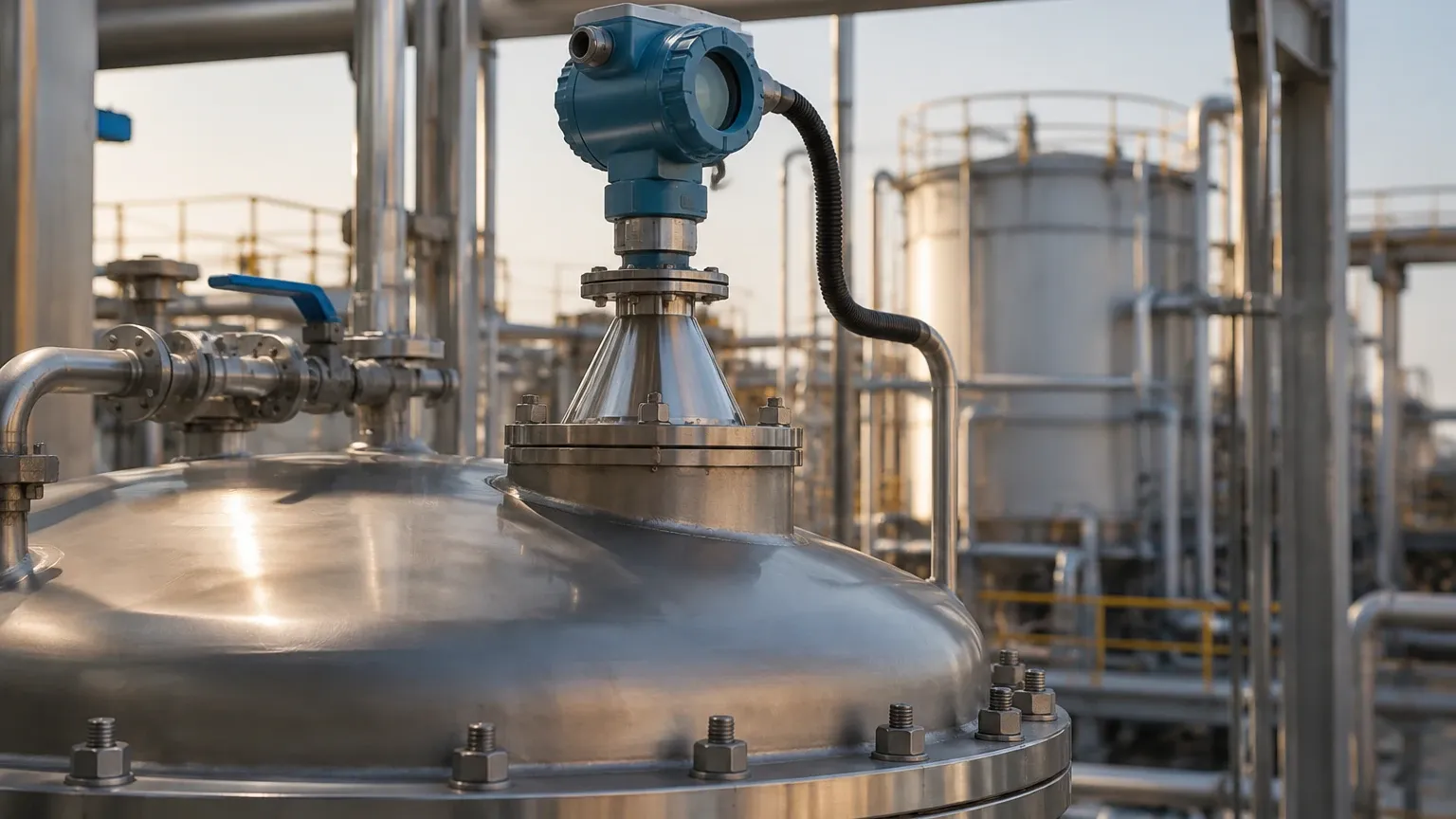
While the rosemount 3408 radar level transmitter is highly capable, certain process conditions present risks that must be mitigated:
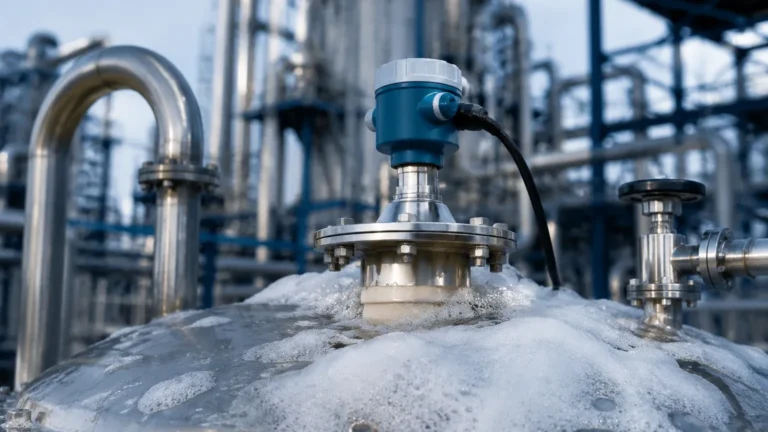
* Heavy Foam: Dense, thick foam can absorb the radar signal entirely. While light foam is often transparent to 80 GHz waves, engineers should specify a guided wave radar (GWR) if persistent, thick foam is expected.
* Condensation and Buildup: Although the 3408 features a flush-lens design to minimize buildup, extreme condensation can still attenuate the signal. In these cases, air purging or specialized lens coatings may be required.
* Solid Applications: While the 3408 is excellent for liquids, measuring bulk solids (like powders or grain) requires accounting for the "angle of repose." The signal reflects off the sloped surface of the solids, which may require a swiveling mounting flange to optimize the signal return.
Engineering Checklist for International Procurement
When specifying a rosemount 3408 radar level transmitter for an international project, B2B buyers should confirm the following technical details with the supplier:
1. Process Connection Standards: Ensure the flange or thread matches the local standard (e.g., ANSI vs. DIN/EN).
2. Hazardous Area Certifications: Verify if the site requires ATEX, IECEx, or FM Global certifications for explosive atmospheres.
3. Wetted Materials: Confirm that the antenna material (typically PTFE or PEEK) and the O-rings are chemically compatible with the process medium.
4. Digital Integration: Determine if the existing control system supports HART 7 or if additional gateways are needed for Bluetooth configuration.
Frequently Asked Questions (FAQ)
Q: Can the Rosemount 3408 measure through a plastic tank roof?
A: Yes. Because microwaves can penetrate non-conductive materials, 80 GHz radar can often measure the level inside a plastic or fiberglass tank without the sensor being inside the vessel, provided the roof material is not too thick or reinforced with metal.
Q: How does the 3408 handle agitators?
A: The narrow beam of the 80 GHz signal often allows it to pass between the agitator blades and the tank wall. Furthermore, the software includes algorithms to identify and ignore periodic echoes caused by moving agitator blades.
Q: Is periodic calibration required?
A: Radar is a solid-state technology with no moving parts. Under stable conditions, it does not drift. However, the "Smart Meter Verification" feature in the 3408 allows users to run a diagnostic check to verify the electronics and antenna health without removing the device from the process, satisfying most regulatory requirements for periodic verification.
Q: What is the minimum dielectric constant the 3408 can detect?
A: Typically, the device can detect materials with a dielectric constant as low as 1.2, although the maximum range is reduced for these low-reflectivity materials. For extremely low εr fluids, a stilling well may be recommended to concentrate the signal.
Conclusion
The rosemount 3408 radar level transmitter is a robust example of how 80 GHz FMCW technology has simplified complex level measurement tasks. By providing a narrow beam, high accuracy, and integrated diagnostics, it reduces the engineering effort required for installation and maintenance. For process engineers and procurement specialists, understanding the interaction between frequency, beam angle, and process conditions is the key to leveraging these advanced Radar Level Meters for long-term operational success.