Radar Level Transmitter Malaysia
Radar Level Transmitter Malaysia: A Technical Guide to Selection and Application
In the diverse industrial landscape of Malaysia—ranging from the vast palm oil refineries of Sabah and Sarawak to the sophisticated petrochemical hubs in Terengganu and Johor—accurate level measurement is a cornerstone of operational efficiency. As industries move toward higher automation, the adoption of the radar level transmitter malaysia market has grown significantly. These instruments provide non-contact, high-precision measurement solutions that can withstand the tropical climate and demanding process conditions inherent to the region.
Selecting the right instrumentation requires a deep understanding of the underlying physics, the specific constraints of the medium being measured, and the environmental factors unique to Southeast Asia. This guide provides a comprehensive engineering overview of Radar Level Meters and how to implement them effectively in Malaysian industrial settings.
Understanding Radar Level Measurement Principles
Radar level measurement is based on the Time of Flight (ToF) principle. The instrument emits electromagnetic waves (microwaves) toward the surface of the material. These waves travel at the speed of light. When they hit the surface of the medium, a portion of the energy is reflected back to the sensor’s antenna. By measuring the time interval between transmission and reception, the device calculates the distance to the product surface.
The Role of the Dielectric Constant
The efficiency of the reflection is primarily determined by the dielectric constant ($ε_r$) of the medium. Materials with high dielectric constants, such as water (ε_r ≈ 80), reflect signals very strongly. Conversely, hydrocarbons, oils, and certain solids have low dielectric constants (ε_r < 2.0), which absorb more energy and return a weaker signal. Modern radar level meters utilize advanced signal processing to track these faint echoes, ensuring reliability even in low-dielectric applications like refined palm oil or chemical solvents.
Comparing Pulse Radar and FMCW Technology
When sourcing a radar level transmitter malaysia, engineers typically choose between two primary technologies: Pulse Radar and Frequency Modulated Continuous Wave (FMCW).
Pulse Radar
Pulse radar instruments emit a short microwave pulse and then wait for the reflection. This technology is known for its low power consumption and is often used in loop-powered (2-wire) configurations. It is highly effective for standard storage tanks where extreme precision is not the primary requirement.
FMCW (Frequency Modulated Continuous Wave)
FMCW radar transmits a continuous signal with a constantly changing frequency. The distance is calculated by measuring the frequency difference between the transmitted and received signals at any given moment. FMCW is generally superior in terms of accuracy and signal-to-noise ratio, making it the preferred choice for agitated surfaces, narrow tanks, or applications involving heavy vapor and dust.
| Feature | Pulse Radar | FMCW Radar |
| :— | :— | :— |
| Accuracy | ±3mm to ±10mm | ±1mm to ±2mm |
| Signal Strength | Moderate | High |
| Power Consumption | Low | Moderate |
| Best Use Case | General storage, water treatment | Process vessels, high-precision custody transfer |
Selection Criteria for Radar Level Transmitters in Malaysia
Choosing the correct instrument involves more than just selecting a measurement range. In Malaysia, several environmental and process factors must be considered during the procurement phase.
1. Frequency Selection (6GHz, 26GHz, 80GHz)
* 6GHz (C-Band): Ideal for applications with heavy foam or extreme turbulence, as the longer wavelength can penetrate surface disturbances more effectively.
* 26GHz (K-Band): The industry standard for most applications. It offers a smaller beam angle than C-band, allowing for easier installation in tanks with internal obstructions.
* 80GHz (W-Band): The latest innovation, offering an extremely narrow beam angle (as low as 3 degrees). This is perfect for tall, narrow silos or tanks with complex internal structures like agitators and heating coils.
2. Antenna Type and Material
The antenna must be compatible with the chemical properties of the medium. For the corrosive environments found in Malaysian chemical plants, PTFE-coated antennas or high-grade stainless steel (316L) are standard. Horn antennas are common for large tanks, while parabolic antennas are used for long-range measurements in solids.
3. Ambient Environmental Conditions
Malaysia’s high humidity and ambient temperatures (often exceeding 35°C) can cause condensation on the antenna. Selecting a radar level transmitter with a "drip-off" antenna design or a flat-face encapsulated antenna helps prevent signal attenuation caused by moisture buildup.
Typical Industrial Applications in the Malaysian Market
Palm Oil Processing
In Crude Palm Oil (CPO) storage and refining, level measurement is challenged by high temperatures (up to 90°C) and the presence of steam. Non-contact radar is preferred over mechanical gauges because it is not affected by the viscosity or the coating nature of the oil. For refined products, high-frequency 80GHz radar provides the precision needed for inventory management.
Water and Wastewater Treatment
Municipal water projects across Malaysia utilize radar for open channel flow and reservoir level monitoring. Unlike ultrasonic sensors, radar is unaffected by air temperature fluctuations, wind, or fog, which are common in outdoor tropical environments.
Oil, Gas, and Petrochemicals
In the refineries of Pengerang or Kerteh, radar transmitters are used for custody transfer and safety-critical level monitoring. These units must be ATEX or IECEx certified for explosive atmospheres. Guided Wave Radar (GWR) is often used here for interface measurement (e.g., oil-water separation) where the microwave travels down a probe rather than through free space.
Installation and Engineering Best Practices
To ensure the accuracy of a radar level transmitter malaysia installation, engineers should adhere to the following guidelines:
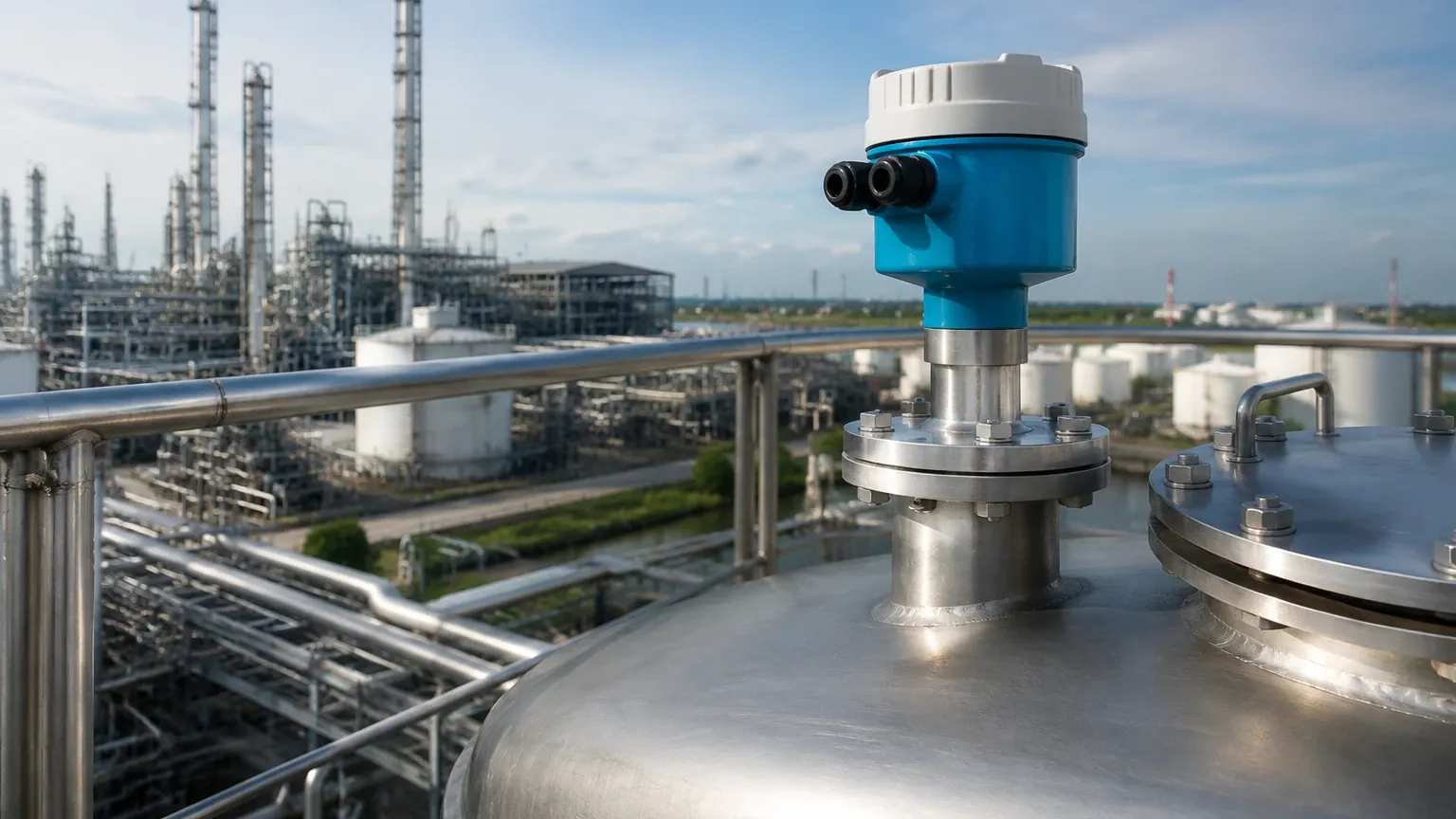
1. Nozzle Height and Diameter: The antenna should extend slightly beyond the bottom of the mounting nozzle to prevent "ringing" or false reflections from the nozzle walls. If the nozzle is very long, a larger diameter nozzle or a specific antenna extension may be required.
2. Obstruction Clearance: The radar beam follows a conical path. Ensure that the beam path is clear of ladders, pipes, and agitators. If an obstruction is unavoidable, most modern transmitters offer "False Echo Suppression" software to map out and ignore these static reflections.
3. Positioning: Avoid mounting the sensor in the center of a domed tank, as this can lead to multiple reflections that confuse the sensor. Ideally, the sensor should be placed at 1/4 to 1/6 of the tank diameter from the wall.
4. Inlet Stream Avoidance: Never install the transmitter directly over the filling inlet. The turbulence and the falling stream will cause significant signal noise and potential measurement errors.
Limitations and Environmental Considerations
While radar is highly versatile, it is not a "one-size-fits-all" solution. Engineers must be aware of the following limitations:
* Heavy Foam: While some radar frequencies can penetrate light foam, extremely thick, dense foam (like that found in some fermentation processes) can absorb the radar signal entirely. In these cases, Guided Wave Radar or hydrostatic pressure sensors might be more appropriate.
* Vacuum Conditions: While radar works in a vacuum, the mechanical seals and pressure ratings of the flange must be carefully checked.
* Extreme Dielectric Changes: If a process involves a medium that changes its dielectric constant significantly during a reaction, the radar might require recalibration or the use of a reference target to maintain accuracy.
Maintenance and Troubleshooting Guide
Radar level meters are generally low-maintenance because they have no moving parts. However, in the Malaysian industrial context, periodic checks are recommended:
* Antenna Cleaning: In applications involving sticky substances (like latex or heavy fuel oil), check for buildup on the antenna. Even though many radars can "see through" some coating, excessive buildup will eventually degrade the signal.
* Housing Integrity: Ensure that the cable glands are properly sealed to prevent the ingress of tropical rainwater or humidity into the electronics compartment.
* Signal Quality Monitoring: Most digital transmitters (HART, Profibus, or Modbus) provide a signal strength or "amplitude" value. Monitoring this over time can provide an early warning of antenna fouling or changes in the process medium.
Frequently Asked Questions (FAQ)
Q: Can radar level transmitters be used for solids like grain or cement?
A: Yes. However, solids measurement requires a high-frequency radar (typically 26GHz or 80GHz) and often a swiveling flange to align the beam with the angle of repose of the material.
Q: How does heavy rain affect outdoor radar installations in Malaysia?
A: Standard radar frequencies are generally unaffected by rain. However, if water pools on the face of the antenna, it can attenuate the signal. Using a protective sunshade/rain cover and selecting a curved antenna face can mitigate this.
Q: What is the difference between Guided Wave Radar and Free-Space Radar?
A: Free-space radar sends a signal through the air. Guided Wave Radar (GWR) sends the signal down a rod or cable. GWR is better for low-dielectric liquids, interface measurement, and tanks with heavy internal obstructions.
Q: Is 80GHz always better than 26GHz?
A: Not necessarily. While 80GHz offers a narrower beam, 26GHz is often more robust in the presence of heavy dust or steam. The choice depends on the specific tank geometry and process conditions.
For technical assistance in selecting the appropriate instrumentation for your facility, you can Review product options and application support to find a solution tailored to your specific process requirements. Whether you are managing a water treatment plant in Kuala Lumpur or a chemical facility in Gebeng, choosing a high-quality radar level transmitter ensures long-term reliability and safety.