Vegapuls 62 Radar Level Transmitter
Vegapuls 62 Radar Level Transmitter: Engineering Selection and Application Guide
In the landscape of industrial process control, the accurate measurement of liquid levels within storage tanks and process vessels is critical for operational safety and efficiency. The vegapuls 62 radar level transmitter has long been a staple in the industry for non-contact level measurement of liquids under a wide range of process conditions. As a specialized instrument within the broader category of Radar Level Meters, it utilizes microwave technology to provide continuous level data without physical contact with the medium.
This guide provides a technical overview of the measurement principles, selection parameters, installation requirements, and practical limitations of this technology to assist engineers and procurement professionals in optimizing their level measurement systems.
Understanding the Radar Measurement Principle
Before selecting a specific instrument, it is essential to understand how radar technology functions in an industrial context. The vegapuls 62 radar level transmitter operates using the Pulse Radar principle, often referred to as Time-of-Flight (ToF).
The Pulse Radar Method
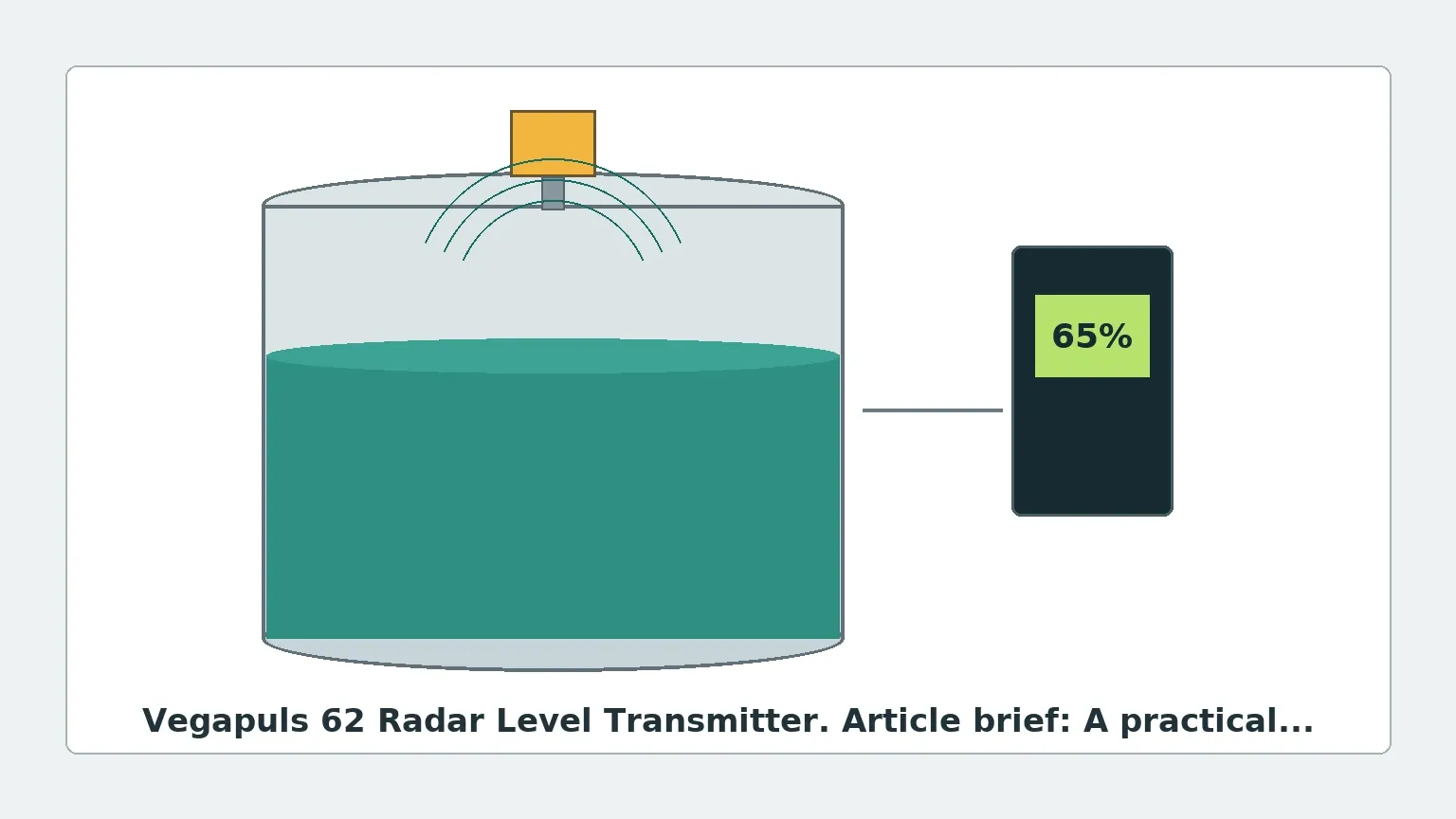
In this method, the sensor emits short microwave pulses toward the product surface via its antenna system. These pulses travel at the speed of light. When they reach the surface of the medium, a portion of the energy is reflected back toward the sensor. The electronics within the transmitter measure the time elapsed between the emission of the pulse and the reception of the echo.
Since the speed of microwaves is constant (approximately 300,000 km/s), the distance ($D$) from the sensor to the product surface can be calculated using the formula:
$$D =
rac{c \times t}{2}$$
Where:
* $c$ is the speed of light.
* $t$ is the measured time-of-flight.
The actual level ($L$) is then determined by subtracting the distance ($D$) from the total height of the vessel ($H$):
$$L = H – D$$
Frequency and Wavelength
The Vegapuls 62 typically operates in the K-band frequency range (approximately 26 GHz). This high frequency allows for smaller antenna sizes and narrower beam angles compared to lower-frequency C-band radars. A narrower beam is advantageous in vessels with internal obstructions like agitators, ladders, or heating coils, as it reduces the likelihood of false reflections.
Technical Specifications and Selection Criteria
Choosing the right configuration for a vegapuls 62 radar level transmitter requires a detailed understanding of the process environment. The instrument is designed for versatile applications, ranging from simple storage tanks to complex process vessels with high pressures and temperatures.
Key Performance Parameters
* Measuring Range: Up to 35 meters (approx. 115 feet).
* Process Temperature: -40°C to +200°C (-40°F to +392°F), depending on the seal and antenna material.
* Process Pressure: Vacuum to 40 bar (4 MPa / 580 psi).
* Accuracy: ±2 mm.
* Frequency: 26 GHz (K-band).
Antenna Selection Table
The antenna is the most critical component for signal focusing. The following table outlines the relationship between antenna diameter and the resulting beam angle, which influences the "footprint" of the radar signal at the bottom of the tank.
| Antenna Type | Diameter (mm) | Beam Angle (°) | Typical Application |
| :— | :— | :— | :— |
| Horn Antenna | 40 mm (1½") | 20° | Small vessels, narrow nozzles |
| Horn Antenna | 50 mm (2") | 18° | Standard process tanks |
| Horn Antenna | 80 mm (3") | 10° | Tall vessels, low dielectric media |
| Parabolic Antenna | 245 mm (10") | 4° | Long-range, high-precision storage |
Material Compatibility and Process Seals
Industrial environments often involve corrosive chemicals or high-purity requirements. The wetted parts of the vegapuls 62 radar level transmitter must be selected to withstand these conditions. Standard materials include 316L stainless steel, though exotic alloys like Hastelloy C22 are available for aggressive media.
The seal (O-ring) between the antenna and the process connection is a potential point of failure. Common options include:
* FKM (Viton): Suitable for standard oils and chemicals up to 150°C.
* EPDM: Preferred for water-based applications and steam.
* FFKM (Kalrez): Highly resistant to a wide range of chemicals and high temperatures up to 200°C.
Installation Requirements and Best Practices
Correct installation is paramount to the reliability of Radar Level Meters. Even the most advanced transmitter will provide inaccurate data if mounted incorrectly.
Mounting Location
1. Avoid the Center: Do not mount the sensor in the center of a tank with a domed or conical roof. This can cause multiple reflections that interfere with the primary signal.
2. Distance from Wall: The sensor should be mounted at a distance of at least 200 mm (8 inches) from the tank wall to prevent interference from wall seams or build-up.
3. Avoid Inflow: Ensure the radar signal path does not cross the path of the incoming product stream, as the falling liquid will reflect the signal and cause false high-level readings.
Nozzle Considerations
The nozzle height and diameter significantly affect signal quality. Ideally, the horn antenna should extend at least 10 mm (0.4 inches) beyond the bottom of the nozzle. If the nozzle is very long, a "waveguide" or a larger antenna might be required to prevent the signal from reflecting off the nozzle walls.
Obstruction Management
If internal obstructions like agitators or baffles are unavoidable, the vegapuls 62 allows for "False Signal Suppression." During commissioning, the user can map the empty tank, allowing the software to identify and ignore static reflections from internal structures.
Application Limitations and Risk Mitigation
While the vegapuls 62 radar level transmitter is highly versatile, certain process conditions can challenge its accuracy.
Dielectric Constant ($ε_r$)
The reflectivity of a liquid depends on its dielectric constant. Water has a high $ε_r$ (~80) and reflects radar signals very well. Hydrocarbons like oil or solvents have low $ε_r$ values (1.7 to 2.5), meaning they reflect less energy. For liquids with $ε_r < 2$, a larger antenna or a guided wave radar (GWR) might be a more reliable choice.
Foam and Turbulence
Heavy, dense foam can absorb radar pulses, leading to signal loss. If the foam is light and airy, the radar may see through it to the liquid surface. In cases of extreme foam, mechanical damping or the use of a stilling well (bypass pipe) is recommended to provide a clear surface for measurement.
Condensation and Build-up
In applications involving hot liquids, condensation can form on the antenna. While the vegapuls 62 is designed to handle some moisture, heavy build-up of viscous or crystallizing products can attenuate the signal. In these scenarios, an antenna with a PTFE cover (flush-mounted) or a purging system using compressed air or nitrogen should be considered.
Comparison with Other Technologies
In the broader market of industrial instrumentation, engineers often compare the vegapuls 62 with other solutions:
* Ultrasonic Sensors: These are cost-effective but limited by air temperature fluctuations, vacuum, and dust. Radar is generally superior in process conditions involving pressure or vapor.
* Guided Wave Radar (GWR): GWR uses a probe to guide the signal. It is better for very low dielectric liquids or extremely turbulent surfaces but is susceptible to mechanical stress and product build-up on the probe.
* Hydrostatic Pressure: This measures the weight of the liquid column. It is reliable but requires contact with the medium and is affected by changes in liquid density.
Maintenance and Troubleshooting FAQ
Q: How often does the vegapuls 62 require calibration?
A: Since radar is a non-contact, electronic measurement with no moving parts, it does not suffer from mechanical wear. In stable applications, a verification check every 12 to 24 months is usually sufficient to comply with quality standards.
Q: What should I do if the signal is lost during a mixing cycle?
A: This is likely due to surface turbulence. Increasing the "damping" time in the transmitter settings or using a stilling well can stabilize the output. Ensure that the False Signal Suppression has been correctly performed while the agitator was running.
Q: Can the transmitter measure through a plastic tank roof?
A: Yes, microwaves can penetrate non-conductive materials like plastic or glass. This allows for measurement without a tank opening, provided the material does not contain carbon or metal reinforcement.
Q: What is the impact of heavy steam on the measurement?
A: Unlike ultrasonic waves, radar signals are largely unaffected by steam or vapor. However, extreme pressure and temperature changes can slightly alter the propagation speed of the microwave, though this is usually negligible (less than 1%) in most industrial applications.
Conclusion
The vegapuls 62 radar level transmitter remains a high-performance choice for demanding liquid level applications. By understanding the nuances of antenna selection, dielectric properties, and installation geometry, engineering teams can ensure long-term reliability and high precision. For projects requiring specialized configurations or alternative Radar Level Meters, it is always advisable to consult with an instrumentation specialist to match the device specifications to the unique challenges of the process environment.