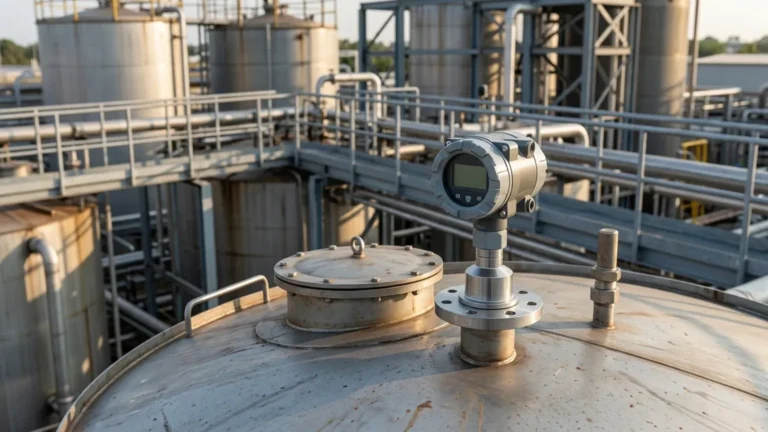
8 Ultrasonic Meter
8 Ultrasonic Meter
In the landscape of industrial process control, selecting the correct instrumentation requires a balance between precision, range, and environmental resilience. For many medium-sized storage tanks, sumps, and open-channel flow applications, an 8 ultrasonic meter (referring to a sensor with an 8-meter effective measurement range) serves as a versatile and cost-effective solution. As a non-contact technology, Ultrasonic Level Meters offer significant advantages in terms of maintenance and hygiene, particularly when dealing with corrosive or viscous fluids.
This guide explores the engineering principles, selection criteria, and installation best practices for 8-meter ultrasonic sensors, providing a technical foundation for engineers and plant managers seeking reliable level measurement solutions.
Understanding the Measurement Principle
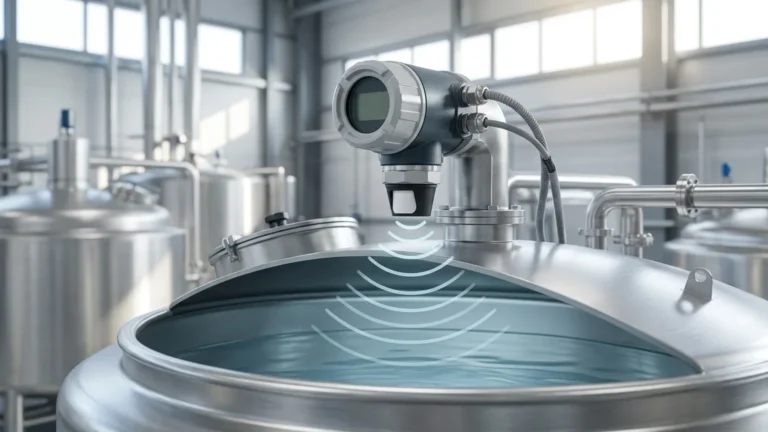
Ultrasonic level measurement is based on the "Time of Flight" (ToF) principle. The device consists of a transducer containing a piezoelectric crystal. When energized, this crystal vibrates at a high frequency, emitting a burst of ultrasonic sound waves toward the surface of the medium being measured.
The Signal Path
1. Emission: The transducer sends out a pulse of sound waves.
2. Reflection: The waves travel through the air gap and hit the surface of the liquid or solid, reflecting back toward the sensor.
3. Detection: The transducer receives the returning echo.
4. Calculation: The internal microprocessor calculates the distance ($D$) based on the time elapsed ($t$) and the speed of sound in air ($v$), using the formula: $D = (v \times t) / 2$.
The level of the material is then determined by subtracting the measured distance from the total height of the vessel. Because the speed of sound is affected by air temperature, modern 8 ultrasonic meter units include an integrated temperature sensor to compensate for these variations automatically, ensuring accuracy across changing environmental conditions.
Why the 8-Meter Range is an Industrial Standard
While ultrasonic sensors are available in ranges from 1 meter to over 40 meters, the 8-meter (approximately 26.2 feet) specification is widely regarded as a "sweet spot" for several reasons:
* Vessel Compatibility: Most standard industrial storage tanks for chemicals, water treatment, and food processing fall within the 3 to 7-meter height range. An 8-meter sensor provides sufficient headroom to cover the entire tank depth while maintaining a strong signal-to-noise ratio.
* Beam Angle Efficiency: Generally, as the range of an ultrasonic sensor increases, the beam angle must be tighter to prevent interference from tank walls. An 8-meter unit typically offers a balanced beam angle (often between 5° and 10°), making it easier to install in vessels with internal structures like ladders or agitators.
* Sensitivity and Resolution: At this range, the transducer can operate at a frequency (often around 40-60 kHz) that provides excellent resolution (typically ±2mm to 5mm) without requiring the massive power output needed for long-range (30m+) sensors.
Technical Selection Criteria
When evaluating an 8 ultrasonic meter for a specific application, engineers must look beyond the maximum range. The following table outlines key specifications to consider during the procurement process:
Selection Table: Mid-Range Ultrasonic Sensor Specifications
| Feature | Specification Requirement | Application Context |
| :— | :— | :— |
| Measurement Range | 0.3m to 8.0m | Standard for medium tanks and sumps. |
| Dead Band (Blocking Distance) | 0.25m to 0.4m | The minimum distance required between the sensor and the max liquid level. |
| Accuracy | ±0.25% to ±0.5% of full span | Critical for inventory management and billing. |
| Output Signal | 4-20mA, RS485 (Modbus), HART | Integration with PLC, SCADA, or DCS systems. |
| Power Supply | 24V DC or 220V AC | Depends on site infrastructure (2-wire vs. 4-wire). |
| Operating Temperature | -20°C to +60°C | Standard industrial range; specialized units for extremes. |
| Ingress Protection | IP66, IP67, or IP68 | IP68 is required for flood-prone sumps or wash-down areas. |
| Housing Material | ABS, PVC, or PVDF | PVDF is preferred for highly corrosive chemical vapors. |
Installation Considerations and Best Practices
The reliability of an 8 ultrasonic meter is highly dependent on its physical installation. Even the most advanced signal processing cannot fully compensate for poor placement.
1. The Dead Band (Blocking Distance)
Every ultrasonic sensor has a "dead band" directly beneath the transducer face where it cannot accurately measure. For an 8-meter sensor, this is typically around 0.3 meters. If the liquid level rises into this zone, the meter may provide erratic readings or "lock" at a full-scale value. Always mount the sensor high enough to ensure the maximum liquid level never enters the dead band.
2. Positioning Relative to Tank Walls
To avoid false echoes from the tank walls, the sensor should be mounted at a specific distance from the side. A common engineering rule of thumb is to place the sensor at a distance of at least 1/6th of the tank height away from the wall. For an 8-meter application, this means the sensor should ideally be at least 1.3 meters away from the nearest vertical surface.
3. Avoiding Internal Obstructions
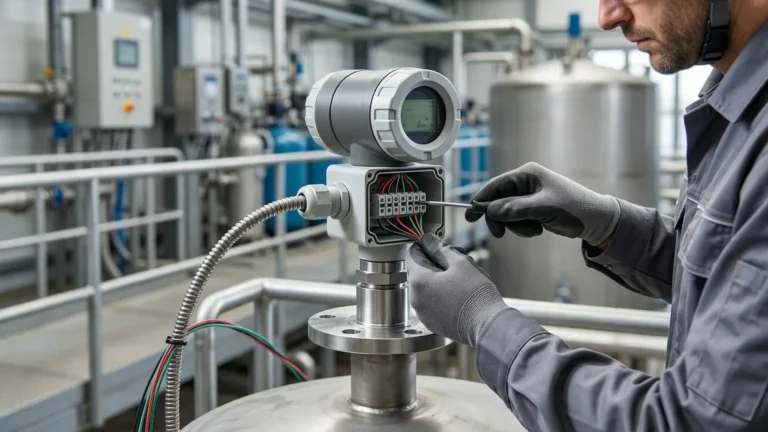
Internal structures such as heating coils, ladders, agitator blades, or reinforcement beams can reflect the ultrasonic signal. If these cannot be avoided, many modern Ultrasonic Level Meters feature "false echo suppression" software, allowing the user to map out static obstructions so the sensor ignores them.
4. Mounting Orientation
The transducer face must be perfectly parallel to the liquid surface. A tilt of even a few degrees can cause the reflected signal to miss the receiver, leading to a "Loss of Echo" (LOE) error, especially at the bottom of an 8-meter range where the signal is weakest.

Limitations and Environmental Factors
While highly versatile, ultrasonic technology is not a universal solution. Engineers should be aware of the following limitations when specifying an 8 ultrasonic meter:
* Heavy Foam: Foam acts as an acoustic absorber. If the liquid surface is covered in thick, dense foam, the ultrasonic pulse may not reflect back, resulting in no reading. In these cases, radar or hydrostatic transmitters are preferred.
* Vacuum and Pressure: Sound waves require a medium (air or gas) to travel. Ultrasonic meters will not function in a vacuum. High-pressure environments also change the density of the air, significantly altering the speed of sound and requiring complex compensation.
* Vapor and Dust: Heavy steam or significant dust concentrations can scatter the sound waves. While mild vapor is manageable, extreme conditions may require a high-power transducer or a transition to radar technology.
* Turbulence: Rapidly churning liquids can scatter the signal. This can often be mitigated by using a stilling well—a vertical pipe that protects the liquid surface from turbulence while allowing the sensor to measure the level inside the pipe.
Application Focus: Water and Wastewater
The 8 ultrasonic meter is the industry standard for wastewater management. In these environments, the non-contact nature of the device prevents fouling from grease, solids, and biological growth that typically plague submerged sensors.
* Lift Stations: Monitoring the level in wet wells to trigger pump cycles.
* Open Channel Flow: When paired with a flume or weir, the ultrasonic meter measures the head height, which the controller then converts into a flow rate (e.g., Liters/Second) using standard hydraulic formulas.
* Chemical Feed Tanks: Precise measurement of alum, polymer, or sodium hypochlorite levels for water treatment dosing.
Frequently Asked Questions (FAQ)
Q: Can I use an 8-meter ultrasonic sensor for solids like grain or sand?
A: Yes, but with caveats. Solids do not reflect sound as efficiently as liquids and often have an "angle of repose" that can deflect the signal. For solids, it is recommended to derate the effective range of the sensor by 50%. An 8-meter liquid sensor may only be reliable up to 4 meters for solids.
Q: How do I handle condensation on the transducer face?
A: Condensation is common in humid tanks. Most Welk ultrasonic transducers are designed with a smooth, concave, or self-cleaning face to encourage droplets to run off. In extreme cases, a PTFE-faced transducer can be used to minimize adhesion.
Q: What is the difference between a 2-wire and 4-wire 8-meter sensor?
A: A 2-wire sensor is loop-powered, meaning it receives power and transmits the 4-20mA signal over the same pair of wires. This is easier to install but provides less power for the signal. A 4-wire sensor has separate power supply wires, allowing for a stronger ultrasonic pulse and more robust performance in challenging environments.
Conclusion
The 8 ultrasonic meter represents a critical tool for modern industrial automation, offering a reliable, non-contact method for monitoring medium-range levels. By understanding the acoustic principles and adhering to strict installation guidelines—particularly regarding the dead band and beam path obstructions—operators can ensure long-term accuracy and minimal maintenance. For applications involving corrosive chemicals or standard water treatment, these instruments provide the necessary data to optimize processes and ensure environmental compliance.
For more detailed technical specifications and to explore various configuration options for your specific project, you can Review product options and application support to find the ideal match for your industrial requirements.