Ultrasonic Level Sensor Water Tank
Ultrasonic Level Sensor Water Tank: A Technical Guide for Industrial Applications
In the realm of industrial automation and water management, the ability to monitor fluid volumes accurately is fundamental to operational efficiency. Whether managing municipal reservoirs, industrial process water, or chemical storage, selecting the right instrumentation is a critical engineering decision. Among the various technologies available, the ultrasonic level sensor water tank application has become a standard due to its non-contact nature, reliability, and ease of integration.
As a professional manufacturer of industrial level measurement instruments, Welk provides a range of Ultrasonic Level Meters designed to meet the rigorous demands of modern infrastructure. This guide explores the technical principles, selection criteria, and installation best practices for deploying ultrasonic technology in water tank environments.
Understanding the Measurement Principle
Before selecting a sensor, it is essential to understand the physics governing its operation. Ultrasonic level meters operate on the "Time-of-Flight" (ToF) principle.
The Time-of-Flight Mechanism
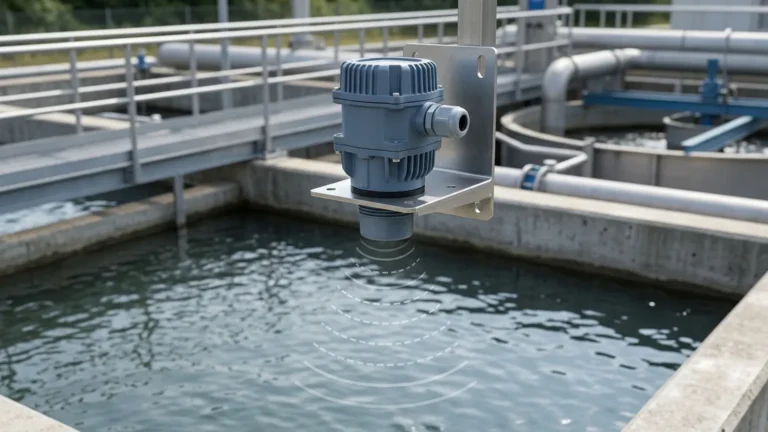
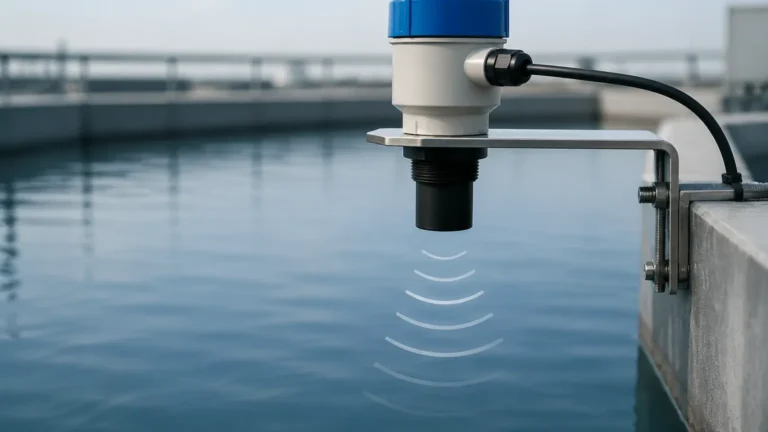
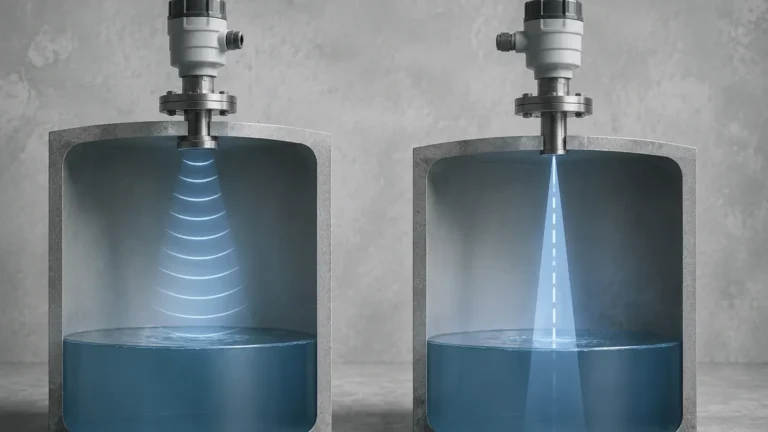
The sensor’s transducer emits high-frequency sound pulses (typically between 20 kHz and 200 kHz). These acoustic waves travel through the air until they strike the surface of the water. Upon contact, the waves are reflected back to the transducer, which now acts as a receiver.
The internal electronics measure the time interval ($t$) between the emission of the pulse and the reception of the echo. Since the speed of sound in air ($c$) is a known constant (approximately 344 m/s at 20°C), the distance ($D$) between the sensor and the water surface can be calculated using the formula:
$$D = \frac{c \times t}{2}$$
The level of the water in the tank ($L$) is then determined by subtracting the measured distance ($D$) from the total tank height ($H$), which is programmed into the device during commissioning ($L = H – D$).
Temperature Compensation
A critical factor in ultrasonic measurement is the variability of the speed of sound. Sound velocity changes by approximately 0.17% per degree Celsius. To maintain accuracy, industrial-grade ultrasonic level meters include an integrated temperature sensor. This allows the device’s microprocessor to automatically compensate for temperature fluctuations within the tank’s headspace, ensuring the distance calculation remains precise regardless of seasonal or process-driven temperature shifts.
Why Use an Ultrasonic Level Sensor for Water Tanks?
Water tank applications benefit significantly from ultrasonic technology compared to contact-based methods like float switches or pressure transmitters.
1. Non-Contact Measurement: Because the sensor never touches the liquid, there is no risk of corrosion, scaling, or mechanical wear. This is particularly advantageous for treated water or wastewater where debris could foul a mechanical sensor.
2. Low Maintenance: With no moving parts to clean or replace, ultrasonic sensors offer a lower Total Cost of Ownership (TCO) over the life of the project.
3. Versatility: These sensors can be used in various tank geometries, including vertical cylinders, horizontal tanks, and rectangular basins.
4. Ease of Integration: Most modern units provide standard industrial outputs, such as 4-20mA analog signals, RS485 (Modbus), or HART protocols, allowing for seamless connection to PLCs, SCADA systems, and IoT gateways.
Key Selection Criteria for Water Tank Applications
Selecting the appropriate ultrasonic level sensor water tank model requires a detailed analysis of the application environment. Engineers should evaluate the following parameters:
1. Measuring Range
Sensors are rated for specific minimum and maximum distances. For small header tanks, a short-range sensor (e.g., 0.3m to 5m / 1ft to 16.4ft) is sufficient. For large municipal reservoirs or deep wells, long-range models capable of reaching 15m to 30m (49ft to 98ft) are required. Always select a sensor with a range slightly exceeding the maximum depth of the tank to ensure a safety margin.
2. Beam Angle
The beam angle determines the spread of the ultrasonic pulse. A narrower beam angle (e.g., 5° to 9°) is preferable for narrow tanks or tanks with internal obstructions like ladders, pipes, or agitators. A narrow beam minimizes the risk of "false echoes" from the tank walls or internal hardware.
3. Environmental Conditions
* Humidity and Condensation: In closed water tanks, humidity is often near 100%. Ensure the sensor face is designed to shed droplets or has a high-power pulse to penetrate light mist.
* Pressure: Standard ultrasonic sensors are designed for atmospheric pressure. If the tank is pressurized, specialized seals and housing materials are necessary.
* Chemical Compatibility: If the water contains additives (like chlorine or acids), the transducer face material (PP, PVDF, or PTFE) must be chemically resistant.
4. Output and Power Supply
Determine if the system requires a 2-wire (loop-powered) or 4-wire configuration. For remote locations, solar-powered systems often require low-power DC sensors with RS485 communication to conserve energy.
Practical Selection Table
The following table provides a general guideline for choosing a Welk ultrasonic level meter based on common water tank scenarios.
| Application Type | Typical Tank Depth | Recommended Range | Required Beam Angle | Suggested Material |
| :— | :— | :— | :— | :— |
| Small Process Tank | < 3m (10ft) | 0.25m – 5m | Standard (9° – 12°) | ABS / PP |
| Standard Industrial Water Tank | 5m – 10m (16 – 33ft) | 0.4m – 12m | Narrow (6° – 9°) | PP / PVDF |
| Deep Reservoir / Sump | 10m – 25m (33 – 82ft) | 0.5m – 30m | Very Narrow (< 6°) | Reinforced Composite |
| Chemical Storage Tank | Variable | Match Depth | Narrow | PVDF / PTFE |
Installation Considerations
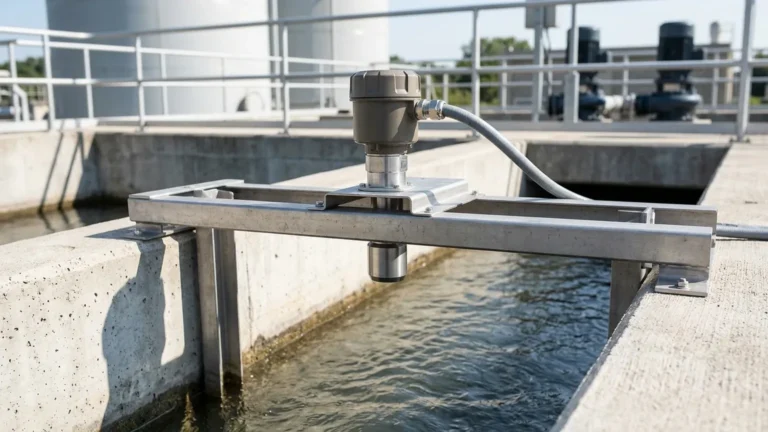
Correct installation is the most significant factor in the performance of an ultrasonic level sensor water tank system. Even the most advanced sensor will fail if placed incorrectly.
The "Dead Zone" (Blocking Distance)
Every ultrasonic sensor has a "Dead Zone" immediately below the transducer face (typically 0.2m to 0.5m depending on the model). In this area, the sensor cannot accurately process the returning echo because the transducer is still vibrating from the initial pulse.
* Guideline: Ensure the maximum water level never reaches into the dead zone. If necessary, use a standpipe or a mounting bracket to raise the sensor above the tank's maximum fill line.
Positioning and Alignment
* Perpendicularity: The sensor must be mounted perfectly perpendicular to the water surface. If the sensor is tilted, the ultrasonic pulse will reflect away from the transducer, resulting in signal loss.
* The 1/6 Rule: For cylindrical tanks, a common rule of thumb is to mount the sensor at a distance of 1/6 of the tank diameter from the wall. This avoids interference from wall reflections while staying clear of the central vortex if an agitator is present.
* Inlet Avoidance: Never install the sensor directly above the water inlet. The turbulence and falling water will scatter the signal and cause erratic readings.
Avoiding Obstructions
Internal structures like heating coils, ladders, or reinforcement beams can create false echoes. If an obstruction is unavoidable, many modern Ultrasonic Level Meters feature "False Echo Suppression" software, allowing the user to map out and ignore stationary reflections.
Limitations and When to Consider Alternatives
While ultrasonic sensors are highly versatile, they are not universal solutions. Engineers should be aware of the following limitations:
1. Heavy Foam: Thick, dense foam on the water surface absorbs ultrasonic waves rather than reflecting them. In applications with heavy surfactants or detergents, a radar level meter or a hydrostatic pressure sensor may be more reliable.
2. Vacuum Conditions: Sound cannot travel in a vacuum. Ultrasonic sensors will not function in tanks under full vacuum.
3. High Turbulence: Extremely turbulent surfaces can scatter the signal. While software filtering can mitigate this, excessive surface agitation may require the use of a stilling well (a vertical pipe that stabilizes the water level for the sensor).
4. Dust and Vapor: While light vapor is usually fine, extremely dense steam or heavy dust can attenuate the ultrasonic signal.
Frequently Asked Questions (FAQ)
Q: How does wind affect an ultrasonic sensor in an open-top water tank?
A: Moderate wind generally does not affect the measurement. However, strong crosswinds can "blow" the sound pulse away, causing intermittent signal loss. For outdoor applications, using a sensor with a higher signal strength or a protective shroud is recommended.
Q: Can I use an ultrasonic sensor for a tank with a sloped bottom?
A: Yes. The sensor measures the distance to the water surface, which remains horizontal regardless of the tank's bottom geometry. However, you must ensure the sensor is calibrated for the specific volume-to-height relationship of the tank if you require volume readouts.
Q: What is the lifespan of a typical ultrasonic water level sensor?
A: In standard water tank applications, a high-quality industrial sensor from a manufacturer like Welk can last 7 to 10 years or more, provided the housing is protected from extreme UV exposure and physical damage.
Q: Does the material of the tank (plastic vs. metal) affect the sensor?
A: Not directly, as the sensor measures the reflection from the liquid surface. However, metal tanks can sometimes produce more "ringing" or internal echoes, which may require more careful configuration of the gain settings compared to plastic tanks.
Conclusion
The ultrasonic level sensor water tank application remains a cornerstone of industrial process control due to its balance of accuracy, cost, and maintenance-free operation. By understanding the underlying acoustic principles and adhering to strict installation guidelines—specifically regarding dead zones and beam path clearance—operators can achieve highly reliable level monitoring.
For engineers looking to implement or upgrade their level measurement systems, Welk offers a comprehensive portfolio of Ultrasonic Level Meters tailored for diverse industrial environments. Selecting the right instrument involves not just looking at the range, but considering the chemical environment, tank geometry, and integration requirements of the broader control system.